Satellite imagery reviewed by Reuters shows China building a widespread network of more than 80 concrete pads, octagonal hubs and supporting infrastructure near nuclear silo fields in Xinjiang and Gansu. Analysts say the sites could host mobile ICBMs, air-defence batteries, electronic‑warfare nodes and command-and-control systems—measures that would strengthen Beijing's second‑strike deterrent. Key details remain unclear, but experts say the scale of the works is notable amid growing U.S.-China tensions over Taiwan.
Exclusive — Satellite Images Reveal China Building Vast Launch-Pad Network To Shield Nuclear Silos
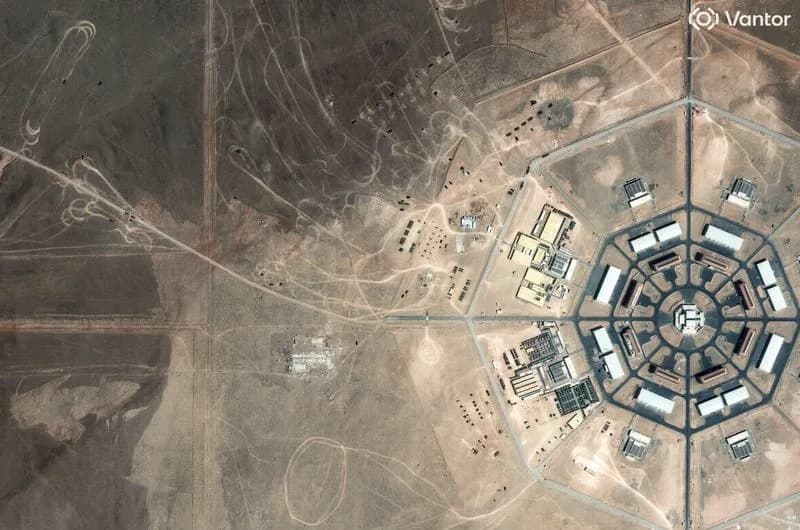
A satellite image shows military activity underway at the edge of the Xinjiang octagon-shaped installation, in the Xinjiang Uyghur Autonomous Region, China, May 11, 2026. Vantor/Handout via REUTERS
Satellite imagery reviewed by Reuters shows China constructing an extensive military network of launch pads, fortified compounds and communications sites in the deserts of Xinjiang and Gansu. Analysts say the infrastructure—centered on distinctive octagonal hubs and linked by roads and conduits—appears designed to help protect and operate Beijing’s land-based nuclear forces and strengthen its ability to retaliate after a first strike.
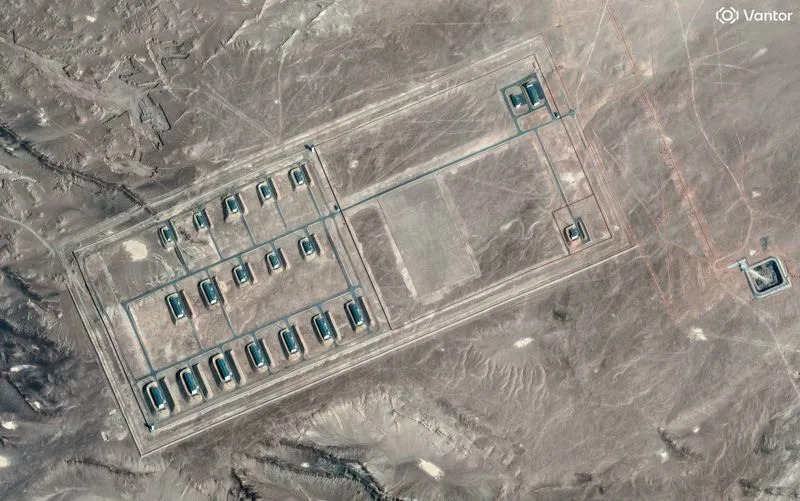
A satellite image shows what security analysts say is a fortified weapons storage installation, revealing revetments around the building, a perimeter wall and guard towers, in the Xinjiang Uyghur Autonomous Region, China, March 19, 2026. Vantor/Handout via REUTERS
What The Images Show
The pictures reveal more than 80 concrete pads scattered among rocky outcrops and dry creek beds, plus airstrips, railheads, hardened bunkers, vehicle housing and fortified storage. Two major octagon-shaped compounds, built over the past six years, lie roughly 140 km and 230 km southwest of the Hami silo fields. A third, less-developed octagon sits south of the Lop Nur test area and appears used as a target range.
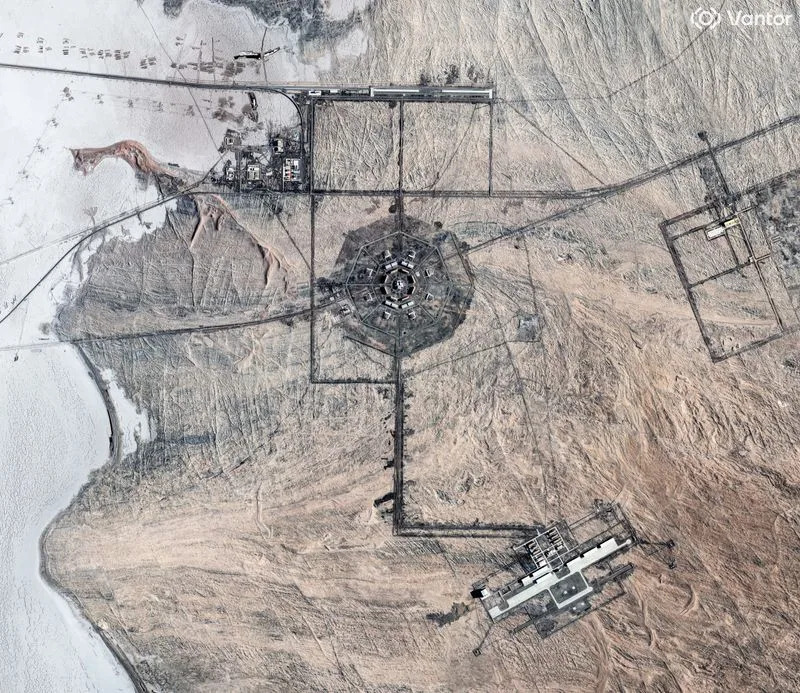
A satellite view shows one of the two Xinjiang octagon-shaped military facilities, which analysts say are likely supporting the nearby Hami silo fields, near an airfield to the south and a rail terminal to the north, in the Xinjiang Uyghur Autonomous Region, China, August 4, 2025. Vantor/Handout via REUTERS
Possible Roles And Capabilities
Three security analysts who assessed the imagery for Reuters say the pads and supporting infrastructure could host a mix of capabilities: road-mobile intercontinental ballistic missile (ICBM) launchers, mobile air-defense batteries, electronic-warfare nodes, and command, control and communications (C3) facilities. Conduits linking pads to the octagons may contain fiber-optic cables, while observed satellite dishes and towers at the northern octagon point to space or microwave communications work.
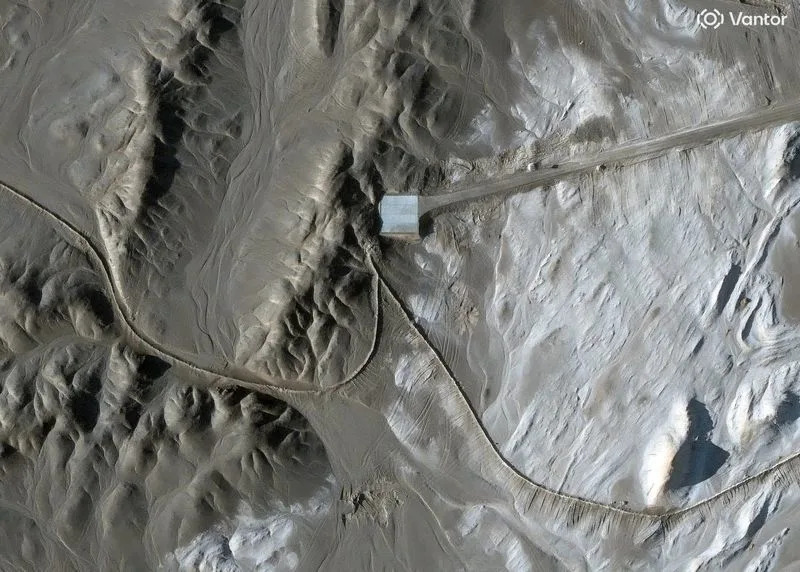
A satellite image shows what security analysts say is a launch pad that is part of two isolated desert networks linked by roads and possible communications conduits, in the Xinjiang Uyghur Autonomous Region, China, April 10, 2026. Vantor/Handout via REUTERS
"We can see this infrastructure is being built on a grand scale, covering thousands of square kilometers of desert beyond the silo fields," said Alexander Neill, adjunct fellow at the Pacific Forum. "Depending on the precise capabilities, we're looking at a very considerable enhancement and diversification of China's strategic nuclear deterrent."
Context And Implications
China’s silo fields in Xinjiang and Gansu form the backbone of its land-based nuclear force. The development of dispersed launch pads and hardened logistics hubs would improve survivability and operational flexibility, reinforcing a second-strike posture designed to assure retaliation if struck first. That posture sits alongside China’s declared "no first use" policy, though some Western officials warn of potential nuclear coercion in crises such as a conflict over Taiwan.
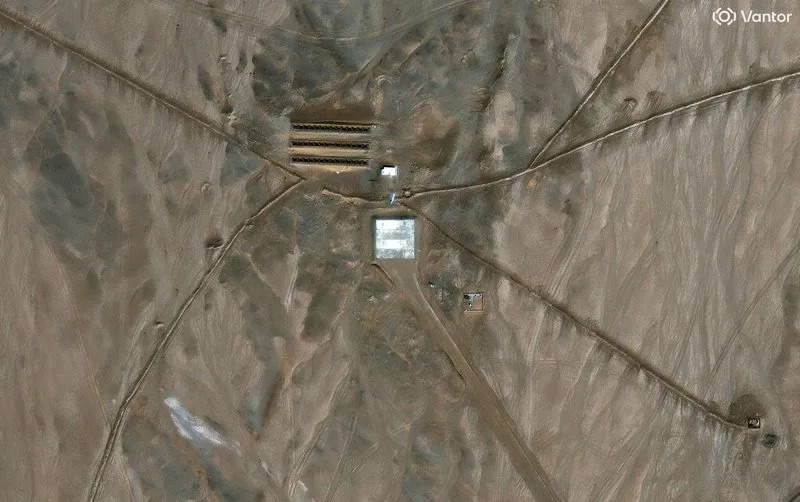
A satellite image shows what security analysts say is a launch pad that is part of two isolated desert networks linked by roads and possible communications conduits, in the Xinjiang Uyghur Autonomous Region, China, April 28, 2026. Vantor/Handout via REUTERS
U.S. assessments cited in the reporting indicate China’s nuclear modernization is accelerating: a Pentagon analysis projected Beijing could field roughly 1,000 warheads by 2030, and estimated about 100 ICBMs may already be loaded across three main silo fields. The U.S. also says China’s Huoyan-1 early-warning satellites can detect an ICBM launch within roughly 90 seconds and alert command centers in three to four minutes—potentially allowing time for silo-based forces to respond.
Limitations And Uncertainties
Five security scholars who spoke with Reuters cautioned that imagery alone cannot answer key questions: which weapons would be deployed on the pads, whether the octagons serve as staging areas for truck-mounted missiles, or if they are maintenance and warhead-integration facilities. The Chinese defense ministry did not respond to queries, and the Pentagon declined to comment on intelligence matters.
Analysts described the scale of the construction as unusual. Hans Kristensen of the Federation of American Scientists said, "it's an extraordinary effort" in a harsh environment—underscoring how rapidly China is upgrading the infrastructure that supports its nuclear forces.
(Reporting by Greg Torode, Laurie Chen and Vijdan Mohammad Kawoosa; additional reporting by Reuters Visual Verification Team; editing by David Crawshaw and Rebecca Pazos.)
Help us improve.