The Great Pyramid of Giza demonstrates built-in resilience to earthquakes, a new study finds. Seismometers placed at 37 locations recorded a uniform, stable response to ambient vibrations, revealing effective mass distribution and energy-dissipating internal features. Key contributors to its longevity include a broad base, low center of gravity, near-perfect symmetry, tapering mass and chambers above the King's Chamber that reduce vibration amplification. The pyramid’s siting on solid limestone bedrock and refined ancient construction practices further enhanced its seismic stability.
Study Finds Great Pyramid of Giza Built With Ingenious Earthquake-Resistant Design

FILE PHOTO: A general view of the Great Pyramids in Giza, Egypt, November 15, 2025. REUTERS/Mohamed Abd El Ghany/File Photo
If any monument symbolizes durability, it is the Great Pyramid of Giza. Erected around 4,600 years ago as the tomb of Pharaoh Khufu, the pyramid has endured millennia of environmental stresses and regional earthquakes while remaining largely intact.

FILE PHOTO: Tourists ride camels in front of the Great Pyramids plateau in Giza, Egypt December 11, 2022. REUTERS/Amr Abdallah Dalsh/File Photo
Seismic Study Reveals Structural Strengths
Researchers placed seismometers at 37 locations in and around the pyramid to record ambient vibrations—the continuous, subtle shaking caused by natural forces and human activity. The measurements show a remarkably uniform and stable structural response across the monument despite its size and internal complexity.
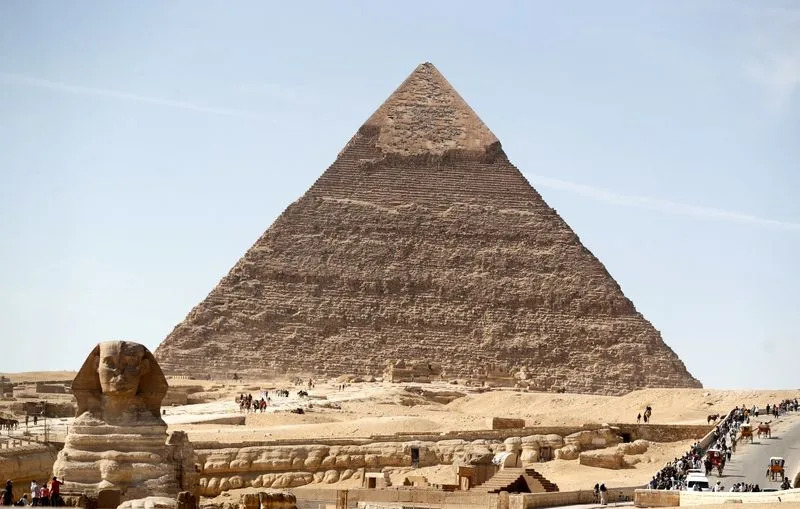
FILE PHOTO: Visitors are seen next to the Sphinx and the Great Pyramid at the Giza Plateau, on the outskirts of Cairo, Egypt, November 1, 2021. REUTERS/Mohamed Abd El Ghany/File Photo
The pyramid’s design and setting help explain its resilience. Each of the four sides measures about 755 feet (230 meters) at the base, the structure covers roughly 13 acres (5.3 hectares) and originally rose to about 480 feet (147 meters); erosion and removal of casing stones have reduced its height to approximately 455 feet (138.5 meters). Built on strong limestone bedrock, the monument combines a very broad base, a low center of gravity and near-perfect symmetry with a gradual tapering of mass toward the top.

FILE PHOTO: The Giza Pyramids and the Sphinx are lit up during the celebration of World Tourism Day at Giza, on the outskirts of Cairo, Egypt, September 27, 2024. REUTERS/Mohamed Abd El Ghany/File Photo
Internal Design That Dampens Seismic Energy
The team found that most recorded vibrations had frequencies indicating mechanical stress is distributed evenly through the structure—reducing the risk of localized amplification that can lead to failure. Notably, five chambers above the King's Chamber exhibit reduced vibration amplification despite being higher in the pyramid, suggesting these voids help dissipate seismic energy and protect the main burial chamber.
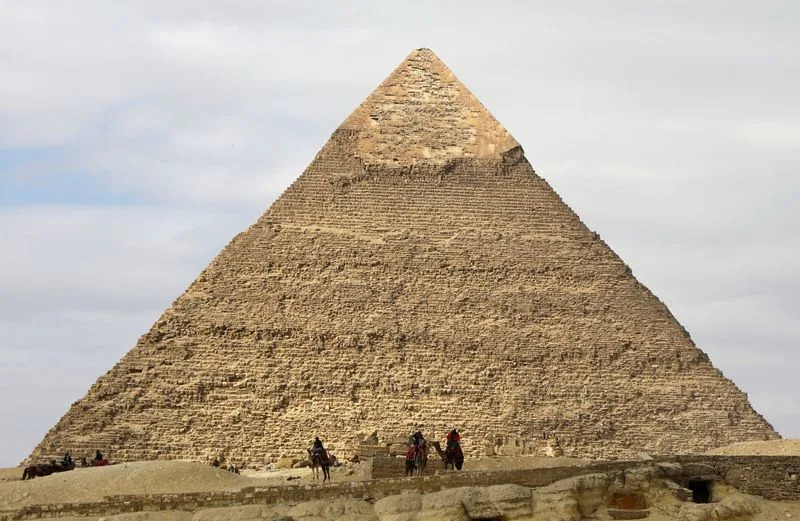
FILE PHOTO: Camel guides wait for customers in front of the Pyramid of Khufu, the largest of the Great Pyramids of Giza, on the outskirts of Cairo, Egypt January 18, 2020. REUTERS/Marius Bosch/File Photo
"These elements together create a well-balanced, coherent structure," said seismologist Mohamed ElGabry of the National Research Institute of Astronomy and Geophysics (NRIAG), lead author of the study published in Scientific Reports. "Ancient Egyptian builders clearly possessed practical knowledge related to stability, foundation behavior, mass distribution and load transfer," added NRIAG seismologist Asem Salama.
The researchers collected measurements from internal passages and chambers, surrounding bedrock and soils. They observed the expected increase in vibration amplification with elevation common to tall structures, but the mitigating effect of the relieving chambers above the King's Chamber points to sophisticated internal geometry that reduces shaking in critical areas.

FILE PHOTO: A man waits for tourists to rent his camel in front of the Pyramid of Khufu, the largest of the Great Pyramids of Giza, on the outskirts of Cairo, Egypt January 18, 2020. REUTERS/Marius Bosch/File Photo
Long-Term Resilience and Human Achievement
Historical quakes in the region, including major events in 1847 and 1992 that caused widespread damage and fatalities, inflicted scant damage on the pyramid. The findings suggest that while the ancient builders may not have designed the monument explicitly for earthquake resistance, their architectural and geotechnical solutions—refined through trial and error—produced exceptional long-term stability.
Beyond engineering, the project exemplifies extraordinary organizational skill. Constructing the Great Pyramid took about 20 years and required a sustained supply chain, workforce management, logistics and coordination of tens of thousands of skilled laborers, engineers and administrators.
The study offers fresh insight into how ancient practical knowledge and deliberate construction choices combined to create one of humanity’s most enduring monuments.
Help us improve.