Sefy Levy, an independent researcher, argues in an SSRN preprint that the Great Pyramid’s dimensions encode astronomical and mathematical information — from a value close to the 27.55-day lunar perigee to a 70-day interval matching Sirius’s disappearance. Levy reports a simulation in which only 2.4% of 100,000 randomly sized pyramids produced comparable numerical matches. His broader thesis links the pyramid to the Benben myth and a proposed Saharan homeland, but the work is unreviewed and lacks archaeological corroboration, so mainstream Egyptologists urge caution.
Great Pyramid: Tomb or Timeless Astronomical Record? Researcher Points to a Hidden Numerical Code
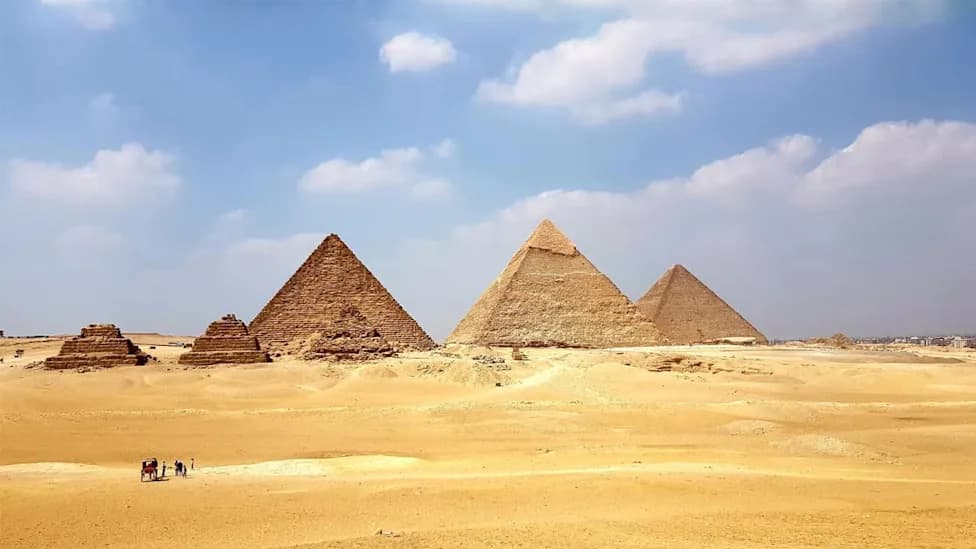
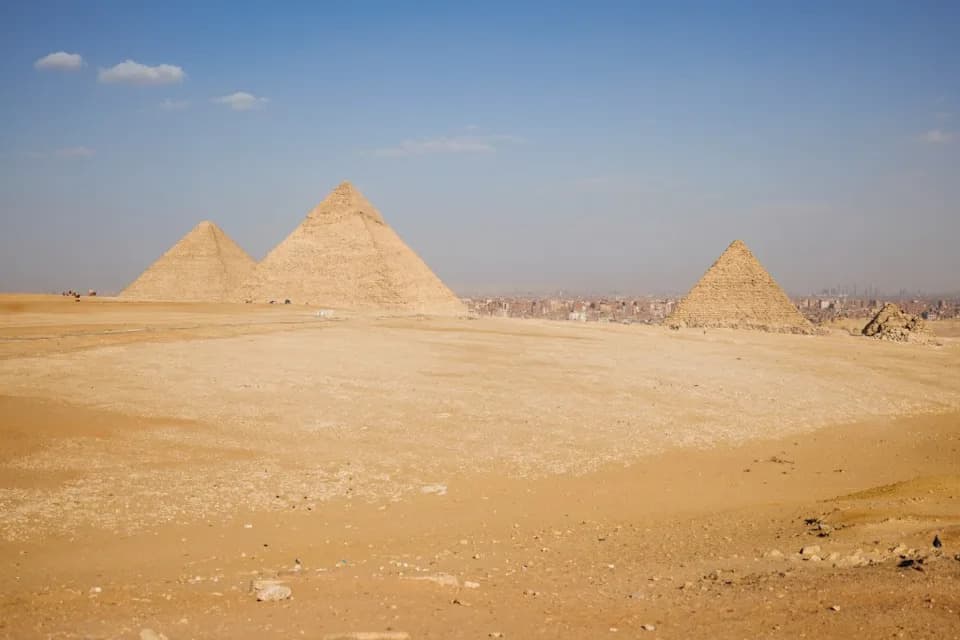
Ancient geometry meets astronomy: Does Giza's famous pyramid hold a deliberate mathematical code hidden in plain sight? | ©Image Credit: Osama Elsayed / Unsplash
For millennia the Great Pyramid of Giza has been understood primarily as Pharaoh Khufu’s monumental tomb. A new, controversial hypothesis from independent researcher Sefy Levy argues the structure may instead encode astronomical and mathematical knowledge in stone — a deliberate, long-lived record rather than only a funerary monument.
What Levy Claims
In a preprint posted to the SSRN server, Levy contends that the pyramid’s precise proportions — its height, base, and slope — were chosen to encode specific numerical relationships tied to naked-eye astronomy. Using fractional arithmetic he says mirrors methods attributed to ancient Egyptian scribes, Levy reports repeated numeric results that correspond to well-known cycles and constants:
- Lunar Cycle: A calculation that yields 27.5, which Levy notes is close to the 27.55-day lunar perigee cycle (the Moon’s return to its closest point to Earth).
- Sirius Disappearance: A recurring value of 70, matching the approximately 70 days during which Sirius is not visible because it is lost in the Sun’s glare.
- Planetary and Mathematical Patterns: Additional proportional relationships that Levy says echo orbital rhythms of Saturn, Jupiter, Venus and Mars, and that reflect constants such as pi and the golden ratio (phi).
Methods And Statistical Test
To assess whether these alignments could arise by chance, Levy reports running a computer simulation that generated 100,000 pyramids with randomly selected dimensions. He writes that just 2.4% of those simulated pyramids produced matches comparable to those he found for the Great Pyramid, an outcome he interprets as evidence the real monument’s dimensions were intentionally engineered.
Broader Cultural Hypothesis
Beyond the numerical claims, Levy advances a cultural narrative: he suggests the Great Pyramid may commemorate Benben, the primordial mound from Egyptian creation myth, and even proposes a distant ancestral homeland near the Eye of the Sahara (a circular geological feature in Mauritania). He hypothesizes that climate-driven migration from that region to the Nile Valley inspired later monuments that memorialized an ancestral landscape.
Reception, Caveats And Context
Levy’s manuscript is a preprint and has not yet undergone peer review; its methods and conclusions have not been vetted through the standard academic process. Mainstream Egyptologists caution there is no established archaeological or historical evidence linking the pyramid’s dimensions to the claimed astronomical encodings or to the Eye of the Sahara migration story.
Balance: The numerical correspondences Levy highlights are intriguing but require independent replication, transparent methodology and contextual archaeological support before they can displace the well-documented funerary and religious interpretations supported by inscriptions, burials, and contemporaneous material culture.
Related Controversies
Levy’s paper appears amid renewed speculation about hidden or undiscovered structures at Giza. Earlier this year, a team of Italian researchers suggested there may be Sphinx-like features below or near the plateau and proposed indicators of an extensive underground complex. Those claims, like Levy’s, have attracted attention but remain contested within the archaeological community.
Bottom Line
The idea that the Great Pyramid intentionally encodes detailed astronomical knowledge is provocative and would, if substantiated, reshape some aspects of how we view ancient Egyptian intellectual achievement. For now, however, Levy’s paper remains an unreviewed hypothesis: interesting, worthy of scrutiny, but not yet established. Continued analysis, transparent methods, and archaeological corroboration are needed to evaluate whether the pyramid is mainly a tomb, a message, or both.
Source: New York Post (via GeekSpin). Levy’s paper: SSRN preprint (not peer reviewed).
Help us improve.