Remote Sensing has retracted a 2022 paper by Filippo Biondi and Corrado Malanga that claimed satellite synthetic aperture radar Doppler tomography could reveal 20 hidden features inside the Great Pyramid of Khufu, citing "serious methodological flaws and statistical errors." Experts raised concerns that satellite-detected surface microvibrations are unlikely to support detailed subsurface reconstructions and that no field verification has confirmed the findings. The retraction applies only to the Khufu paper; later Khafre claims remain unverified and controversial, and the authors disagree with the journal's decision.
Scientific Journal Retracts 2022 Pyramid Study Citing Major Methodological Flaws
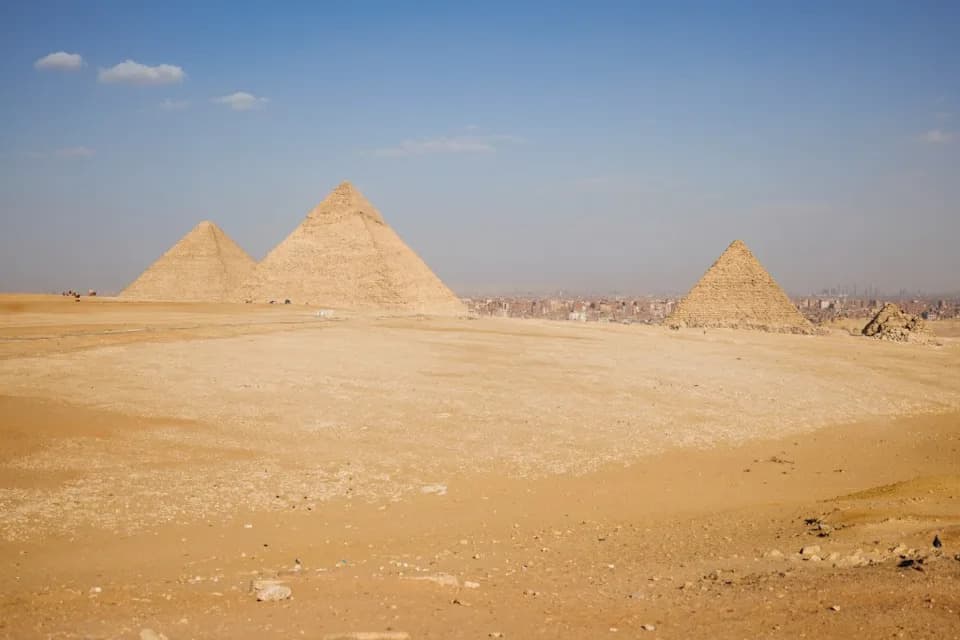
General view of The Great Pyramid of Giza, Sunday, Oct. 15, 2023 in Giza, Egypt.
A peer-reviewed journal has retracted a 2022 study that claimed satellite radar could reveal hidden chambers and corridors inside the Great Pyramid of Khufu, saying it found "serious methodological flaws and statistical errors" that undermine the paper's conclusions.
What Happened
The article, authored by Italian researchers Filippo Biondi and Corrado Malanga and published in Remote Sensing, used a technique the authors described as "synthetic aperture radar Doppler tomography." They argued that tiny surface vibrations detectable by satellite radar could be analyzed to infer internal structures within the pyramid.
Why the Retraction Matters
Remote Sensing announced on August 10 that an internal investigation—prompted by a reader's concerns—had confirmed methodological and statistical problems sufficient to render the study's findings unreliable. The notice did not accuse the authors of data fabrication or other misconduct, but it did state the paper's conclusions should not be considered reliable.
Claims and Criticism
The original paper reported up to 20 previously unidentified features beneath or inside the Great Pyramid, and said its method detected the previously reported "Big Void" seen in muon-tomography studies. The authors later and separately applied their method to the nearby Pyramid of Khafre, promoting more expansive and unverified claims—widely shared online—about shafts, chambers and an alleged "underground city."
Archaeologists and radar specialists raised immediate questions about the approach. Critics, including Egyptologist Zahi Hawass and radar expert Lawrence Conyers, argued that (1) synthetic aperture radar cannot image deep interiors directly, (2) the hypothesized surface microvibrations would be too small or noisy for satellites to resolve reliably, and (3) no on-site field investigations or independent surveys had confirmed the detailed structures presented.
Remote Sensing said the findings and conclusions of the 2022 article are not reliable. The retraction applies specifically to the Khufu paper and does not constitute a formal review of the team's later Khafre claims.
Authors' Response and Ongoing Activity
According to the journal notice and reporting by Retraction Watch, the authors disagree with the retraction. News outlets reached out to the researchers for comment. Despite the retraction, lead author Biondi has continued to share project materials publicly, including a History Channel segment and project updates claiming permit applications and proposed noninvasive field plans—none of which confirm the paper's original analyses or address the journal's stated concerns.
Takeaway
Extraordinary claims about hidden structures under the Giza pyramids have generated intense public interest, but the Remote Sensing retraction underscores the need for rigorous, reproducible methods and independent, on‑site verification before drawing firm scientific conclusions.
Help us improve.