Ground-based LiDAR has detected chemical traces from reentering space debris, including a lithium spike on Feb. 19–20, 2025 that matched the reentry of a SpaceX Falcon 9 upper stage. The Leibniz Institute of Atmospheric Physics has built a three-channel lidar to search for metals and compounds such as copper, aluminum oxide, and hydrogen fluoride. A May 1 study warns that material from reentering "space waste" may alter the mesosphere and lower thermosphere and could pose risks to the ozone layer. Researchers call for systematic monitoring and reentry-simulation experiments.
Lasers Expose How Reentering Space Debris Pollutes the Upper Atmosphere
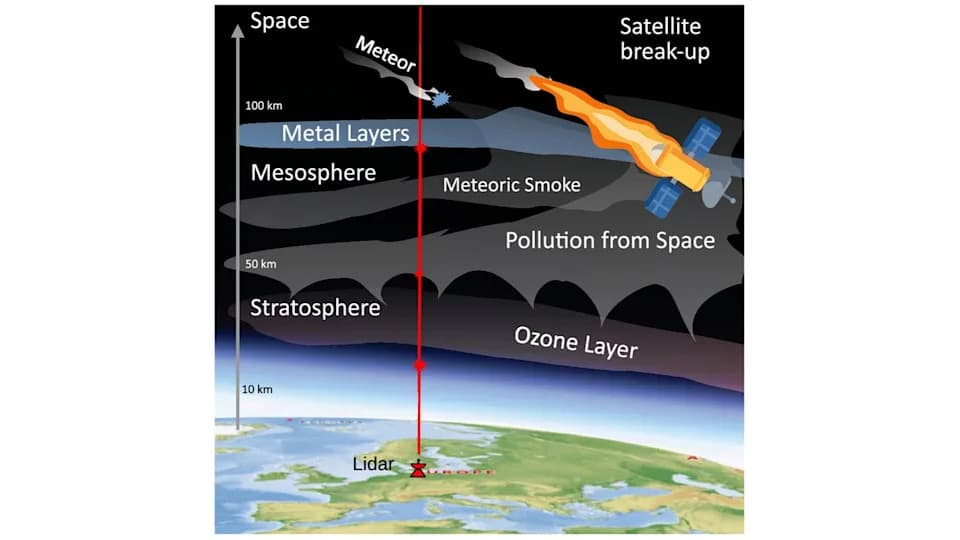
While natural metal layers form in the upper mesosphere due to meteor ablation, new LiDAR measurements have found that additional mass and elements are being introduced via the reentry of space hardware. This type of pollution has unknown consequences for the upper atmosphere and ozone layer. | Credit: Robin Wing, et al./Communications Earth & Environment
Scientists are using ground-based LiDAR (light detection and ranging) to track chemical fallout from reentering space debris and assess its impact on Earth’s upper atmosphere.
LiDAR systems send laser pulses into the sky and measure the return signals to determine the presence and movement of specific atoms and molecules. Researchers report that ablation products from burning spacecraft can now be detected remotely, opening a new window on how orbital debris affects mesospheric and stratospheric chemistry.
First Direct Link: A Lithium Spike
On Feb. 19–20, 2025, ground instruments recorded a lithium concentration roughly ten times higher than normal. Back-trajectory analysis traced the lidar-sampled air mass to a region west of Ireland that coincided with the reentry path of a SpaceX Falcon 9 upper stage. That observation provided the first direct, ground-based association between a reentering rocket component and a measurable chemical anomaly in the middle atmosphere.
"Lithium is a crucial species for investigating anthropogenic impacts on the middle atmosphere because of its extensive use in the space industry," said Michael Gerding of the Leibniz Institute of Atmospheric Physics (IAP), University of Rostock.
New Multi-Species LiDAR
The IAP has developed a three-channel, multi-species lidar to search for multiple elements and compounds expected to be released during reentry. Targets include metals and compounds such as copper, aluminum oxide, and hydrogen fluoride — the latter being a propellant component in some rocket engines.
Robin Wing, also of IAP, told Space.com that test measurements are complete and subsystem improvements are underway. An upgraded survey channel is designed to scan systematically for individual spacecraft elements, with copper identified as the first priority.
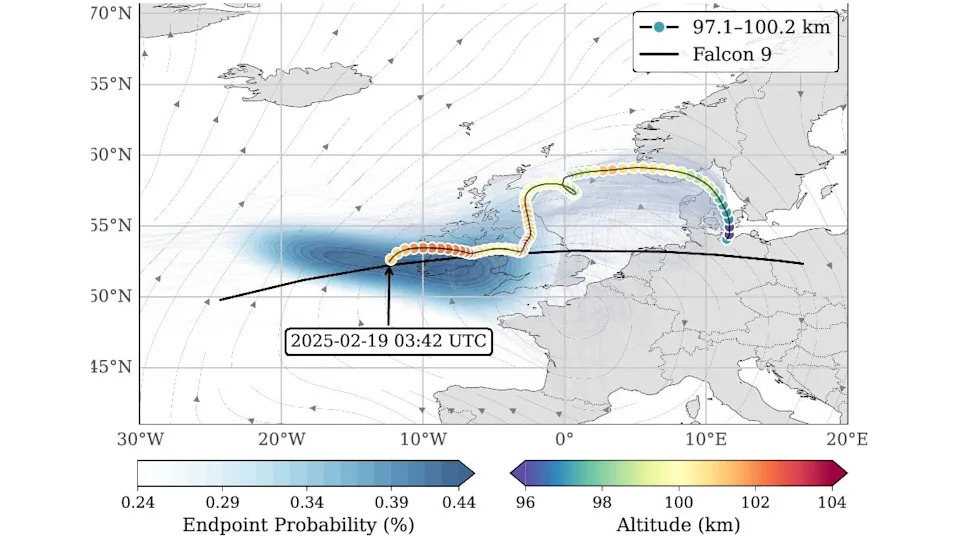
Backward trajectories, including wind variability as measured by radar, traced air masses to a SpaceX Falcon 9 reentry path at roughly 60 miles (100 kilometers) altitude, west of Ireland, in February 2025. | Credit: Robin Wing, et al./Communications Earth & Environment
Why This Matters
These materials normally occur only in trace amounts at mesospheric and stratospheric altitudes. IAP researchers note that recent measurements indicate growing concentrations and influences on atmospheric chemistry that have not been previously documented and are likely to intensify as satellite launches and megaconstellations increase.
In a May 1 paper in Advances in Space Research, Leonard Schulz and colleagues at Technische Universität Braunschweig warned that reentering "space waste" injects a significant amount of material into the mesosphere and lower thermosphere — potentially large enough to raise concerns about effects on the ozone layer and wider atmospheric processes.
The authors called for dedicated searches for debris that survives reentry and impacts the ground, more detailed observations of ablation during reentry, and ground-based experiments that simulate reentry conditions to better quantify chemical releases and atmospheric consequences.
Looking Ahead
As the number of launches grows and megaconstellations expand, systematic monitoring will be essential to understand and manage the environmental impact of space activity. Improved lidar observations, targeted laboratory experiments, and coordinated international monitoring campaigns are practical next steps to assess risks to the mesosphere, stratosphere, and ozone layer.
Sources: Leibniz Institute of Atmospheric Physics (IAP), presentations at the 2026 European Geosciences Union meeting, and the May 1, 2026 issue of Advances in Space Research.
Help us improve.