Megachelicerax cousteaui, a newly described arthropod from Utah’s middle Cambrian Wheeler Formation, is now the oldest known chelicerate, pushing the group's origin back about 20 million years. The 84 mm fossil preserves three-segmented chelicerae and a body divided into specialized anterior and posterior regions, combining primitive and later chelicerate traits. The find fills a morphological gap, clarifies how chelicerae may have evolved, and shows that complex body plans can precede ecological dominance by millions of years.
Oldest Known Relatives of Spiders and Horseshoe Crabs Found — 20 Million Years Earlier Than Thought
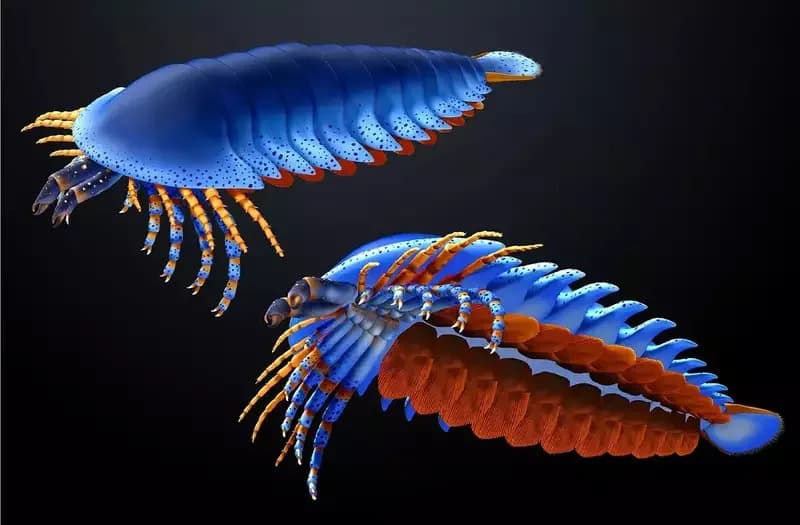
Artistic reconstructions by M. Hattori illustrating oblique views of the dorsal (top) and ventral (bottom) morphologies. The sanctacaridid-like morphology of the posteriormost body region is speculative. (CREDIT: Nature)
A routine cleaning of a Cambrian fossil revealed a landmark discovery: a three-segmented chelicera — the pincer-like front appendage that defines chelicerates. The fossil, described in Megachelicerax cousteaui, comes from the middle Cambrian Wheeler Formation in Utah and pushes the origin of chelicerates (the group that includes spiders, scorpions and horseshoe crabs) back by roughly 20 million years.
After a long day of teaching at Harvard, researcher Rudy Lerosey-Aubril examined a specimen under a microscope and used a fine needle to remove matrix. What appeared at first to be an ordinary Cambrian arthropod turned out to preserve an unexpectedly placed claw.
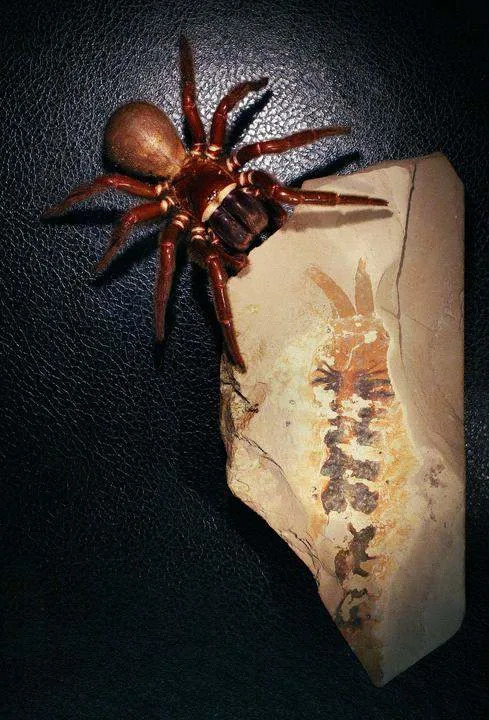
Modern Day Spider next to Megachelicerax cousteaui. (CREDIT: Rudy Lerosey-Aubril)
“Claws are never in that location in a Cambrian arthropod,” Lerosey-Aubril said. “It took me a few minutes to realize the obvious: I had just exposed the oldest chelicera ever found.”
Anatomy of a Transitional Predator
The specimen, about 84 mm long, preserves a semicircular head shield and at least nine trunk segments. Near the front are a pair of large, robust chelicerae — each composed of three segments and ending in a pincer — followed by five pairs of post-cheliceral appendages. The posterior region bears at least seven pairs of broad, plate-like appendages with roughly 35 overlapping lamellae each, structures that resemble the book-gill–style respiratory appendages seen in later chelicerates such as horseshoe crabs.
Because it combines primitive Cambrian features with clear chelicerate traits, Megachelicerax is best interpreted as a stem chelicerate: it sits after earlier Cambrian arthropods but before better-known post-Cambrian chelicerate relatives. That transitional mix helps reconcile competing hypotheses about how the chelicerate body plan assembled.
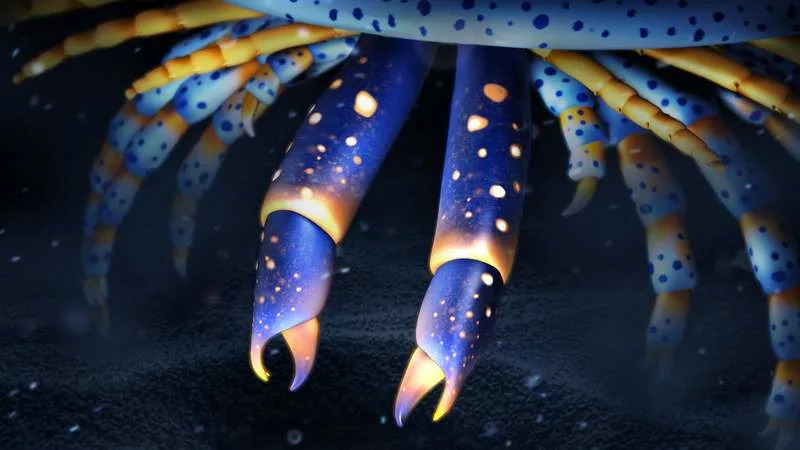
The Cambrian chelicerate Megachelicerax cousteaui approaching a prey—the worm Ottoia—on the Cambrian seafloor of what is now Utah. (CREDIT: Artistic reconstruction by Masato Hattori / Harvard University)
Why This Matters
The find demonstrates that two defining features — chelicerae and a body divided into specialized anterior (head) and posterior (trunk) regions — were already present by the middle Cambrian (~500 million years ago). Earlier, the oldest undisputed chelicerates came from the Early Ordovician Fezouata Biota (~480 million years ago). By moving the chelicerate origin back by about 20 million years, the fossil tightens timelines used to interpret early arthropod evolution.
The study also bears on how chelicerae evolved. The authors argue the three-segmented chelicera seen in this fossil is likely an ancient condition for chelicerates and favors an origin from the raptorial ‘great appendages’ of earlier megacheiran arthropods rather than direct transformation from long, multisegmented antennae.
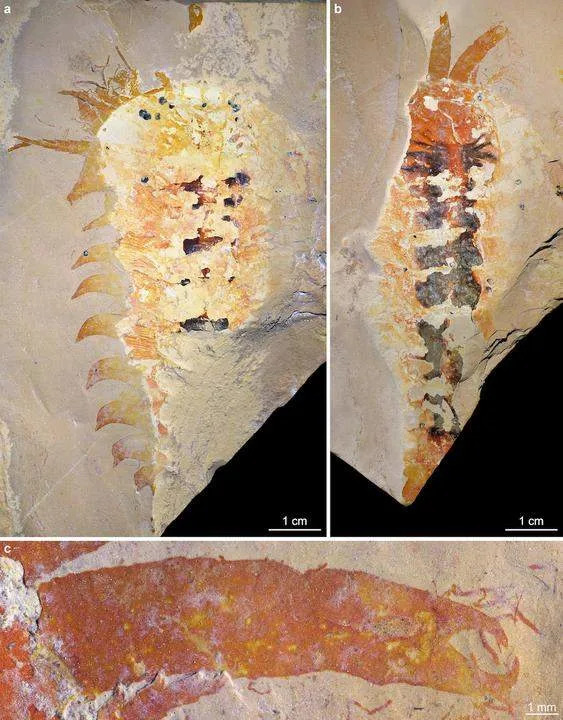
Holotype specimen (part and counterpart) of the Cambrian chelicerate Megachelicerax cousteaui, showing its spectacular pincer-like chelicera. (CREDIT: Rudy Lerosey-Aubril)
Limits and Open Questions
Some anatomical details remain incomplete: parts of the walking limbs and the very end of the body are uncertain, and the evolutionary position of pycnogonids (sea spiders) still varies among analyses. Because the combination of features does not match any known order or family, the authors do not assign Megachelicerax to an existing chelicerate group.
A Museum Drawer Discovery
The specimen was collected by amateur fossil hunter Lloyd Gunther from the upper Wheeler Formation and donated in 1981 to the University of Kansas Biodiversity Institute and Natural History Museum. For decades it sat among other Utah fossils until Lerosey-Aubril examined it and spent more than 50 hours preparing it under a microscope — work that revealed the crucial claw.
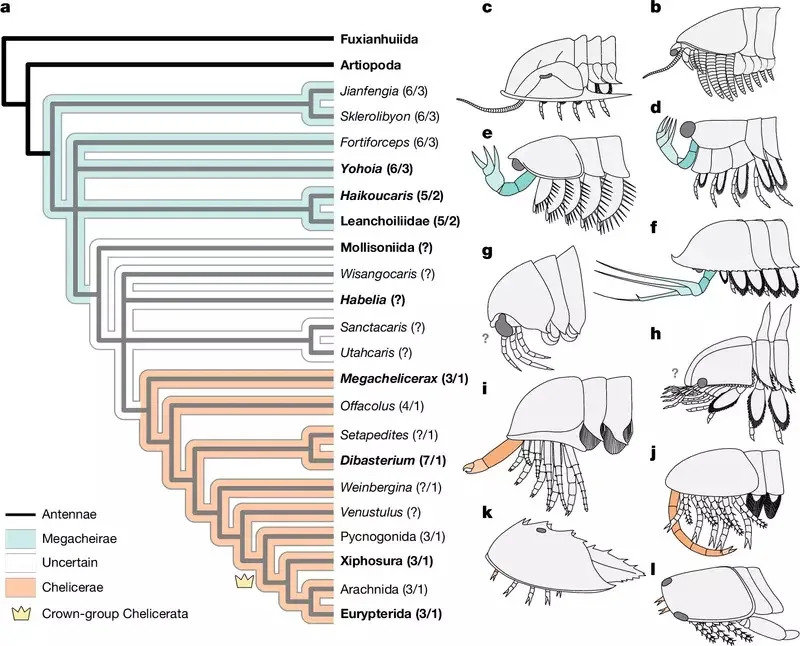
Evolution of deutocerebral raptorial appendages in total-group Chelicerata. (CREDIT: Nature)
The species name honors Jacques-Yves Cousteau, acknowledging his role in inspiring generations to look beneath the ocean surface.
Broader Implications
Beyond filling a gap in arthropod phylogeny, the discovery illustrates a larger evolutionary lesson: major anatomical innovations can arise long before they translate into ecological dominance. Early chelicerates appear to have remained relatively inconspicuous for millions of years, often overshadowed by groups such as trilobites, only later diversifying and moving onto land.
The research, led by Lerosey-Aubril and Javier Ortega-Hernández of Harvard, is published online in the journal Nature.
Help us improve.