New UK-backed research warns that Europe’s reliance on Chinese-made clean technology is creating a mounting security risk. China supplies roughly 90% of the world’s solar panels and about 80% of wind turbines and battery cells, concentrating critical manufacturing and raw materials. The report cautions that export curbs or deliberate disruption could create a serious national-security problem and urges diversification and increased domestic capacity.
UK Report Warns: Europe's Reliance on Chinese Clean Tech Creates Growing Security Risk
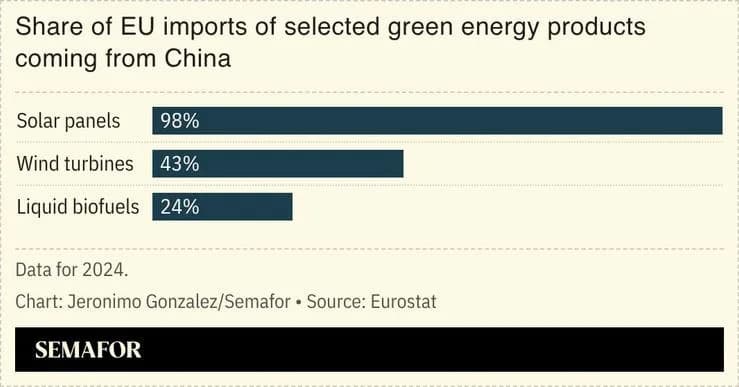
A chart showing the share of EU imports of selected green energy products coming from China.
New research for the UK government warns that Europe's heavy dependence on Chinese-made clean technology is creating an increasingly serious security vulnerability.
Why It Matters
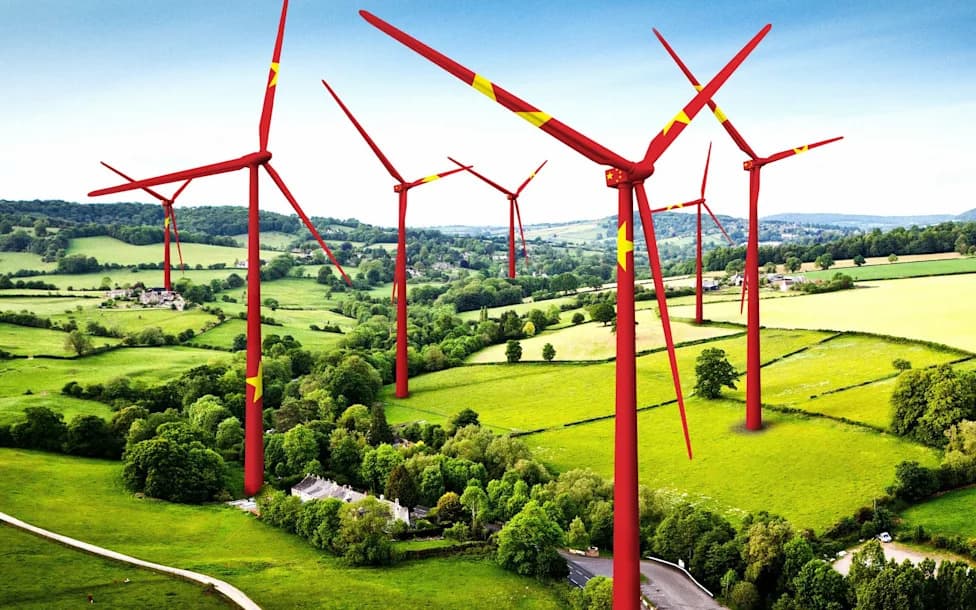
Countries across Europe have accelerated deployment of renewables after the Iran war triggered the second major global energy shock in five years, exposing fragility in fossil-fuel supplies. At the same time, China now accounts for roughly 90% of global solar-panel manufacturing and about 80% of wind turbines and battery-cell production, while also controlling large shares of key raw-material supplies.
Key Findings
European authorities are "sleepwalking into a scenario where you are suddenly confronted with a big national security problem," the report says, warning of risks if Beijing restricts exports or if installed systems are disrupted by attacks.
The risks include sudden export curbs that could slow repairs and expansion, and deliberate disruption — cyber or physical — of installed equipment and supply networks. Because critical components and materials are concentrated in a single country, Europe could face higher costs, slower build-out, and strategic vulnerability in an emergency.
What Experts Recommend
The report recommends urgent steps to reduce exposure: diversify suppliers and manufacturing capacity, boost domestic production of key components and raw materials, invest in secure and resilient supply chains, and develop contingency plans for rapid replacement or repair. Strengthening standards, stockpiles of critical parts, and international partnerships are also highlighted as practical mitigations.
Bottom line: Clean energy transition remains essential, but policymakers must address supply-chain concentration now to avoid turning a green-energy success into a geopolitical weakness.
Help us improve.