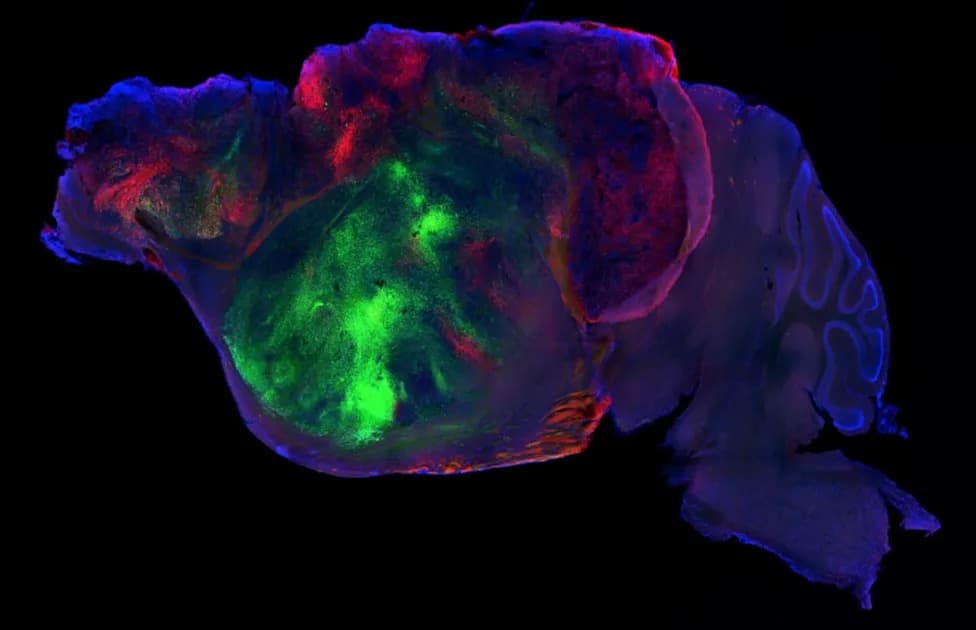
Researchers produced the first detailed atlas of odor receptors across the mouse nasal lining and found they form narrow, overlapping stripes rather than a random scatter. Using single-cell sequencing and spatial transcriptomics on ~5.5 million neurons from 300+ mice, the team mapped ~1,172 receptor genes and showed that neurons expressing the same receptor target matching sites in the olfactory bulb. Retinoic acid appears to provide positional cues, and scientists are investigating whether humans share this organized layout and how the findings could help treat smell loss.
New Atlas of the Mouse Nose Reveals a Surprising, Highly Ordered Map of Smell Receptors
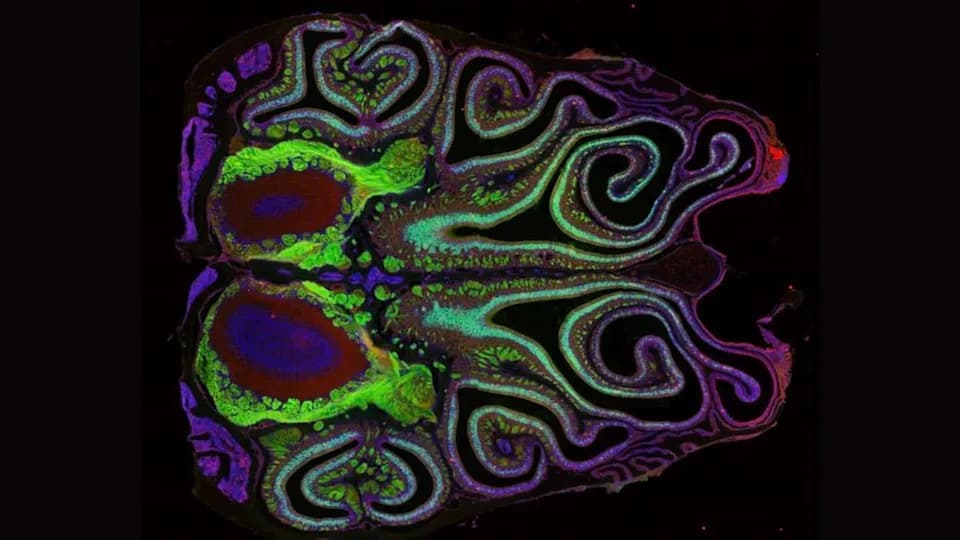
This microscope photo of a cross section of a mouse nose shows scent-sensing neurons in green, as well as dying neurons in red. | Credit: Datta Lab
Scientists have created the first comprehensive atlas of odor receptors across the lining of the mouse nose — and the result overturns a long-standing assumption that smell receptors are randomly distributed.
Organized Stripes of Receptors
Using single-cell sequencing and spatial transcriptomics, researchers mapped expression of roughly 1,172 olfactory receptor genes across about 5.5 million neurons sampled from more than 300 mice. Rather than appearing at random, receptor types cluster into narrow, recurring, overlapping bands or "stripes" along the nasal epithelium.
Peripheral And Brain Maps Are Aligned
The team found that neurons expressing the same receptor converge on the same target in the olfactory bulb, the brain's primary smell-processing center. "The map in the nose is precisely aligned with the map in the brain," said senior author Dr. Sandeep Datta of Harvard Medical School, highlighting a direct spatial correspondence from peripheral receptor layout to central targets.
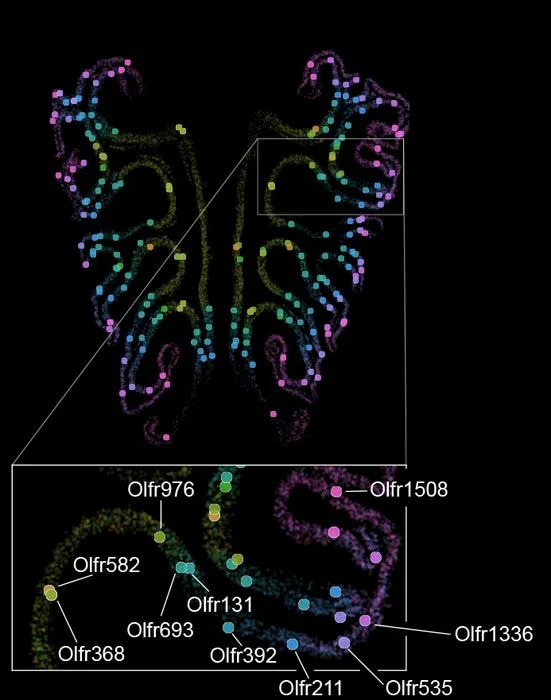
A map of the thousand types of smell receptors in the scent-sensing tissue of a mouse nose, labeled by a color gradient. The bottom inset shows the precise spatial positions of specific smell receptors in the nose. | Credit: Datta Lab
Positional Cues And Retinoic Acid
Study authors identified retinoic acid (RA) as a likely positional cue: experimentally increasing or decreasing RA shifted the receptor bands up or down in the nasal lining. This suggests RA helps control where particular receptors are expressed and how neurons adopt their identities based on location.
Scale And Significance
The nasal epithelium is remarkably complex. Mice have about 20 million olfactory neurons and over a thousand receptor types, compared with just three main receptor types for human color vision. The relative positions of the ~1,100 receptor types were reproducible across all lab mice examined, implying a robust, genetically and developmentally guided organization.
Implications And Next Questions
Researchers are now probing why the stripes appear in the particular order observed and whether human noses share the same organizational principles. Understanding peripheral olfactory mapping could inform new approaches to treat smell loss (anosmia) and its downstream effects, such as increased risk of depression.
Methods note: Key techniques included single-cell RNA sequencing to identify the receptor expressed by each mature olfactory sensory neuron and spatial transcriptomics to place those molecularly identified neurons back in their anatomical positions.
Help us improve.