The University of Colorado Boulder developed a quantitative framework showing how turbulence reshapes odor signals as they travel, through three processes: frequency filtering (high frequencies blur with distance), frequency spreading (energy redistributes across nearby frequencies), and frequency production (airflow generates new temporal fluctuations). Two-dimensional simulations (air at 0.1 m/s in a 0.75×0.6 m domain, 180 s at 50 Hz) with sensors 0.05–0.40 m downstream reproduced all effects. The framework yields testable predictions about whether animals use spectral changes to infer distance and direction to odor sources.
How Turbulence Rewrites Odor Signals: Filtering, Spreading and New Fluctuations
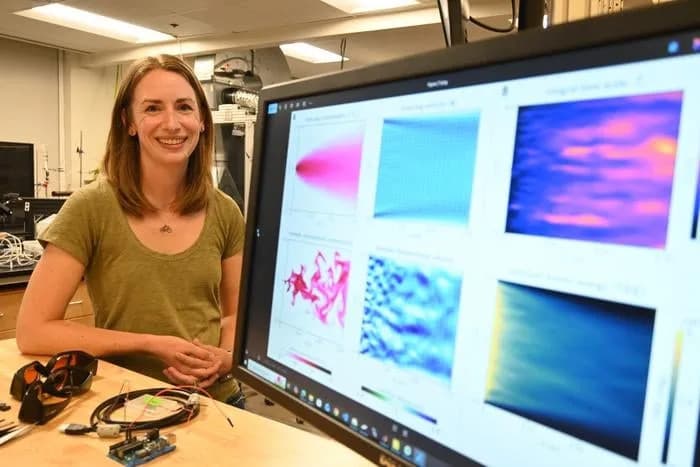
Wind reshapes the timing of odor whiffs, potentially giving animals clues about where a scent originated. (CREDIT: Scott Franz/CU Boulder Today)
Odors rarely arrive at an animal’s nose in the same form they left their source. As scent plumes travel through moving air, turbulence reshapes their timing and frequency content—removing some information, redistributing other parts, and even creating new fluctuations that were not present at the origin.
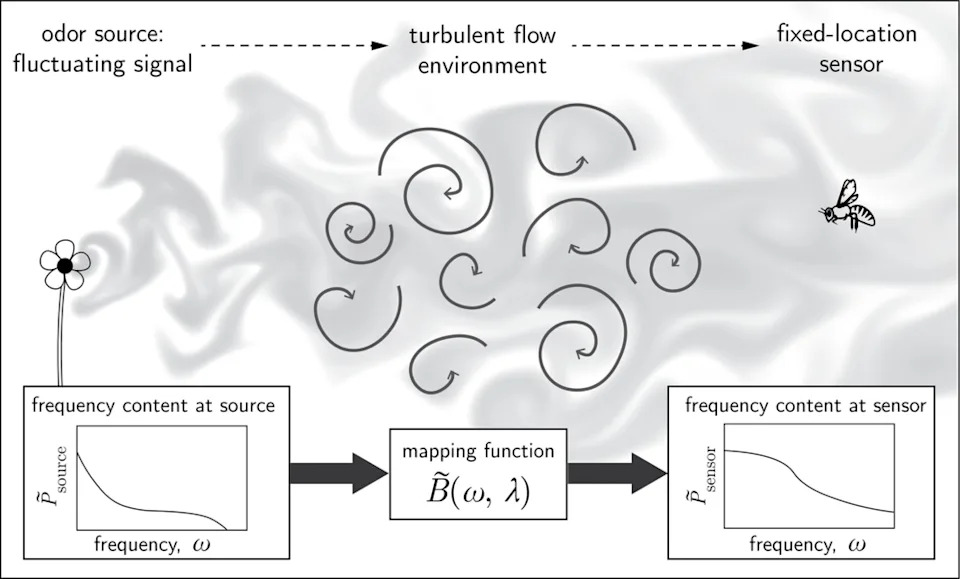
Conceptual overview of the system of interest, depicting a fluctuating source signal whose power spectrum, P̃ source, is transformed by turbulent transport into a new spectrum at the sensor, P̃ sensor. (CREDIT: PRX Life)
Three Ways Turbulence Changes Odor Signals
Researchers at the University of Colorado Boulder developed a quantitative framework describing how turbulent transport alters the frequency content of odor signals. Their analysis identifies three dominant transformations:
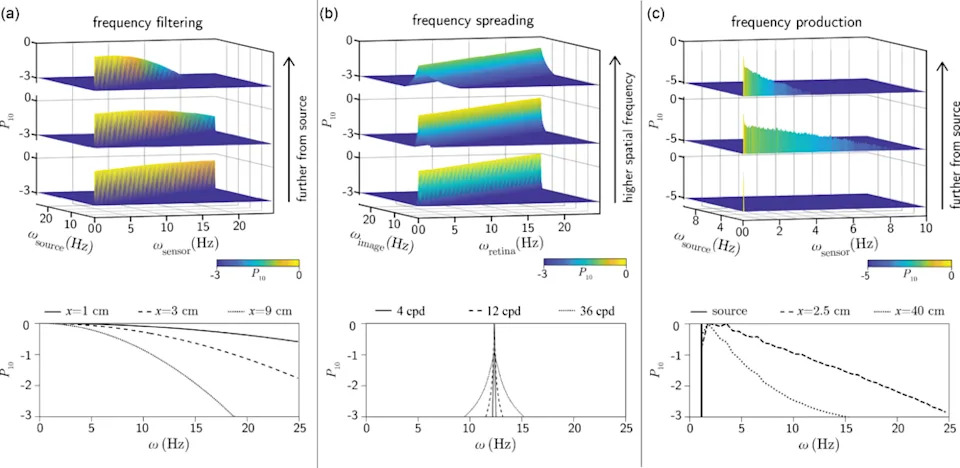
Idealized cases illustrating three key processes in the turbulent transport of an odor signal, where P10 represents the log of the power spectral density for each frequency. (CREDIT: PRX Life)
- Frequency Filtering: Turbulent stirring and molecular diffusion spread arrival times of odor packets, blurring rapid fluctuations more quickly than slow ones. The process acts like a low-pass filter: low-frequency components survive farther downstream while high-frequency details fade with distance.
- Frequency Spreading: Rather than simply attenuating a single frequency, turbulence redistributes spectral energy into nearby frequencies. Eddies across many scales broaden initially narrow spectral features during transport.
- Frequency Production: Perhaps most surprisingly, turbulence can generate temporal fluctuations that were absent at the source. The airflow’s own eddies impose timing patterns on the plume, so a steady source can produce a downstream signal with a broad frequency spectrum.
How They Showed It
To probe these effects, the team ran two-dimensional computational fluid-dynamics simulations. In their setup, air flowed at 0.1 m/s through an array of cylinders that produced chaotic motion inside a 0.75 × 0.6 m region. They generated 180 seconds of data sampled at 50 Hz with a spatial grid spacing of 500 μm. Virtual odor particles were emitted from a point source and monitored by seven sensors positioned 0.05–0.40 m downstream.
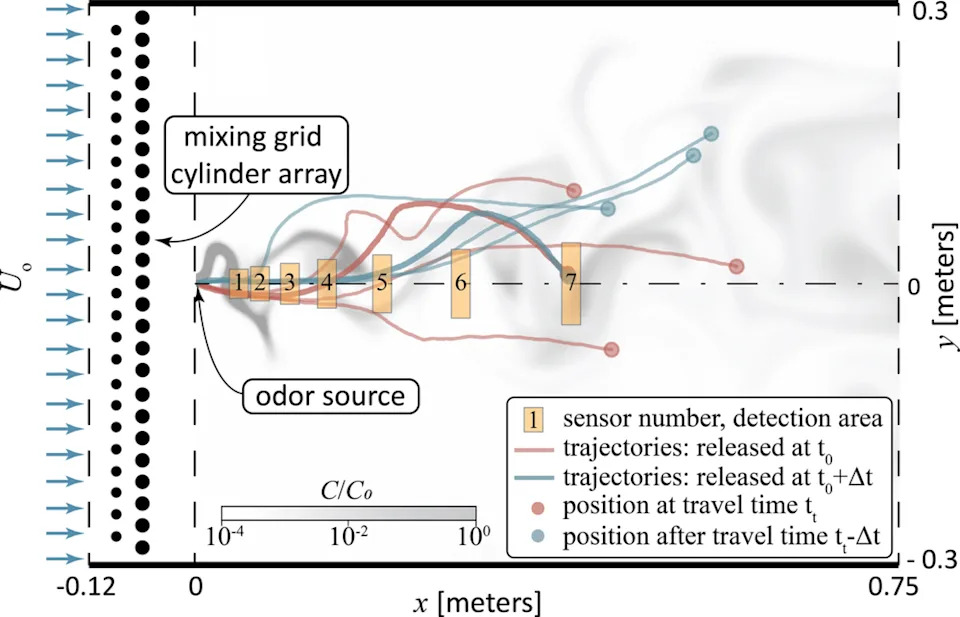
Schematic of the computational fluid dynamics model used for generating the velocity field for the paired-particle analysis, along with the concentration field for the idealized frequency production case. (CREDIT: PRX Life)
The simulations revealed all three processes acting together: high-frequency details in the source signal decayed with distance, spectral peaks broadened, and turbulence created an underlying spectrum even when the source had no intrinsic fluctuations. Sensor size also mattered—larger sensors intercepted more of the spreading plume and recorded stronger correlated fluctuations, which could affect how different animals perceive the same plume depending on their sensory morphology.
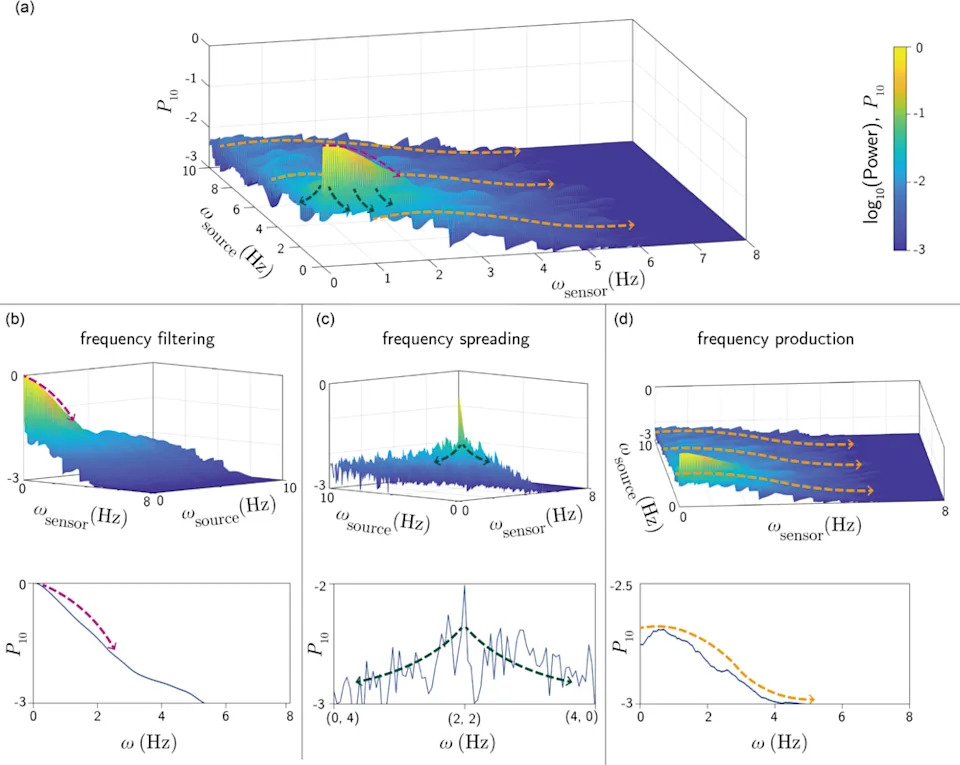
Naturalistic case: Example frequency mapping of an odor signal with a range of frequency content at the source, which is then transformed by turbulent transport to a different spectrum in the signal received at the sensor. (CREDIT: PRX Life)
Biological and Practical Implications
These transformations suggest a testable idea: because high-frequency source structure is retained only when close to the emitter, animals that know an odor’s typical spectral signature might estimate distance from spectral changes. The authors emphasize they have not shown animals actually use such calculations—rather, their framework provides concrete predictions that experiments can test.
Odor perception is further shaped by animal behavior: sniffing, flicking antennae, wing beats and movement through a plume (so-called active sensing) all modify what receptors receive, and neural processing then transforms that information again. Understanding the interplay between turbulent transport and biological sensing could inform both studies of animal navigation and engineered systems—such as robotic odor searchers or chemical leak detectors.
Lead author Elle Stark (CU Boulder): "By understanding how air and wind transform odor signals, we can better interpret animal navigation and eventually mimic these strategies for applications such as search and rescue and locating hazardous leaks."
The research and related literature are available in PRX Life.
Help us improve.