Experts warn cislunar space—the region between Earth and the Moon—could host strategic chokepoints similar to the Strait of Hormuz. While the Moon currently has limited commercial value, expected future industries (mining, orbital manufacturing, data centers) could create concentrated transit points and orbital hubs vulnerable to interdiction. Analysts urge investment in resilient infrastructure, international norms and space-domain awareness to prevent single actors from disrupting a potential multi-trillion-dollar lunar economy.
Could the Moon Be Blockaded? Experts Warn Cislunar Space Could Become the Next Strait of Hormuz
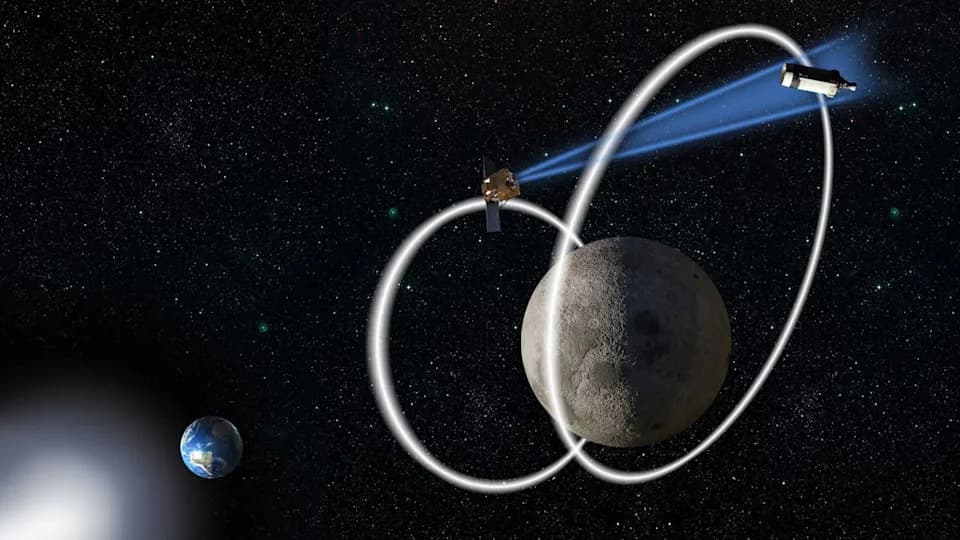
An illustration of the U.S. Air Force Research Laboratory's Cislunar Highway Patrol System (CHPS), a spaceflight experiment designed to keep track of objects entering, operating in, or leaving cislunar space. | Credit: U.S. Air Force Capt. David Buehler
The recent standoff in the Strait of Hormuz and renewed momentum to return humans to the Moon have prompted experts to ask whether cislunar space—the region between Earth and the Moon—could one day be interdicted or blockaded in a way that mirrors terrestrial chokepoints.
Why Experts Are Worried
The U.S. Space Force has created a dedicated acquisition office to assess the strategic importance of cislunar space for warfighting and national security, while NASA’s Artemis 2 mission and broader plans for lunar habitation have renewed public and industry focus on lunar logistics and infrastructure.
Marc Feldman, executive director of the Center for the Study of Space Crime, Piracy & Governance, and Hugh Taylor, a fellow co-founder, argue that the recent closure of the Strait of Hormuz should inform how nations plan to inhabit and defend the Moon. Feldman and Taylor—co-authors of the 2025 book Space Piracy: Preparing for a Criminal Crisis in Orbit—warn that apparent openness can hide a few strategic choke points.
"Just as the Strait of Hormuz is a narrow waterway, cislunar space, though seemingly large, actually contains a few unique and exclusive points of transit through which all lunar travel must pass," Feldman said.
What Makes Cislunar Space Vulnerable?
Experts say vulnerability depends on how much future economic and strategic value is assigned to lunar activity. Peter Garretson, a senior fellow in defense studies at the American Foreign Policy Council, emphasizes the difference between current commercial value—which is small—and expected future value, which could be enormous in both market and strategic terms.
Not all lunar territory is equally valuable. Strategic terrain includes the lunar poles (water ice), equatorial regions, areas rich in useful minerals, key lunar orbits and the Lagrange points. If control of those transit points or orbital nodes fell into hostile hands, nascent public and private lunar enterprises could face serious disruption.
How A Blockade Might Work—and What It Could Disrupt
Analysts outline several possible pressure points and consequences:
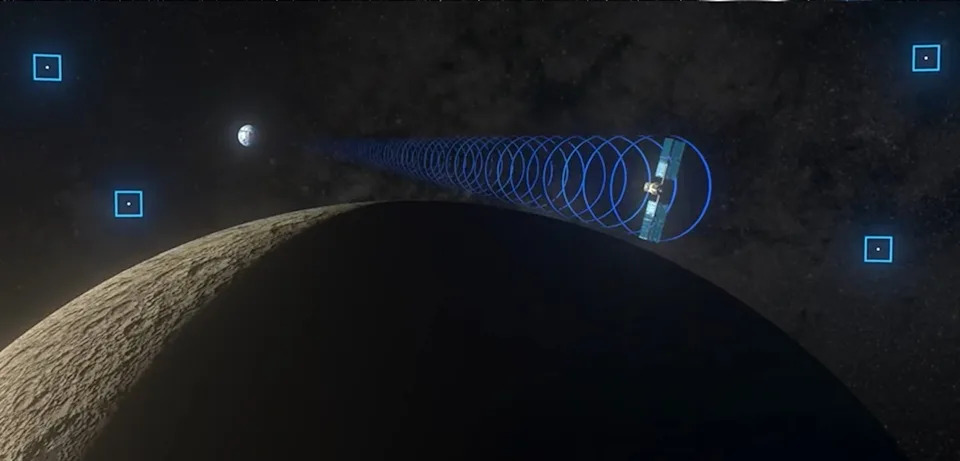
A still from a U.S. Air Force Research Laboratory video about a planned system of surveillance spacecraft known as the Cislunar Highway Patrol System (CHPS). | Credit: Air Force Research Laboratory
Orbital services: Positioning, navigation and timing (PNT), communications, remote sensing and space domain awareness are likely to be essential for lunar operations. Disruption of these services could halt surface production, mining, manufacturing and logistics.
Supply chains: Mining, refining and manufacturing on the Moon could feed orbital factories, data centers and power stations. Interrupting the flow of raw materials, fuel or personnel could undermine production and reduce the Moon's economic viability.
Strategic infrastructure: Proposed technologies such as mass drivers, electromagnetic catapults, and even speculative concepts like a lunar space elevator would concentrate value at particular locations and could become targets or leverage points.
Garretson cited speculative industrial scenarios—including comments attributed to Elon Musk about electromagnetic catapults—that imagine lunar-sourced materials enabling large-scale orbital construction, such as space-based data centers and power stations. In those futures, the Moon could become as strategically important as the Gulf region is for Earth today.
Policy, Governance and Preparedness
Experts stress this is not inevitable—much depends on policy, international cooperation, norms of behavior and a mix of technical and diplomatic safeguards. Early investment in resilient architectures, distributed logistics, international agreements on access and strong space-domain awareness will reduce the risk that a single actor could seize effective control of key cislunar routes.
As humanity moves beyond low Earth orbit, policymakers and industry leaders face a choice: build cislunar infrastructure with resilience and shared governance in mind, or risk repeating familiar geopolitical vulnerabilities on a new frontier.
Help us improve.