Washington is urging allies to accept higher prices for critical minerals sourced outside China to break Beijing's dominance in processing. The EU and US are reportedly close to forming a club of countries that would trade minerals at agreed minimum prices. Critics warn of higher business costs and potential Chinese retaliation, while US trade officials call the added cost a necessary 'national security premium'.
US Urges Allies To Pay A 'National Security Premium' To Wean Off Chinese Rare Earths
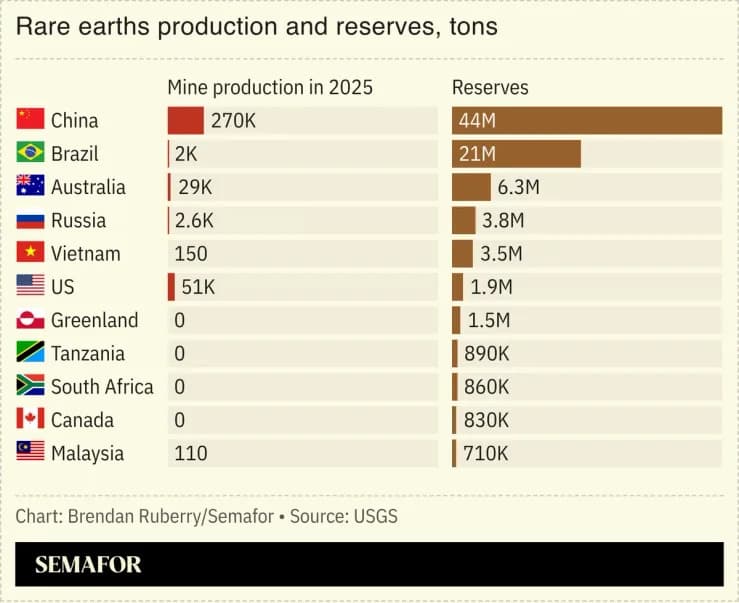
Rare earth production data
The White House trade representative has urged allied countries to accept higher prices for critical minerals sourced outside China as part of a push to reduce Beijing's near-monopoly on rare-earth processing.
According to reports, the European Union and the United States are close to striking a coordinated agreement to support mining and processing outside China. The proposal would create a club of like-minded countries that trade critical minerals at agreed minimum prices to ensure a resilient, diversified supply chain.
Some partner governments and industry groups have warned the plan could increase costs for businesses and might provoke retaliatory measures from China. Supporters, however, argue that the extra expense is justified by the strategic importance of secure supplies for advanced manufacturing, defense and clean-energy technologies.
Key Details
The US trade representative, Jamieson Greer, told the Financial Times that 'we will all pay a national security premium to have a secure supply chain,' framing the higher prices as an investment in collective security. The move comes amid longstanding concern that China controls roughly 90% of global processing capacity for rare-earth elements and other critical minerals.
Analysts say the proposal highlights a difficult trade-off: accepting higher short-term costs to reduce strategic vulnerabilities and strengthen Western industrial resilience in the longer term. How partners balance economic impacts, legal and trade rules, and the risk of geopolitical escalation will determine the plan's feasibility and effectiveness.
“We will all pay a national security premium to have a secure supply chain,” Jamieson Greer told the Financial Times.
Governments and companies will now face complex choices about subsidies, procurement rules, and industrial policy as they try to rebuild non-Chinese processing capacity without unduly harming competitiveness or sparking a damaging trade confrontation with Beijing.
Help us improve.