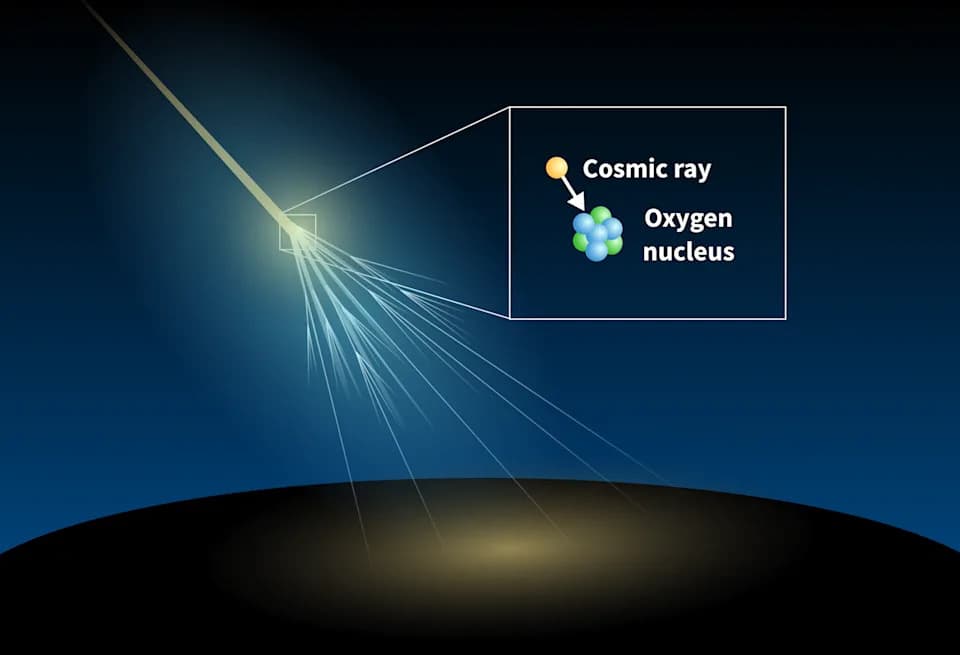
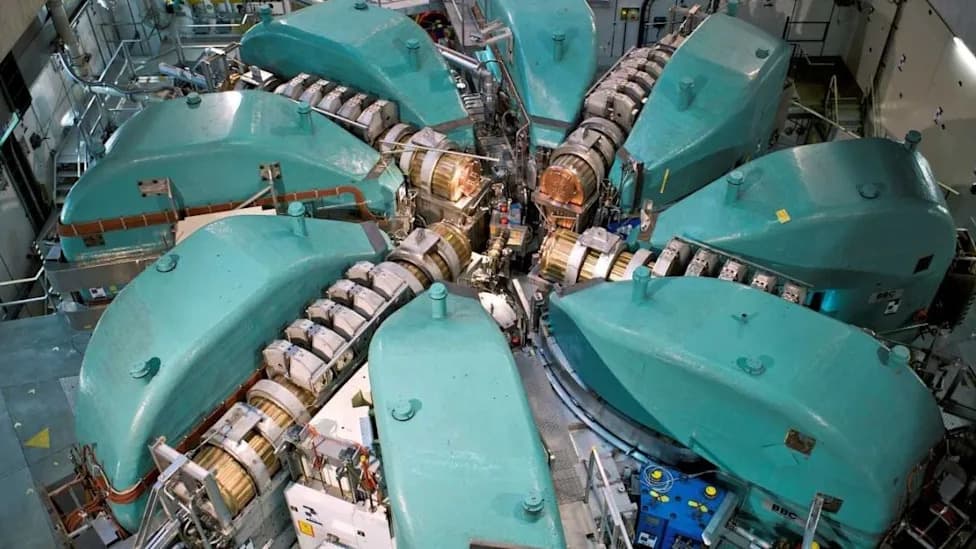
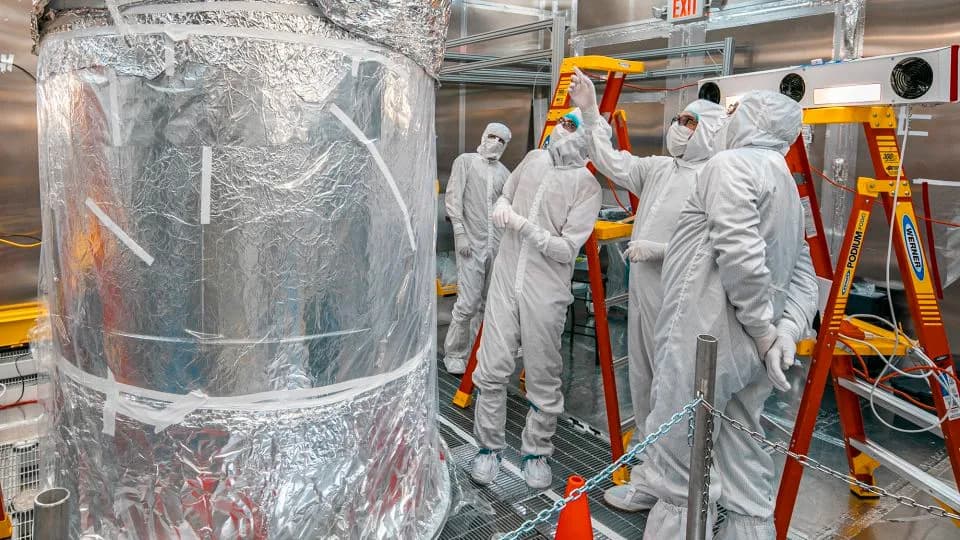
The Mississippi State team led by Jaspreet Randhawa has performed the first direct laboratory measurement of the copper‑59 proton‑alpha reaction under conditions relevant to Type‑I X‑ray bursts. Using a 59Cu beam at TRIUMF and a windowless solid hydrogen target (~4 K), they measured cross sections of 0.28 ± 0.06 mb and 0.85 ± 0.21 mb at center‑of‑mass energies 4.0 ± 0.4 MeV and 4.68 ± 0.25 MeV. The new data shrink the reaction‑rate uncertainty from factors of ~100 to about a factor of two and indicate the NiCu recycling cycle is negligible (≈5% or less), so heavier‑element production during bursts is unlikely to be strongly blocked.
Laboratory Measurement Shows Copper‑59 Unlikely To Block Heavy‑Element Production In Neutron‑Star X‑ray Bursts
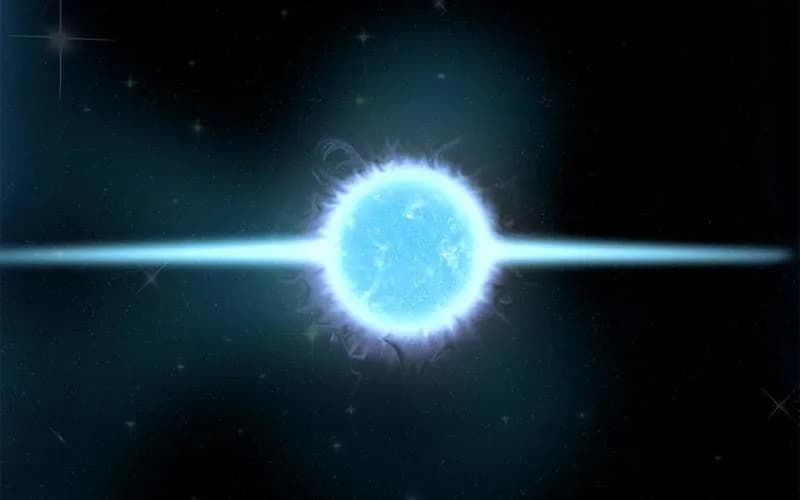
Direct lab data suggests neutron star X-ray bursts face a weaker element-building bottleneck than expected. (CREDIT: Jani Närhi / University of Helsinki)
For years scientists have debated whether an unstable isotope of copper could act like a traffic jam in some of the universe’s most violent explosions. A new laboratory measurement led by Mississippi State physicist Jaspreet Randhawa shows that the suspected bottleneck — a recycling loop involving copper‑59 — is much weaker than feared, allowing nucleosynthesis to proceed toward heavier elements during Type‑I X‑ray bursts on neutron stars.
What the team measured

Mississippi State physicist Jaspreet Randhawa. (CREDIT: Grace Cockrell, MSU Office of Public Affairs)
The group performed the first direct laboratory measurement of the copper‑59 (59Cu) proton‑alpha (p,α) reaction under conditions relevant to X‑ray bursts. Using a radioactive 59Cu beam produced at TRIUMF in Canada, they fired the beam into a windowless solid hydrogen target cooled to about 4 K and detected reaction products downstream. Separate measurements tracked target thickness and removed background from the silver foil backing.
Key experimental results
The team collected data at two center‑of‑mass energies: 4.0 ± 0.4 MeV and 4.68 ± 0.25 MeV. From those runs they extracted total cross sections of 0.28 ± 0.06 millibarns and 0.85 ± 0.21 millibarns, respectively. Those measured cross sections allowed the researchers to compute the 59Cu(p,α) reaction rate with far tighter bounds than previous theoretical estimates.
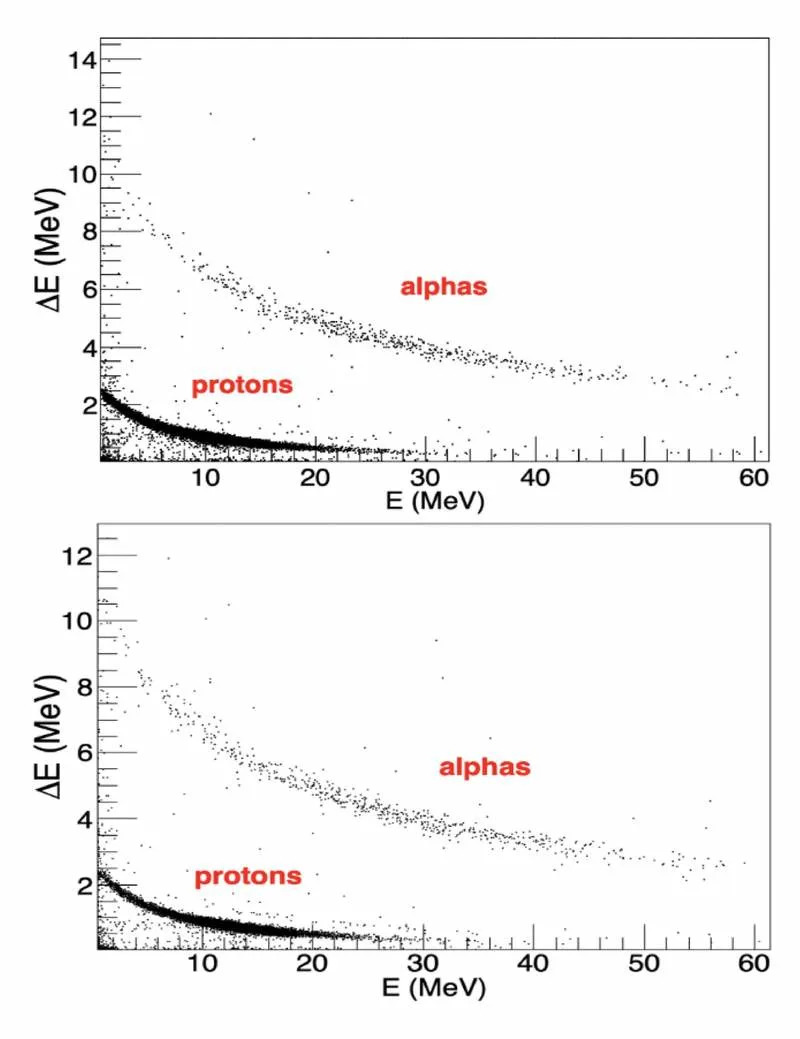
Particle Identification plots, using ΔE–E detectors, at Ec.m. 4.0 ± 0.4 MeV (upper panel) and 4.68 ± 0.25 MeV (lower panel), respectively. (CREDIT: The Astrophysical Journal)
Why this matters
Previous reaction libraries relied heavily on theory and treated the 59Cu(p,α) uncertainty as enormous — sometimes varying by factors of ~100. The new direct measurement reduces that uncertainty to roughly a factor of two. Compared with available estimates for the competing proton‑capture plus gamma (p,γ) route, the data indicate the NiCu recycling cycle’s strength is negligible across temperatures relevant to X‑ray bursts (about 5% or less). In plain terms: the feared bottleneck is not significantly blocking the synthesis of heavier elements during these bursts.
Astrophysical implications
These reactions contribute energy that shapes X‑ray burst light curves — the brightness patterns astronomers observe — and light curves are used to test neutron‑star models such as mass–radius constraints. The researchers ran a one‑zone X‑ray burst model tuned to the well‑studied burster GS1826‑24 and found that varying the new reaction rate within its tightened uncertainty produced no discernible change in the modeled burst light curve. This removes a significant source of ambiguity when comparing models with observations.
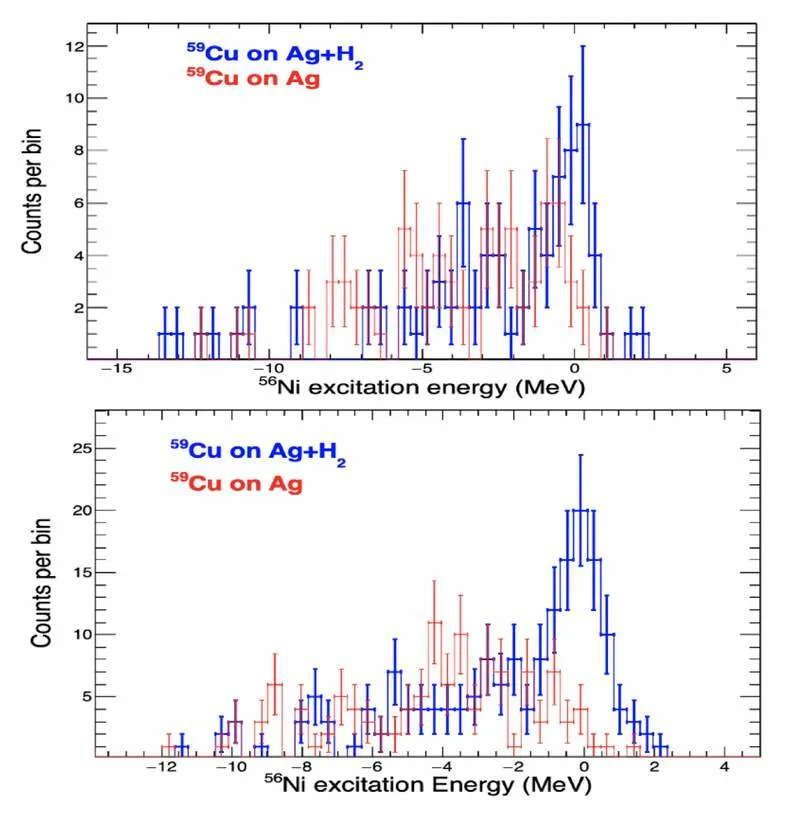
The excitation energy spectrum of 56Ni with (blue) and without (red) H2 target at Ec.m. 4.0 ± 0.4 MeV (upper) and 4.68 ± 0.25 MeV (lower panel), respectively. (CREDIT: The Astrophysical Journal)
The result also narrows uncertainties about the nuclear “ashes” left after bursts (material that contributes to the neutron‑star crust). Earlier sensitivity studies suggested large swings in this rate could shift final compositions across several mass numbers; the new measurement reduces that variation. The team notes that full multizone simulations are needed to quantify the complete astrophysical consequences, which were beyond the scope of the present study.
“The universe began almost entirely with hydrogen and helium,” said Jaspreet Randhawa. “By identifying how stellar explosions build heavier elements, scientists gain a clearer picture of how the elements that form planets and support life are distributed through the cosmos.”
The experiment included contributions from graduate student Muhammad Asif Zubair and was conducted at TRIUMF, one of the few facilities capable of producing a useful 59Cu beam. The research findings are available online in The Astrophysical Journal.
Bottom line: Direct laboratory data now give astrophysicists a much firmer value for a previously uncertain reaction. That should improve X‑ray burst models, reduce an important source of error in model‑to‑telescope comparisons, and strengthen the conclusion that nucleosynthesis can proceed beyond the copper region rather than becoming trapped in a recycling loop.
Help us improve.