LZ, an underground liquid-xenon detector, recorded an unusual particle interaction in June 2023 that could be a hint of dark matter. Analysis of 220 days yields roughly 2.6 sigma (≈0.5% chance of known background), short of the 5-sigma discovery threshold. Researchers are analyzing a 700-day dataset and using blind-analysis techniques; independent confirmation from XENONnT and PandaX-4T would be required to establish a true detection.
Intriguing LZ Signal Hints at Dark Matter — Scientists Urge Caution Until Confirmed
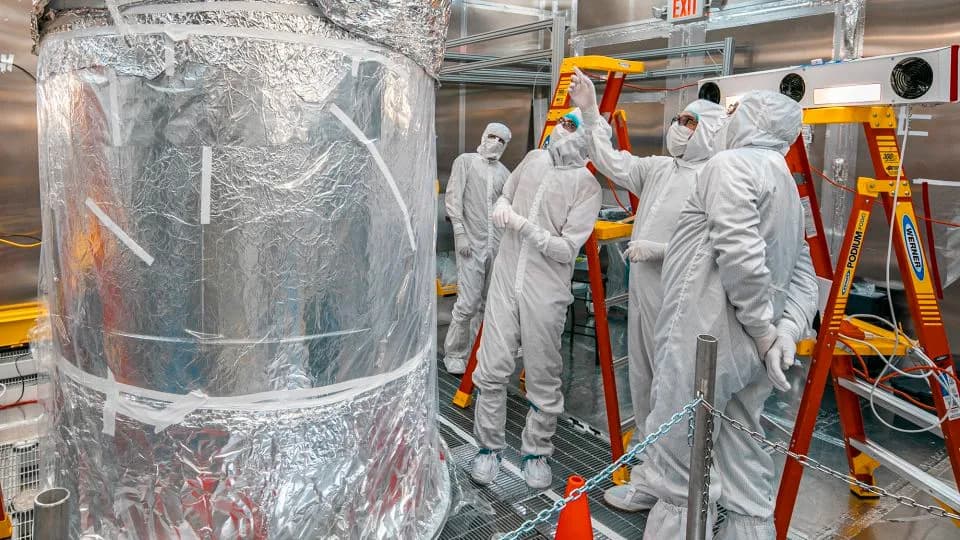
Researchers assess the LZ experiments's central detector. The instrument searches for dark matter candidates. - Matthew Kapust/Sanford Underground Research Laboratory
An international collaboration of physicists operating the LUX-ZEPLIN (LZ) experiment has reported a curious particle interaction recorded in June 2023 that could be a hint of dark matter. The event produced a brief flash of light in the detector's liquid xenon and has prompted months of careful follow-up analysis.
What Is Dark Matter And Why It Matters
Dark matter is thought to make up about 85% of the matter in the universe, roughly five times the abundance of ordinary matter that forms stars, planets and people. It does not emit, absorb or reflect light, but its gravitational effects shape galaxies and the large-scale structure of the cosmos. Identifying the particle (or particles) that make up dark matter would be a major breakthrough in both astrophysics and particle physics.

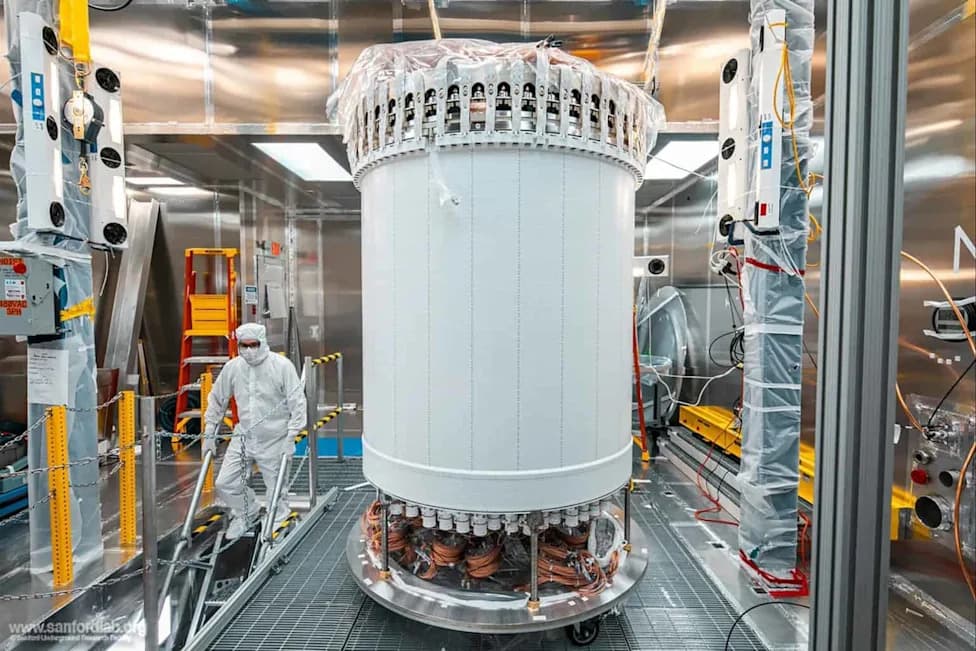
The LZ central detector is seen in the clean room at Sanford Underground Research Facility in South Dakota after assembly, before beginning its journey underground. - Matthew Kapust/Sanford Underground Research Laboratory
What The LZ Experiment Observed
The LZ detector, located about a mile (≈1.5 km) underground at the Sanford Underground Research Facility in South Dakota, contains seven active metric tons of ultra-pure liquid xenon. In June 2023 the instrument recorded an unusual interaction that produced light and charge signals — the kind of tiny nuclear recoil a dark matter particle (such as a hypothetical WIMP) might cause.
After months of scrutiny, the collaboration — about 250 scientists and engineers from 39 institutions — estimates a roughly 0.5% probability that a known background produced the event. Statistically, that corresponds to about 2.6 sigma, short of the 5-sigma standard typically required in particle physics to claim a discovery.

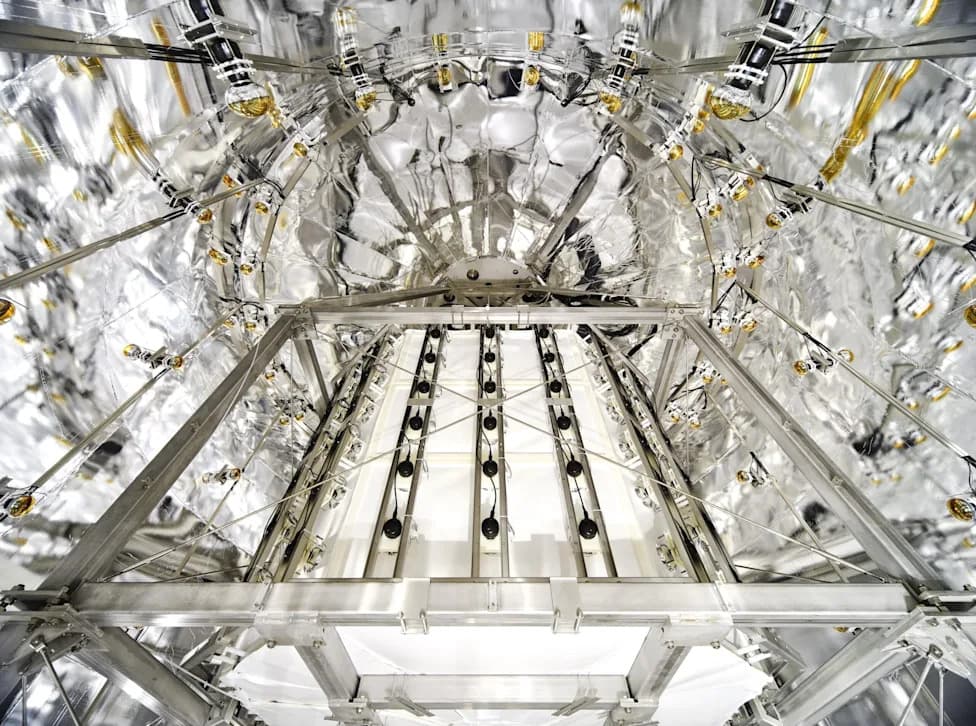
A view looking up into the LZ outer detector, used to veto radioactivity that can mimic a dark matter signal. - Matthew Kapust/Sanford Underground Research Laboratory
"One event, by itself, is not enough," said Alvine Kamaha, an assistant professor at UCLA and a member of the LZ collaboration. "We need to see whether additional events appear as we collect more data and whether the statistical significance increases."
Why Caution Is Necessary
Background radiation, rare detector effects, or statistical fluctuations can all mimic a true dark matter signal. The LZ team stresses that single events—especially isolated, higher-energy candidates—must be treated cautiously. Independent verification from other large detectors, notably XENONnT in Italy and PandaX-4T in China, would be crucial to confirming any genuine dark matter detection.
Ongoing Work And Next Steps
The June 2023 candidate was found in an analysis of 220 days of data (March 2023–April 2024). Researchers are now analyzing a larger dataset spanning about 700 days and applying blind-analysis techniques (including synthetic events seeded into the data) to reduce unconscious bias. The collaboration has presented the result at a conference and submitted a paper for peer review.
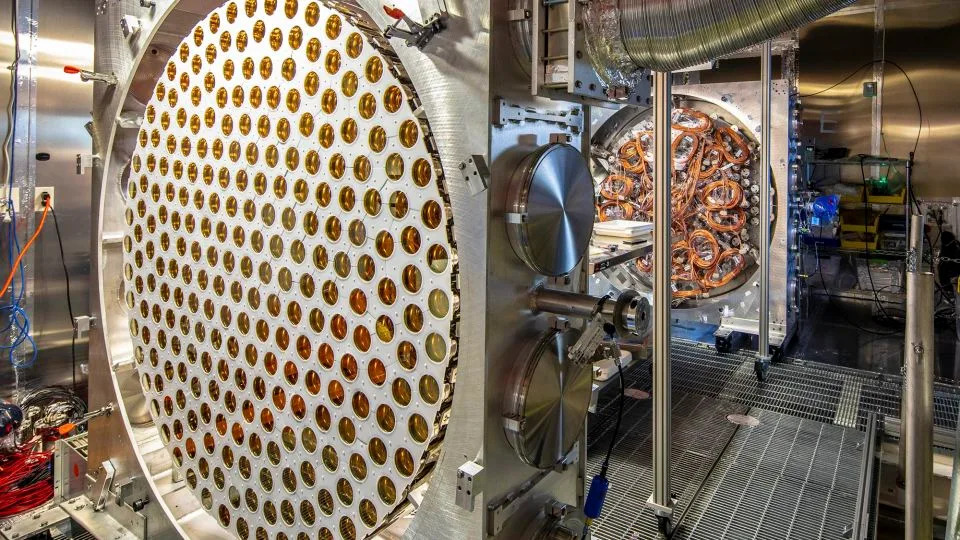
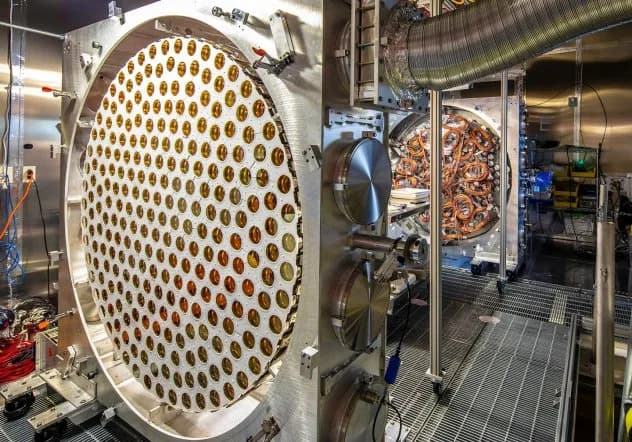
To search for dark matter, the LZ experiment uses photomultiplier tubes, shown here before installation in the detector, to capture light from particle interactions. - Matthew Kapust/Sanford Underground Research Laboratory
Because the current significance stands at about 2.6 sigma (≈1-in-200 chance of a fluke) and the community standard for discovery is 5 sigma (≈1-in-3.5-million), additional events and independent cross-checks are required before any firm claim can be made.
Possible Implications If Confirmed
If the signal is ultimately shown to be dark matter, it would open a new window on particle physics and cosmology, enabling direct studies of dark-matter properties and informing astrophysical models of structure formation. Even if this event proves to be a background or statistical anomaly, the episode underscores the sensitivity and rigor of modern dark-matter searches.
Photo credit: Matthew Kapust / Sanford Underground Research Laboratory
Help us improve.