The STAR experiment at Brookhaven's RHIC found a pronounced dip in transverse-momentum correlations from about 1 billion gold-ion collisions at 3–7.7 GeV per nucleon pair. The dip deviates from a smooth energy trend with 5-sigma significance and could indicate a critical point in the nuclear matter phase diagram. The result is persuasive but not conclusive: further tests, extra observables and comparisons with theory are planned.
Collider Recreates the Early Universe — Unexpected 'Dip' Could Point to a Nuclear Critical Point
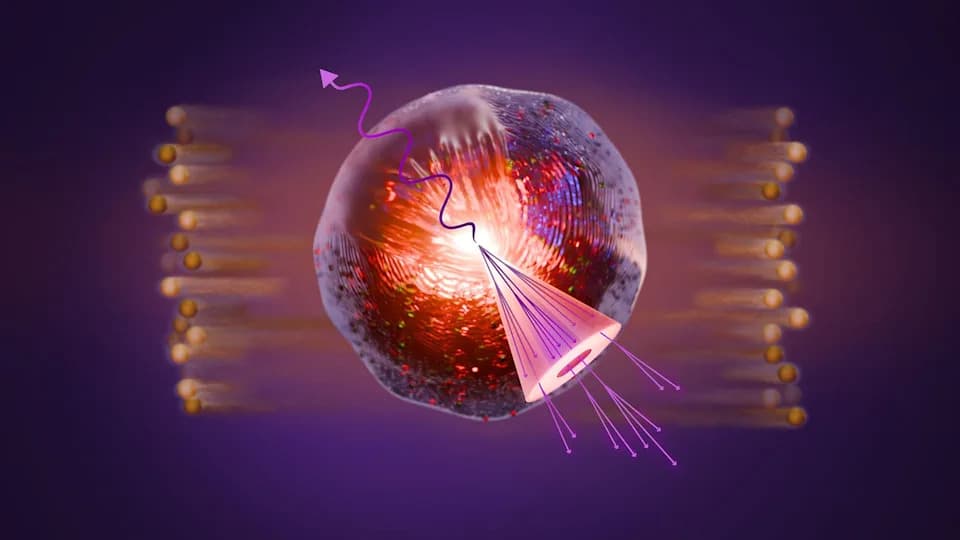
An illustration of a liquidlike fireball of quark-gluon plasma, the substance thought to permeate the universe just milliseconds after the Big Bang. Scientists at the Relativistic Heavy Ion Collider (RHIC) create quark-gluon plasma by colliding gold ions together at high speed. The collisions produce a spray of particles (a "jet") back-to-back with a photon (wavy purple line). | Credit: Valerie A. Lentz/Brookhaven National Laboratory
Physicists at Brookhaven National Laboratory's Relativistic Heavy Ion Collider (RHIC) have observed an unexpected pattern in the debris from nearly light-speed gold-ion collisions — a pronounced "dip" in transverse-momentum correlations that may signal a long-sought critical point in the phase diagram of nuclear matter.
The signal was recorded by the STAR experiment during a campaign of low-energy collisions designed to recreate the hot, dense conditions that existed microseconds after the Big Bang. By analyzing roughly 1 billion gold-ion collisions at center-of-mass energies per nucleon pair between 3 and 7.7 GeV, the team found that event-to-event variations in how strongly particles are flung sideways (the transverse momentum) do not change smoothly with collision energy. Instead, the variations shrink and then grow again — producing a distinct dip.
What This Means
Protons and neutrons are made of quarks bound by gluons. Under extreme heat or compression, these nucleons "melt" into a quark-gluon plasma, a state believed to have filled the universe in its first microseconds. Physicists want to map the equation of state of nuclear matter — the relationship among pressure, temperature and density that dictates how and when matter changes phase under extreme conditions, such as inside neutron stars.
Many theories predict a critical point in the nuclear phase diagram, analogous to the critical point of water where liquid and vapor become indistinguishable. Near such a point, properties like the heat capacity can change dramatically, which would alter how temperature and flow fluctuate in the fleeting fireball produced by heavy-ion collisions. These changes would show up as non-smooth behavior in observables such as transverse-momentum correlations.
How the Team Measured the Effect
For each collision the STAR collaboration measured the transverse momentum of charged particles and studied pairwise correlations: whether particles from the same event were both harder or both softer than average. Strong, coherent fluctuations indicate variations in the overall temperature or collective expansion of the fireball.
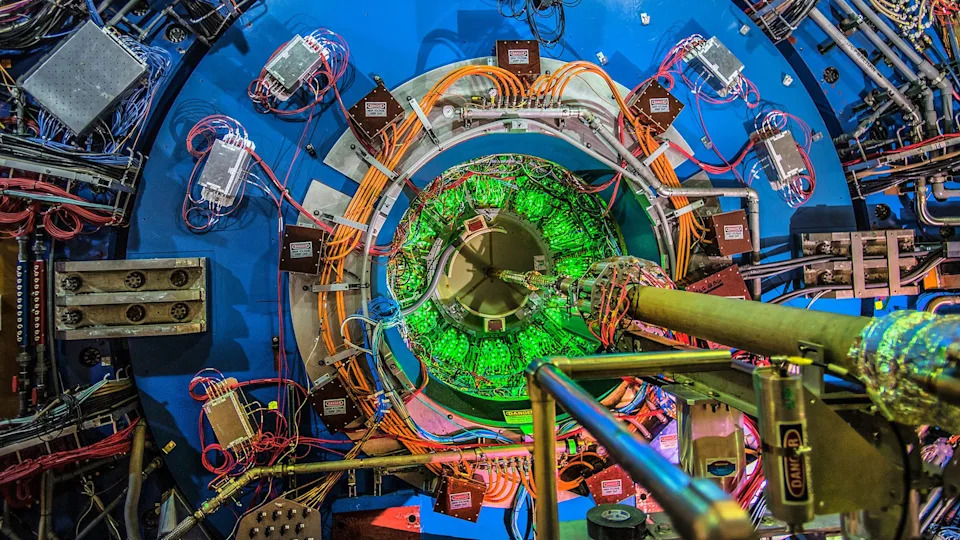
The central part of the three-story STAR detector at the Relativistic Heavy Ion Collider (RHIC). Scientists recently used the detector to study the conditions of the early universe, just milliseconds after the Big Bang. | Credit: Brookhaven National Laboratory
In the most central (head-on) collisions, the correlations dip away from a smooth extrapolation based on higher-energy data. The departure reaches a statistical significance of 5 sigma — the conventional threshold in particle physics indicating a chance of about one in 3.5 million that the effect is a random fluctuation if the true trend were smooth.
"The result is suggestive, not proof of a critical point," said study co-author Rutik Manikandhan of The Ohio State University, noting that other physics effects might also influence the observed fluctuations.
Checks, Caveats, and Next Steps
A widely used collision model that contains no critical point reproduced the overall energy dependence but not the dip, lending weight to the observation. Off-center collisions show only a faint hint of the same feature, too weak to count as independent evidence. The STAR team therefore treats the result as a compelling hint rather than a definitive discovery.
Planned follow-ups include extracting the specific heat from the measured correlations and confronting that number with first-principles supercomputer calculations of quarks and gluons. The collaboration will also test the signal against additional theoretical models and combine it with other observables, such as fluctuations in proton yields, because agreement among multiple independent measurements will be needed to claim a true critical point.
Whether this dip ultimately marks the long-sought critical point or another unexpected phenomenon, it provides a precise new experimental constraint for theorists and advances our understanding of how the early universe evolved from a quark-gluon soup into the ordinary matter we see today.
Publication: The STAR collaboration published these findings on Sept. 22 in Physical Review Letters.
Help us improve.