Silencing "Fighting Bob" reconstructs the federal campaign to discredit and silence antiwar progressives in the run-up to and during U.S. mobilization for World War I. Chester focuses on four targets—the Lower East Side Jewish community, the People's Council (PCA), the Nonpartisan League (NPL), and Sen. Robert La Follette—and shows how the Committee on Public Information and the Bureau of Investigation used legal threats, propaganda and front organizations to coerce silence. The book traces both the mechanics of repression and the partial postwar restoration of civil liberties, and it warns that public–private information operations remain a persistent threat to dissent.
Silencing 'Fighting Bob': Wilson's Wartime Campaign To Muzzle Antiwar Progressives
Woodrow Wilson's War at Home
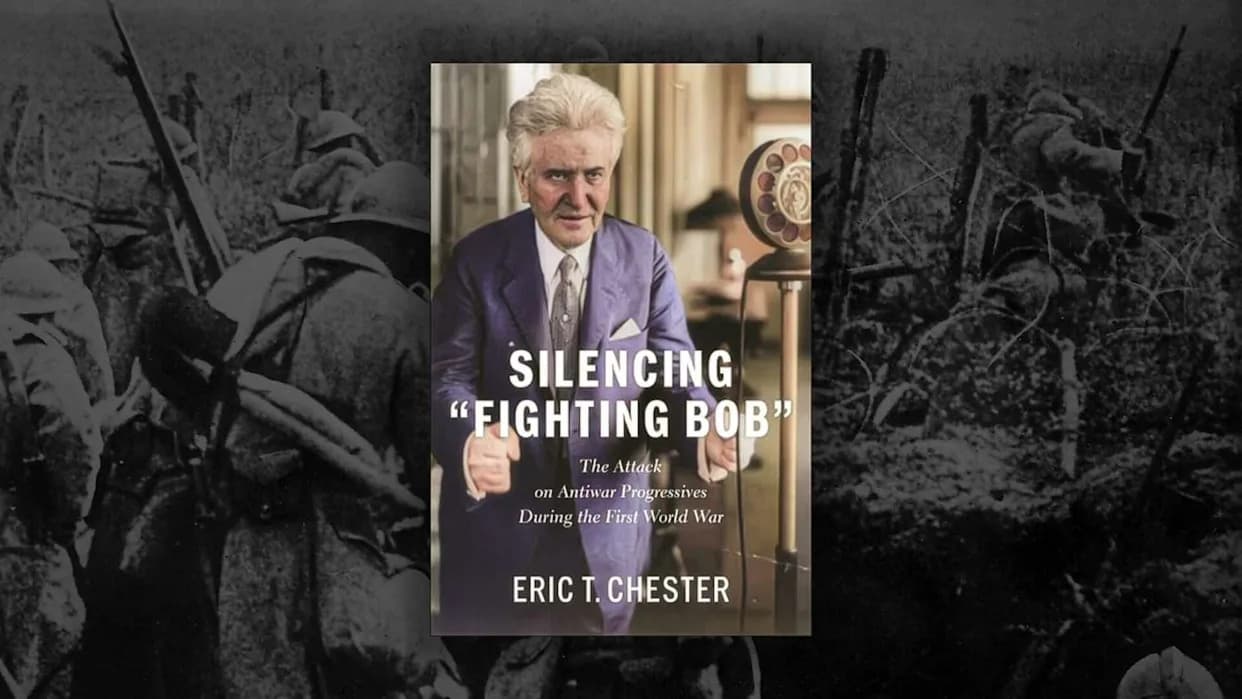
Eric T. Chester's Silencing "Fighting Bob": The Attack on Antiwar Progressives During the First World War (NYU Press, 216 pages, $24) reconstructs a sustained federal campaign of propaganda, legal pressure and covert operations aimed at discrediting and silencing opponents of U.S. intervention in World War I. At the center of the book is Sen. Robert "Fighting Bob" La Follette Sr., whose outspoken opposition made him a focal point for government efforts to curtail dissent. Chester's study shows how state power, working through official agencies and nominally private intermediaries, narrowed the space for dissent with surprising speed.
The Targets
Chester organizes the book around four principal targets of federal pressure: the largely antiwar Jewish community of New York's Lower East Side, the People's Council of America for Democracy and the Terms of Peace (PCA), the Midwestern Nonpartisan League (NPL), and Sen. Robert La Follette himself. Drawing on press accounts, internal correspondence and pamphlets, he traces how each group was infiltrated, provoked or co-opted by government agencies and allied organizations.
The Mechanics Of Repression
The Committee on Public Information (CPI), created by executive order as a wartime publicity agency, and the Bureau of Investigation (a precursor to the FBI) emerge as the principal instruments of federal pressure. Chester documents a coordinated mix of tactics—legal threats under the Espionage Act, press manipulation, psychological operations, and the creation or subsidizing of front organizations—to isolate and neutralize antiwar voices. Government operatives often worked through nominally private groups such as the American Defense Society and the American Alliance for Labor and Democracy (AALD) to blur the line between state action and civil society activity.
“The government 'opted to discredit La Follette by initiating a coordinated effort to malign him through a covert operation of psychological warfare,'” Chester writes—an allegation the author supports with examples of document-sharing, press pressure and coordinated attacks.
La Follette And Psychological Warfare
When legal avenues for silencing La Follette proved limited, Chester shows, officials turned to a coordinated press and propaganda campaign to damage his reputation. The CPI worked with prowar organizations to publicize charges that La Follette’s calls for negotiated peace amounted to disloyalty—at times securing prominent placement in newspapers such as The New York Times. Chester argues that the cumulative pressure helped push La Follette into public reticence.
Exploiting Divisions
A key strength of Chester’s account is his attention to fissures within the progressive and labor movements. Ethnic tensions on the Lower East Side, sectional splits in labor, and ideological rivalries gave federal agents openings to amplify prowar voices and marginalize dissenters—often by funding or otherwise supporting sympathetic labor leaders such as Samuel Gompers and by using state authority to disrupt meetings of groups like the PCA.
Limits, Questions And Legacy
Chester is plainly sympathetic to his subjects, but he also shows nuance: progressives were not unified in their opposition, and many moderated their stances once U.S. entry became inevitable. One shortcoming the author acknowledges (and could explore further) is why some leading progressives—George Creel among them—backed intervention while others fiercely opposed it. That split helps explain why repression was sometimes driven by fellow progressives as much as by conservatives: the motivation was consolidation of power, not simple partisan alignment.
The book closes by drawing sober parallels to later eras: the use of public–private partnerships to shape opinion, the cultivation of sympathetic journalists, and selective legal or administrative penalties for dissent. Chester also documents a hopeful postwar coda: wartime abuses eventually produced a civil-liberties backlash, pardons for wartime prosecutions and a partial rollback of the worst excesses of the Red Scare.
Conclusion
Silencing "Fighting Bob" is a tightly argued, well-documented account of how wartime institutions can be turned to suppress dissent. By concentrating on the mechanics of repression and the networks that enabled it, Chester gives readers a clear, unsettling lesson about the fragility of civil liberties during moments of national crisis—and about the vigilance needed to preserve them.
Help us improve.