The WARRIOR Act, introduced by Rep. Chrissy Houlahan with 36 veteran cosponsors, would prohibit excluding service members from military specialties based on sex and require annual reporting to Armed Services committees. The bill mandates gender-neutral standards, an 18-month review period for new job criteria, and separate skill categories for technical, tactical, cognitive, and physical demands. It also asks the Pentagon to share the combat-effectiveness review, now assigned to Johns Hopkins APL, and notes roughly 4,500 women serve in Army and Marine ground combat roles.
Veteran Lawmakers Introduce WARRIOR Act to Protect Women’s Access to Ground Combat Roles
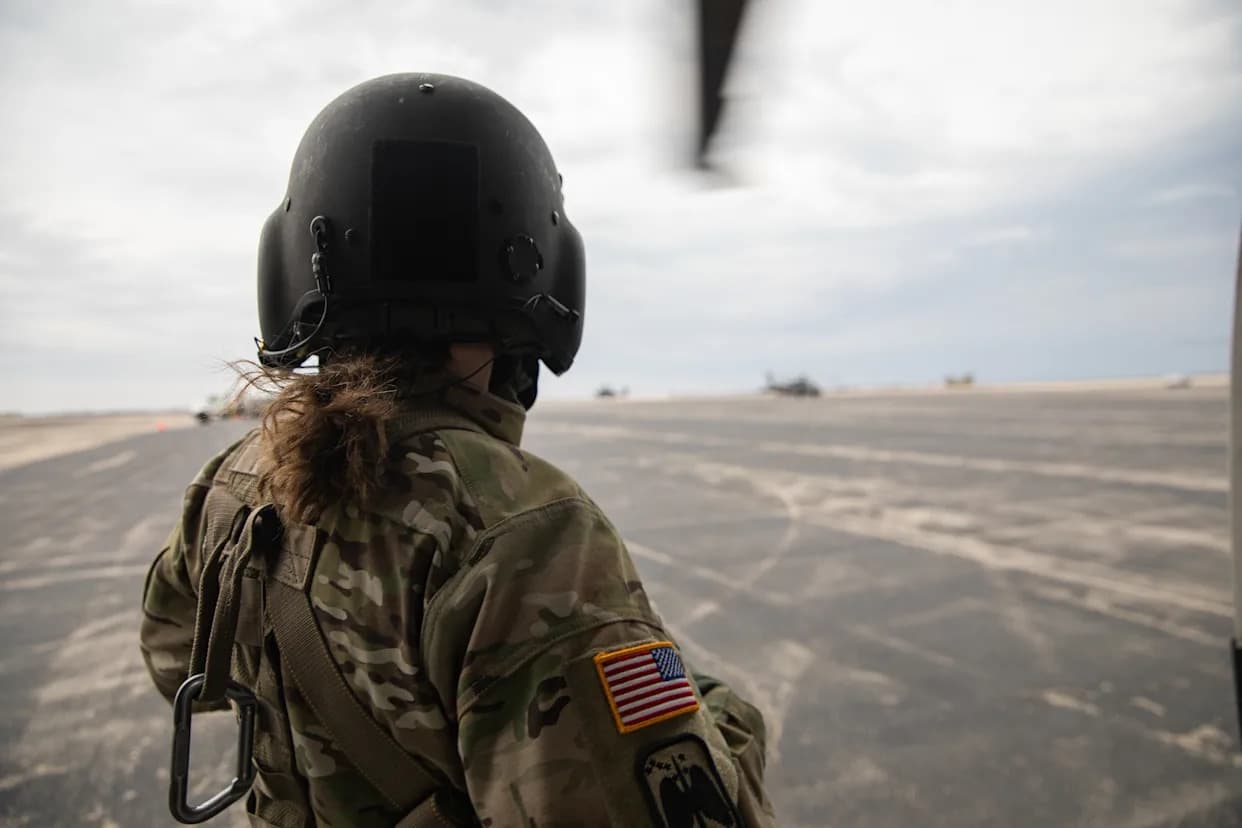
A Black Hawk crew chief assigned to the 3rd Assault Helicopter Battalion, 1st Aviation Regiment, 1st Combat Aviation Brigade, 1st Infantry Division, looks out over the flight line during a hot refueling in Topeka, Kansas, March 7, 2023. (Spc. Charles Leitner/Army)(Sgt. Charles Leitner)
A group of veteran lawmakers has introduced the Women Add Resourcefulness and Resilience to Improve Operational Readiness (WARRIOR) Act to enshrine women’s access to ground combat and other military occupational specialties.
Rep. Chrissy Houlahan (D-Pa.), a former Air Force officer, led the effort with 36 cosponsors — all veterans — including Reps. Jason Crow (D-Colo.) and Maggie Hassan (D-N.H.). The bill would bar the military from excluding service members from any “occupational specialty, career field, or assignment” on the basis of sex.
What the WARRIOR Act Would Do
Key provisions require the Department of Defense to:
- Prohibit gender-based exclusion from occupations and assignments;
- Submit an annual report to the House and Senate Armed Services Committees describing any changes to occupational standards made in the prior year and explaining how those changes predict performance of “actual, regular, and recurring duties” for each military occupational specialty;
- Disclose the number of service members involuntarily reassigned or separated for reasons other than disciplinary action or court-martial;
- Adopt an 18-month evaluation period for adding new job standards and organize standards into four categories — technical, tactical, cognitive, and physical — to better reflect real job requirements;
- Provide Congress with a copy of the Pentagon’s combat-effectiveness review, which was recently reassigned from the Institute for Defense Analyses to Johns Hopkins University’s Applied Physics Laboratory.
Context and Reaction
The bill was framed as a direct response to the Pentagon’s review of women’s performance in ground combat roles and to recent comments by Defense Secretary Pete Hegseth questioning whether women can meet existing standards. Supporters say the legislation updates outdated statutes, ensures gender-neutral evaluation, and prevents future rollbacks of access to military jobs.
“The WARRIOR Act proactively affirms women’s qualifications to serve in combat,” said Rep. Houlahan’s office, noting the measure updates laws from 1996 and 2006 so service members are judged by gender-neutral standards tied to job requirements.
Organizations representing veterans, including Iraq and Afghanistan Veterans of America, endorsed the measure at the bill’s rollout in late March. Kyleanne Hunter, IAVA’s CEO, said updating standards is “commonsense” and critical to national security given that women are among the fastest-growing groups of recruits.
About 4,500 women currently serve in ground combat roles across the Army and Marine Corps, according to an NPR analysis. There has been no formal move to reverse the 2015 policy that opened combat jobs to women, but the WARRIOR Act aims to prevent exclusions tied to future reviews or reinterpretations of standards. The bill so far has no Republican sponsors.
Why it matters: The WARRIOR Act would lock in a policy approach that evaluates service members on gender-neutral, job-relevant criteria and increases Congressional visibility into how occupational standards are set and applied.
Help us improve.