New paleomagnetic measurements from roughly 900 rock samples in Western Australia indicate parts of Earth's lithosphere were moving by about 3.5 billion years ago. The Pilbara block shifted from ~53° to ~77° latitude and rotated over 90°, implying sustained drift of tens of centimeters per year. Comparison with near-stationary data from South Africa's Barberton Greenstone Belt suggests the early lithosphere was segmented and capable of relative motion, providing direct evidence for plate-like behavior in the Archean.
Earliest Direct Evidence: Plate Tectonics Active 3.5 Billion Years Ago

The researchers studied the East Pilbara Craton formation in Western Australia’s Pilbara region, seen here. - Roger Norman/Alamy Stock Photo
New paleomagnetic data suggest parts of Earth's outer shell were moving about 3.5 billion years ago, pushing the accepted start of plate-like behavior far earlier than some theories have proposed. The results — published in the journal Science on March 19 — come from an unusually large, high-quality dataset that helps clarify how and when the planet developed a segmented lithosphere capable of relative motion.
What the Study Found
Researchers led by Roger Fu of Harvard University and Alec Brenner (now at Yale) measured magnetic signals preserved in roughly 900 rock samples from the East Pilbara Craton in Western Australia. Those minerals record the inclination of Earth's magnetic field at the time the rocks formed, allowing scientists to reconstruct the paleo-latitude and orientation of the rock unit when it solidified.

Volcanic activity, seen at the Sundhnúkur crater row in Iceland, is more likely to occur where tectonic plates meet. - John Moore/Getty Images
“Why do you have mountains? Why do you have oceans? It only makes sense with plate tectonics,” Fu said. “So, trying to understand when it happened on early Earth is a fundamental question. It makes everything else make sense.”
Across an interval of about 30 million years, a portion of the Pilbara sequence appears to have shifted from roughly 53° to 77° latitude and rotated clockwise by more than 90°. That change corresponds to sustained drift on the order of tens of centimeters per year for millions of years — rates comparable to modern plate motions.
Why This Matters
The team compared the new Pilbara measurements with paleomagnetic data from the Barberton Greenstone Belt in South Africa. Barberton remained nearly stationary at a lower latitude during the same time window, implying relative motion between these ancient crustal blocks. The authors interpret this as evidence that the lithosphere was already segmented and capable of independent movement in the Archean Eon, rather than being a single rigid shell.
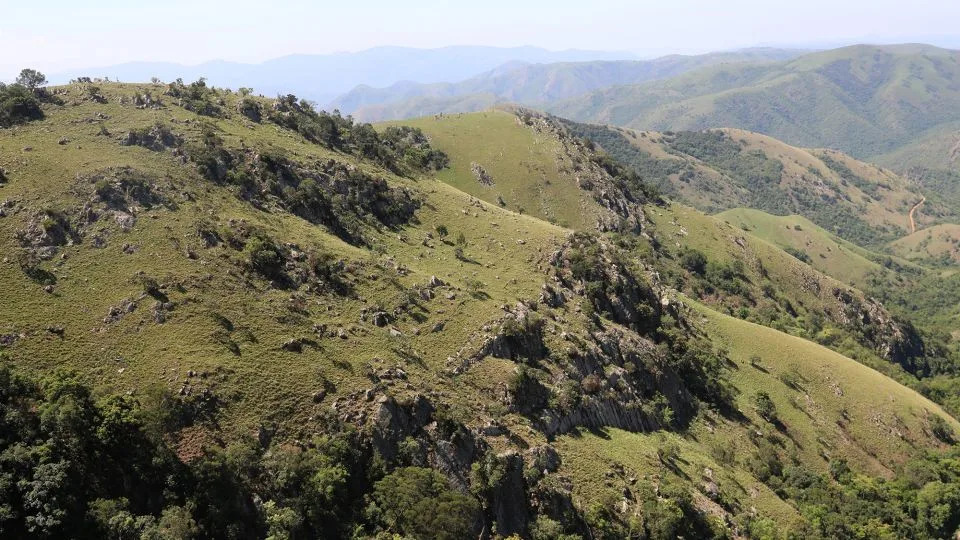
Located on the Barberton Greenstone Belt, the Barberton Makhonjwa Mountains in northeastern South Africa are some of the oldest geological formations in the world. - Murat Ozgur Guvendik/Anadolu Agency/Getty Images
That conclusion addresses a major debate in Earth science. Some researchers have argued for very early plate motions (as far back as 4.4 billion years ago), while others propose that modern-style plate tectonics began much later or evolved through intermediate regimes (episodic plates or a single rigid lid). This study provides direct, time-constrained paleomagnetic evidence of relative motion around 3.5 billion years ago, a time when simple microbial life was already present on Earth.
Expert Reaction and Significance
Independent scientists praised the dataset's size and quality for rocks of this age. Uwe Kirscher of Curtin University, who was not involved in the research, highlighted the importance of showing relative motion — one region moving while another stayed put — as a key stepping stone in Earth’s transition to sustained plate tectonics. The findings have implications for early climate, geochemical cycles, continental formation and the environments that supported early life.
Study Details: Published in Science (March 19). Site: East Pilbara Craton, Western Australia. Samples: ~900, spanning ~30 million years. Lead researchers: Roger Fu and Alec Brenner.
Help us improve.