A 3D thermal model in Nature Communications suggests parts of Earth's crust cooled and remained continuously stable after about 4.4 billion years ago, creating expanding "never-sterilized" zones. The study, co-led by Oleg Abramov, identifies an optimal window near 4.33 billion years ago when fragile prebiotic molecules could persist long enough for complex chemistry. The work models impact heating from 4.5–3.5 billion years ago but does not claim life existed then—it identifies when conditions may have become suitable.
3D Thermal Model Suggests Earth May Have Been Ready For Life By ~4.33 Billion Years Ago

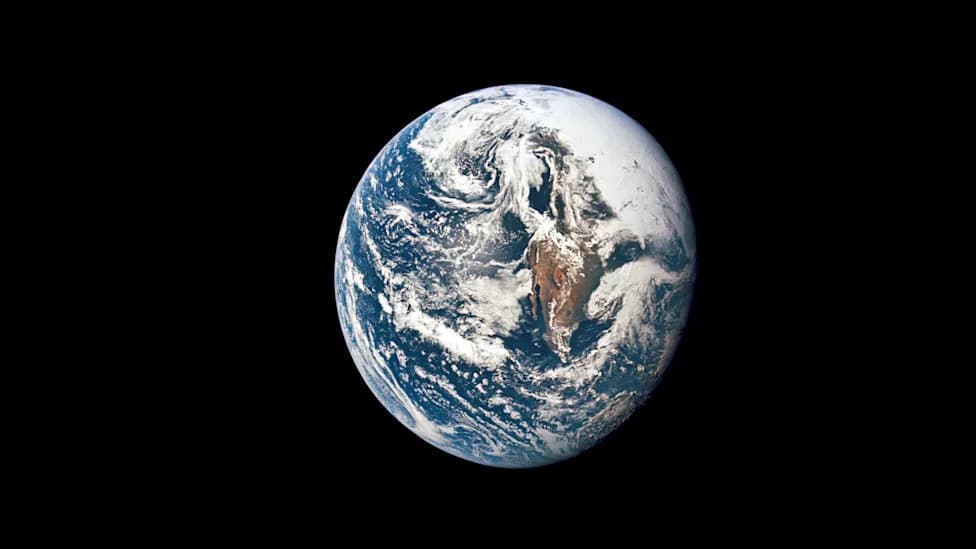
Models suggest stable environments for prebiotic chemistry emerged around 4.33 billion years ago as devastating impacts declined. (CREDIT: Shutterstock)
A new three-dimensional thermal reconstruction indicates that parts of the early Earth's crust cooled and remained stable long enough for fragile prebiotic molecules to persist as early as roughly 4.33 billion years ago. The study, published in Nature Communications and co-led by Planetary Science Institute senior scientist Oleg Abramov, models how impact bombardment heated and reshaped the shallow crust between about 4.5 and 3.5 billion years ago.
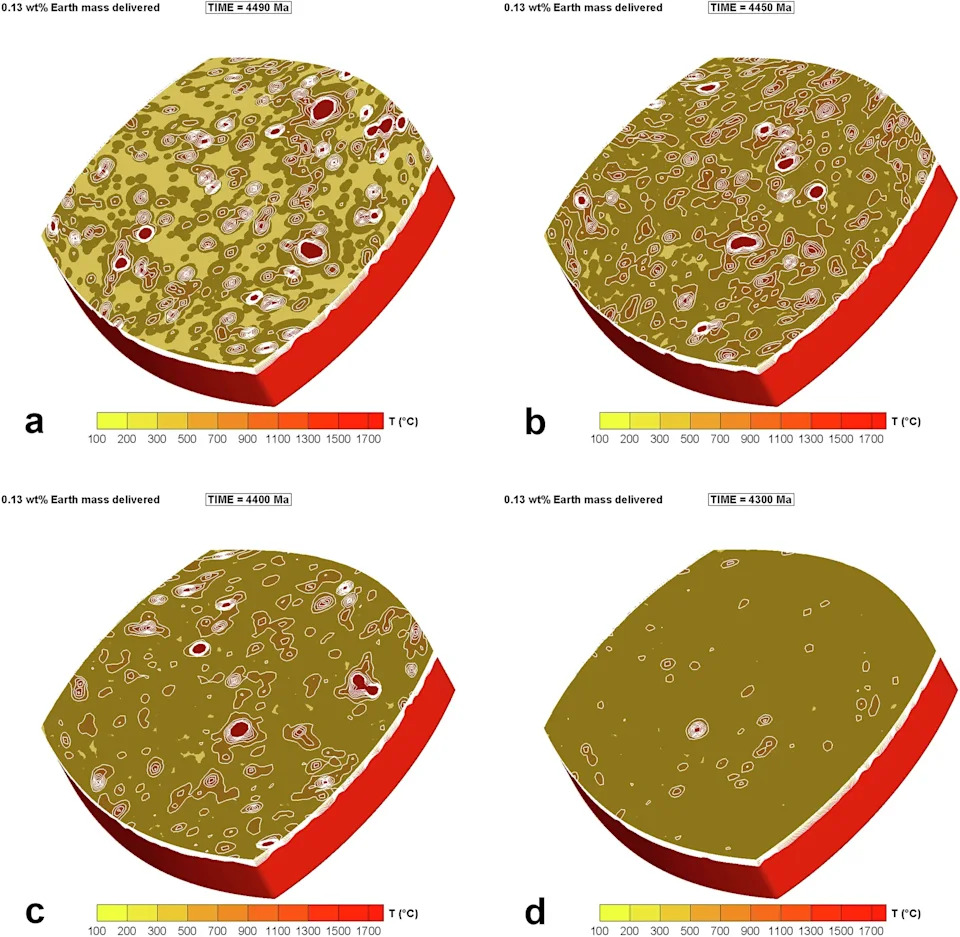
Thermal modifications to the Hadean crust from impact bombardment. (CREDIT: Oleg Abramov et al, Nature Communications 2026)
Study Approach
The researchers built a 3D thermal model to simulate how repeated asteroid, comet and planetesimal impacts—especially during the so-called late accretion period after the Moon-forming collision—changed crustal temperatures through time. They constrained the impact history using multiple lines of evidence, including the Moon's crater record and abundances of highly siderophile elements in Earth's mantle. The simulated crustal temperatures were then compared with experimentally and theoretically derived stability limits for key prebiotic molecules (for example, RNA components, peptides and lipids).
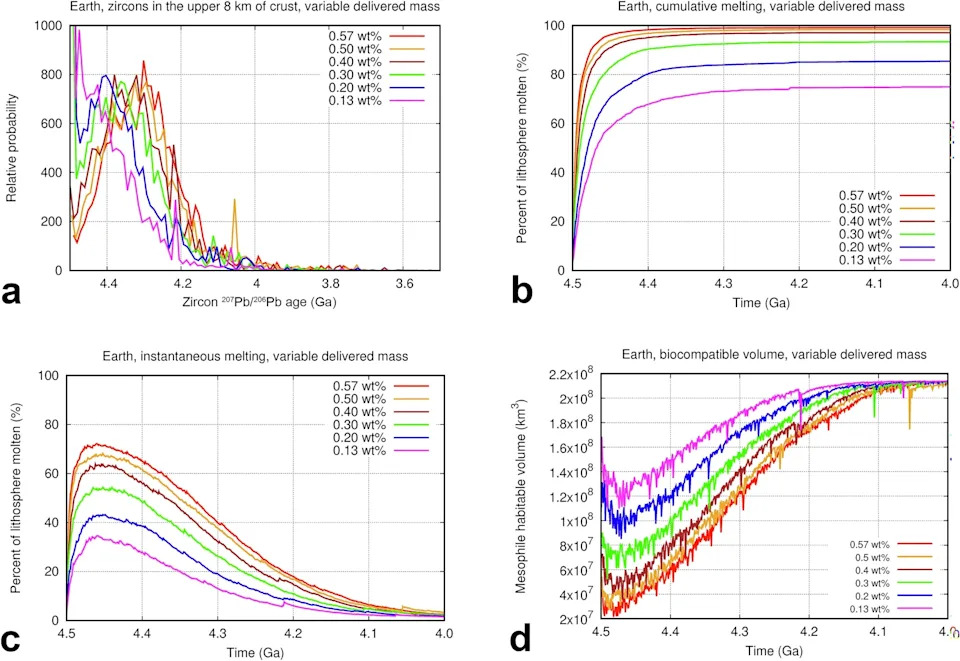
Consequences of late accretion to the Hadean crust. (CREDIT: Oleg Abramov et al, Nature Communications 2026)
Key Findings
The simulations reveal a transition after about 4.4 billion years ago: the largest impacts became less likely to uniformly reheat the entire shallow crust, while impact-generated hydrothermal systems—potentially favorable for some prebiotic pathways—remained common. The team identifies a growing volume of crustal regions that, once they cooled below critical temperature thresholds, were not reheated by subsequent modeled impacts. The authors term these "never-sterilized" regions.
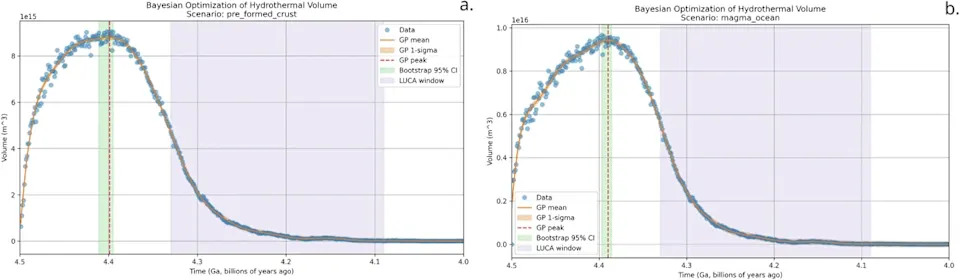
Biocompatible volume (
"These criteria point to the Earth becoming suitable for an early stage of life between 4.4 billion and 4.3 billion years ago, with optimal conditions at approximately 4.33 billion years ago," Abramov said.
Implications
These results do not demonstrate that life existed at that time. Rather, they identify when environmental continuity—one essential ingredient for prebiotic chemistry—may have become widespread enough for delicate molecular building blocks to survive and interact over long periods. By expanding the volume of "never-sterilized" crustal areas while hydrothermal systems persisted, the modeled environment could have provided both stable niches and dynamic energy/chemistry sources favorable to increasingly complex chemistry.
Limitations and Caveats
The conclusions depend on model assumptions about impact flux, thermal properties of the early crust, and temperature thresholds chosen for molecular stability. Real early-Earth environments were heterogeneous, and local conditions (e.g., water availability, chemical composition, and surface vs. subsurface settings) also matter for prebiotic chemistry. The study reframes the origin-of-life timeline from a planetary-physics perspective rather than providing direct biological evidence.
Bottom line: The 3D thermal model identifies a plausible window—centered near 4.33 billion years ago—when parts of Earth's crust may have become continuously hospitable long enough for fragile prebiotic molecules to persist, marking an early potential milestone on the path toward life.
Help us improve.