At a March 7 summit, President Trump urged a Latin American military coalition to target cartels, but experts warn that leader-focused operations often fuel violence and fragmentation. The death of CJNG boss El Mencho triggered deadly reprisals and highlights how cartels diversify into mining, agriculture and legitimate businesses. Reports from ACLED, UNODC and GI-TOC point to high homicide rates, prison-based gang growth, porous borders and pervasive corruption. Analysts recommend pairing law-enforcement actions with anti-corruption measures, better border controls, prison reform and demand-reduction strategies.
Experts Warn Military Crackdown Could Backfire After Trump’s Call For Latin American Coalition Against Cartels
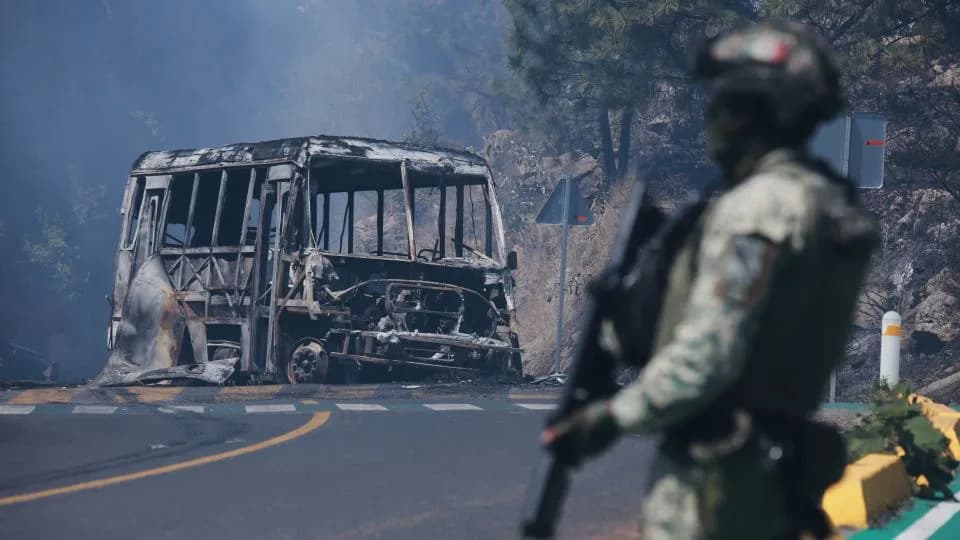
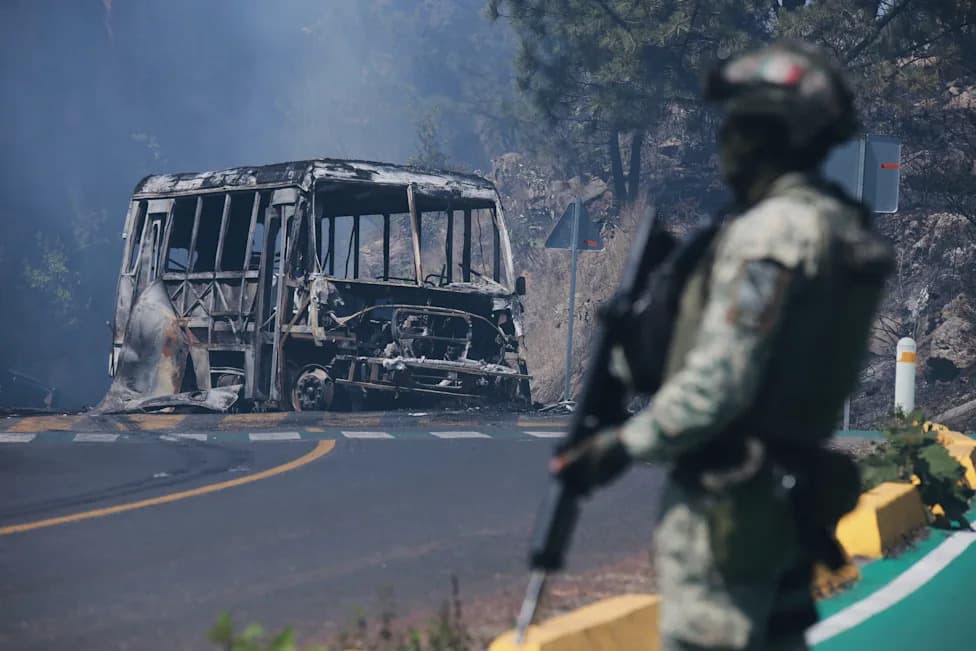
A soldier stands guard by a charred vehicle after it was set on fire, in Cointzio, Michoacán state, Mexico, Sunday, Feb. 22, 2026, following the death of the leader of the Jalisco New Generation Cartel, Nemesio Oseguera, known as "El Mencho." - Armando Solis/AP
President Trump’s March 7 Shield of the Americas Summit at his Doral golf club urged a Latin American military coalition to confront drug cartels. But analysts and regional experts warn that a strategy focused on decapitation — removing cartel leaders — often fuels violence, fragmentation and new criminal enterprises rather than eradicating trafficking.
El Mencho’s Death and Its Fallout
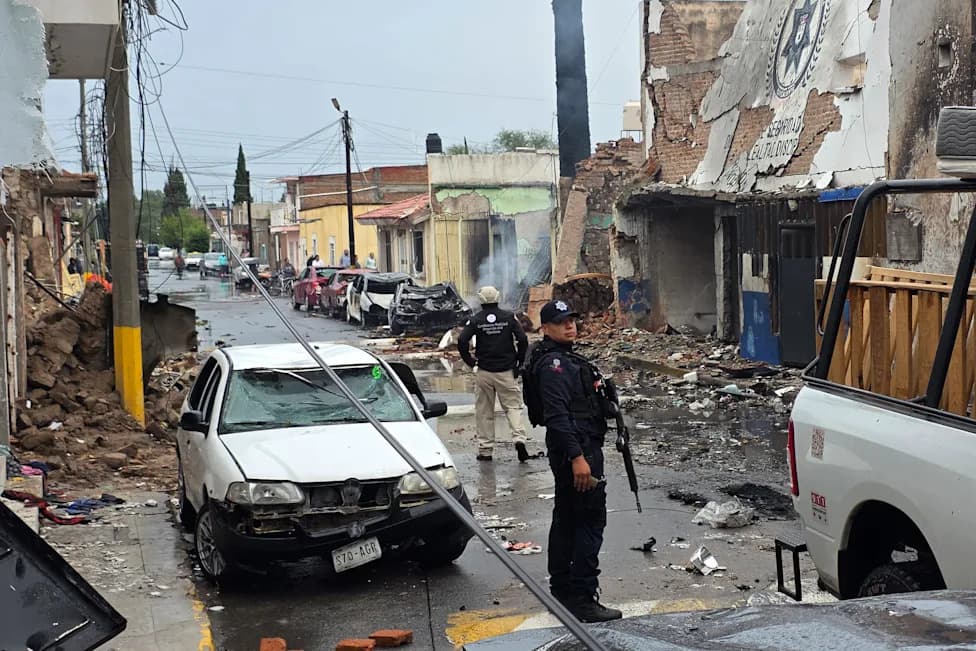
Last month’s operation that mortally wounded Nemesio Oseguera Cervantes, known as El Mencho, illustrates the risks. Mexican authorities say his death sparked violent reprisals across Mexico that left about 60 people dead and raised the prospect of a brutal power struggle inside the Jalisco New Generation Cartel (CJNG). Analysts say such leadership vacuums commonly prompt splintering, turf wars and greater instability.
Why Decapitation Strategies Often Fail
“Where there are many groups disputing territory, disputing businesses, that’s where violence is exacerbated and these autonomous units start to form,” said sociologist Marcelo Bergman. “These groups end up fighting among themselves, carrying out executions, extorting, creating panic in societies.”
Experts point to several mechanisms that blunt the effectiveness of leader-focused strikes: ready replacement candidates, fragmentation into smaller violent gangs, and expansion of criminal portfolios into legal and quasi-legal businesses.
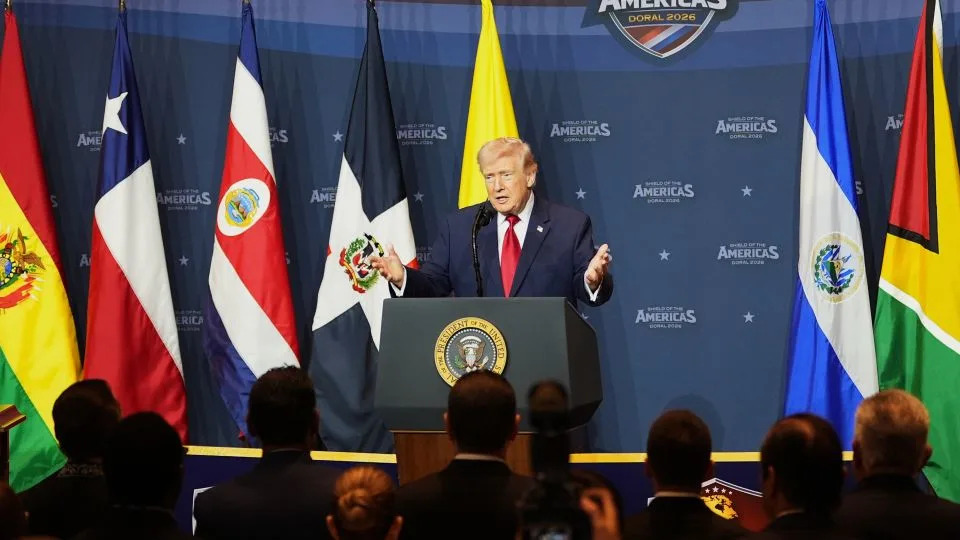
President Donald Trump speaks at the Shield of the Americas Summit, Saturday, March 7, at Trump National Doral Miami in Doral, Florida. - Rebecca Blackwell/AP
Diversified, Transnational, and Tech-Savvy Networks
Reports from the Global Initiative Against Transnational Organized Crime (GI-TOC) and others show criminal groups have diversified into illegal gold mining, human trafficking, extortion, money laundering and even legitimate sectors like agriculture and tourism. The CJNG, for example, reportedly extended into mining, avocado production and hotels. Technology — from drones to social media and AI-enabled cyber tools — is accelerating recruitment and cross-border operations.
Regional Trends: Prisons, Borders and Corruption
Multiple data sources underline structural problems: the United Nations Office on Drugs and Crime (UNODC) reports that Latin America and the Caribbean account for roughly 9% of the world’s population but nearly one-third of global homicides, with an estimated 40% linked to organized crime. The monitoring group ACLED recently ranked Ecuador among the world’s most violent countries after a surge in gang violence and shocking incidents such as the discovery of severed heads on a beach in Puerto López.
Prisons are frequently incubators for gangs — examples include Venezuela’s Tren de Aragua (originating in Tocorón prison), Brazil’s Red Command and First Capital Command, and Ecuador’s Los Choneros and Los Lobos — with overcrowding across nearly every country creating opportunities for criminal networks to recruit and operate from behind bars.
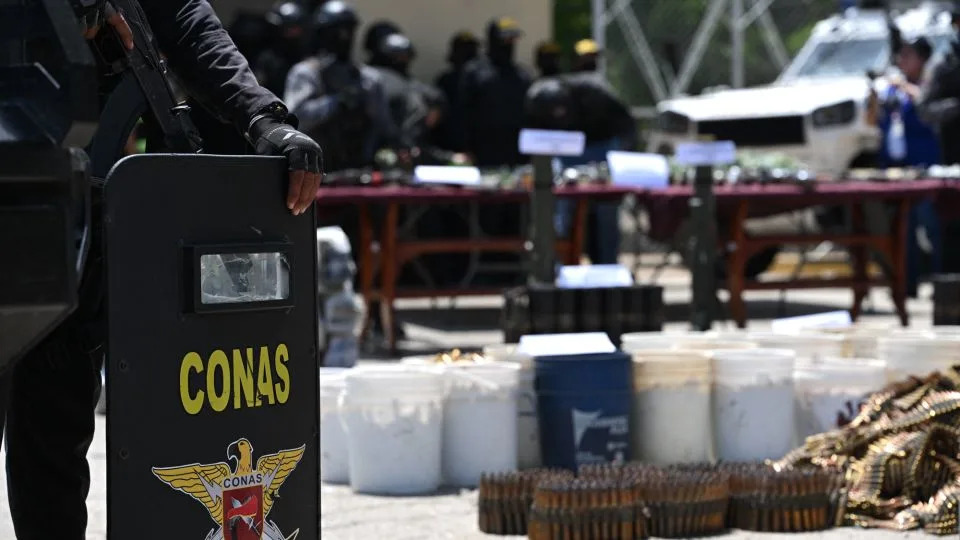
A member of the Anti-Extortion and Kidnapping Group (CONAS) stands guard as confiscated weapons and ammunition are displayed during a press conference after authorities seized control of the prison in Tocoron, Aragua State, Venezuela, on September 21, 2023. - Yuri Cortez/AFP/Getty Images
Porous frontiers also help traffickers. The Colombia–Ecuador border stretches about 364 miles (586 km) and has more than 70 irregular crossings, enabling criminal groups to substitute for weak state presence. Corruption inside law enforcement and judicial institutions further erodes state capacity to respond effectively.
What Experts Recommend
Analysts argue that military and police measures should be paired with broader reforms:
- Target corruption to remove criminal influence from state and judicial institutions.
- Improve border controls and customs capacity to disrupt trafficking ecosystems rather than just individual actors.
- Address demand for drugs through prevention and treatment programs, which reduce the profitability of trafficking.
- Reform prisons to prevent gangs from forming and running operations from inside.
Conclusion
The Greek myth of the Hydra — a many-headed serpent that regrew heads when one was cut off — is a frequent metaphor for organized crime. In the myth, Hercules succeeds only with Iolaus’ help, who cauterizes each stump to stop regrowth. In Latin America, experts say an effective response will similarly require coordinated, multi-pronged efforts that "cauterize" the underlying conditions (corruption, impunity, porous borders, demand) that allow criminal groups to regrow and expand — not only military action.
Help us improve.