Researchers have identified cinnabar (mercury sulfide) in a 1,900‑year‑old double burial of two Scythian women at Chervony Mayak in southern Ukraine. The study, published in Antiquity (2025), is the first chemical confirmation of cinnabar in a Late Scythian grave. The deep‑red pigment may have served symbolic and cosmetic roles and possibly helped slow decay when tombs were reopened for secondary burials. Only three of 177 graves at the site contained cinnabar, all associated with female burials.
Toxic Vermilion Found in 1,900‑Year‑Old Scythian Double Burial in Ukraine
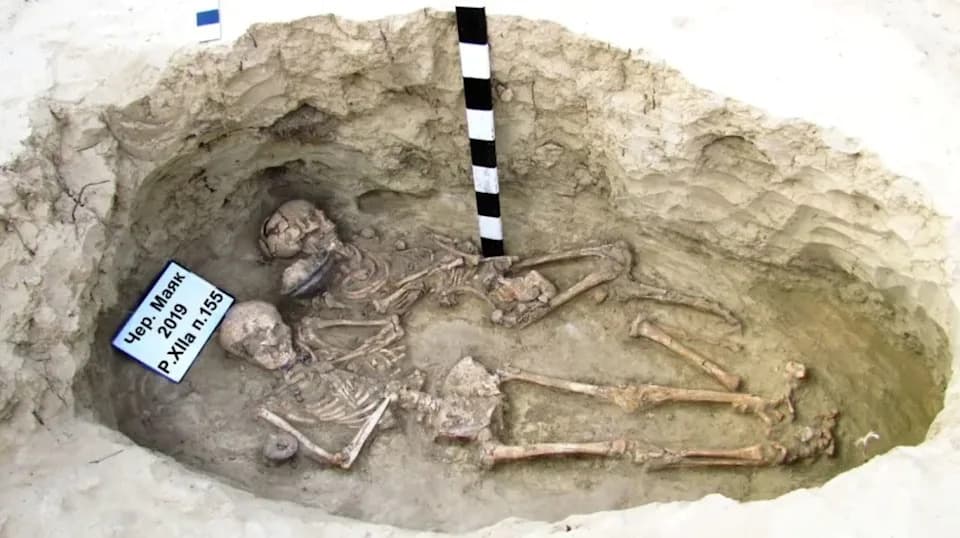
The cinnabar lumps were found in the grave of two Scythian women at the Chervony Mayak burial ground. | Credit: B. Polit/Late Scythian Archaeological Expedition, Institute of Archaeology, National Academy of Sciences of Ukraine
Archaeologists working at the Late Scythian cemetery of Chervony Mayak in southern Ukraine have chemically identified lumps of cinnabar — the deep‑red mineral form of mercury sulfide, long used as the pigment vermilion — in a 1,900‑year‑old double burial, a study published in Antiquity (2025) reports.
The burial and the discovery. The tomb contained the remains of two women: one aged about 35–45 and a younger woman aged 18–20, the latter apparently interred later as a secondary burial. Both individuals were buried with typical grave goods such as beads, pottery and metal objects. Although red lumps had been noted at Chervony Mayak since 2011, this is the first study to identify those lumps chemically as cinnabar and the first confirmed instance in a Late Scythian burial.
Possible uses and cultural context. Cinnabar (vermilion) has a long prehistoric history in Europe as a pigment for body paint, ritual use and art. At Chervony Mayak the researchers suggest several possible roles: a symbolic ‘flush’ of life applied to the dead, a cosmetic associated with female burial assemblages, and — plausibly — a practical agent to slow bacterial decay when graves were reopened to add later interments. Field evidence indicates some Scythian crypts were reused for decades; as lead author Olena Dzneladze notes, one crypt could serve for up to 50 years with secondary and tertiary burials.
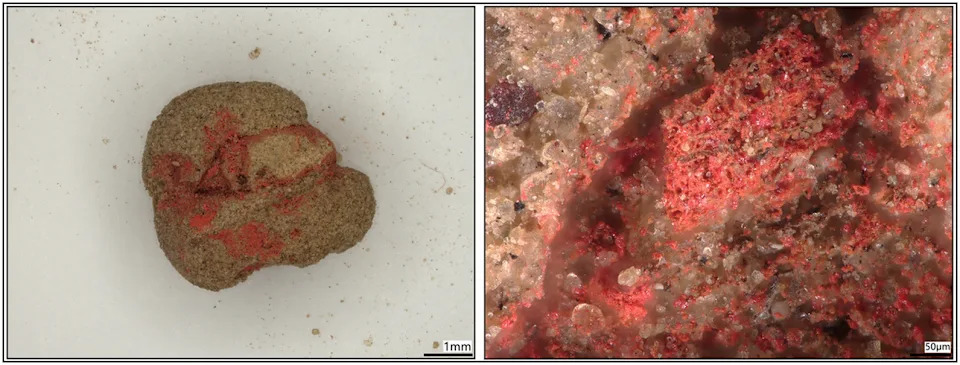
The cinnabar in the grave and may have slowed decay so that more bodies could be buried there, or it may have been used as a cosmetic. | Credit: A. Kurzawska/Late Scythian Archaeological Expedition, Institute of Archaeology, National Academy of Sciences of Ukraine
Toxicity and health implications. Cinnabar is mercury sulfide and can be hazardous: heating or grinding it can release mercury vapor, which can lead to mercury poisoning with symptoms such as tremors and respiratory problems. Archaeological cases show elevated mercury levels in bones of people frequently exposed to cinnabar. The study's authors caution that Scythians who used cinnabar in the first century A.D. may not have understood its toxicity.
Distribution and interpretation. Only three of the 177 graves examined at Chervony Mayak contained cinnabar deposits, and Scythian burials at other sites have rarely yielded the mineral. The team suggests cinnabar may sometimes have been recorded merely as "red pigment" or "ocher" in older reports without chemical analysis, so it could be underreported. Notably, all three cinnabar‑bearing graves at this site belonged to women, supporting the idea of a gendered or cosmetic association within the local mortuary tradition.
"Often in archaeological field reports and publications we read a small description that 'red pigment,' 'a piece of ocher' or 'blush' was found in the burial, [but] without clarification and analysis," Dzneladze told Live Science. "These could be different substances."
Broader perspective. Independent experts note that cinnabar has been used in prehistoric Europe and later in medieval medicine. Colorants such as cinnabar and ochre appear in funerary contexts going back to the Mesolithic, showing a long cultural affinity for red pigments in burial rituals across millennia.
What this means. The chemical identification of cinnabar in a Late Scythian tomb adds a new detail to our understanding of Scythian mortuary practice, gendered grave goods, and the complex interplay of symbolic and practical motives behind pigment use — while also reminding researchers to test and specify pigments rather than assume ochre or generic "red" materials.
Help us improve.