Purdue researchers developed an IZUMO1‑based immunocontraceptive that significantly lowered fertility in CD‑1 mice, especially when formulated with the NanoST nanoparticle adjuvant. NanoST formulations cut pregnancy rates and pup numbers by more than half in some experiments, while AddaS03 was less effective in lower‑dose schedules. Epitope mapping linked efficacy to antibodies against a beta‑hairpin hinge (amino acids 148–173) of IZUMO1, suggesting antibody specificity is critical. The team plans single‑dose, controlled‑release delivery and is testing the vaccine in a multi‑year BLM horse trial.
IZUMO1 Contraceptive Vaccine Slashes Mouse Fertility — A Promising, Humane Tool for Wildlife Management

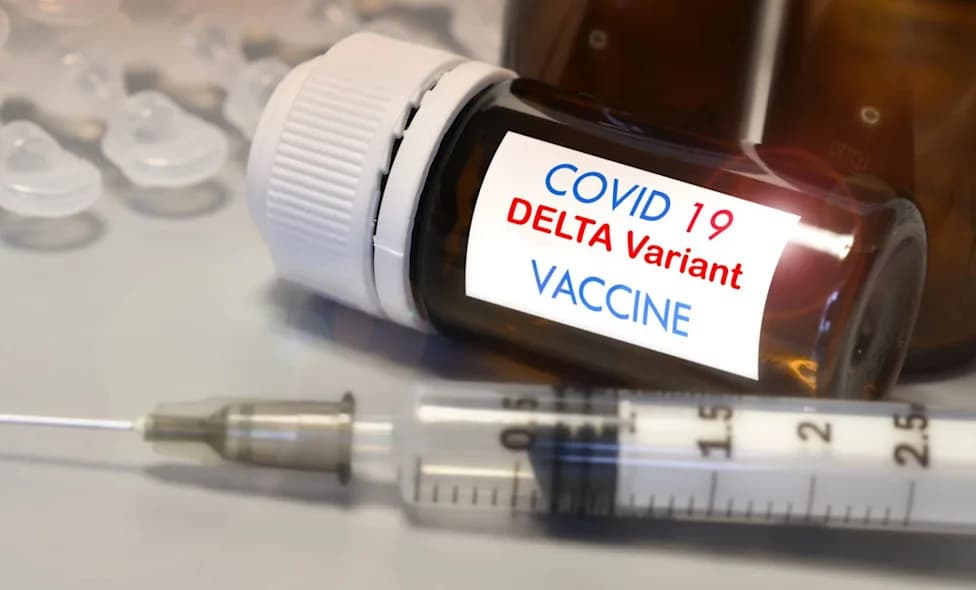
Purdue’s IZUMO1 vaccine cut fertility in mice, aiming for humane control of feral horses, deer, and other wildlife. (CREDIT: Wikimedia / CC BY-SA 4.0)
Purdue University researchers report a new immunocontraceptive vaccine built on the sperm protein IZUMO1 that sharply reduced fertility in early mouse trials — a potential step toward humane, single-dose contraceptives for free‑ranging wildlife such as feral horses, deer and wild pigs.
What the Team Did
The study, led by Dr. Harm HogenEsch and Dr. Raluca Ostafe and published Feb. 6 in the journal Vaccine, tested recombinant mouse IZUMO1 produced in Chinese hamster ovary (CHO) cells (≈30 kDa) and formulated it with different adjuvants. The researchers verified the protein by SDS–PAGE and western blot, then evaluated fertility outcomes and immune responses in outbred CD‑1 mice — a demanding model chosen for its robust reproductive performance.

Purdue University researchers Dr. Raluca Ostafe and Dr. Harm HogenEsch have developed a vaccine that induces a robust and long-lasting immune response and infertility in female mammals to address animal overpopulation. (CREDIT: Purdue University/Ed Lausch)
Adjuvants and Formulations
Two adjuvant systems were compared:
- AddaS03 — a squalene oil‑in‑water emulsion containing alpha‑tocopherol and polysorbate 80, compositionally similar to the human influenza adjuvant AS03.
- NanoST — a nanoparticle platform of modified phytoglycogen particles combined with ADU‑S100, a synthetic cyclic dinucleotide that activates the STING innate‑immune pathway.
Key Findings
Fertility was judged by pregnancy rates and pup counts after immunization. In a three‑dose schedule (days 0, 28, 56) the control group (Tris‑saline) produced 70 pups across six dams (all six pregnant). Results included:
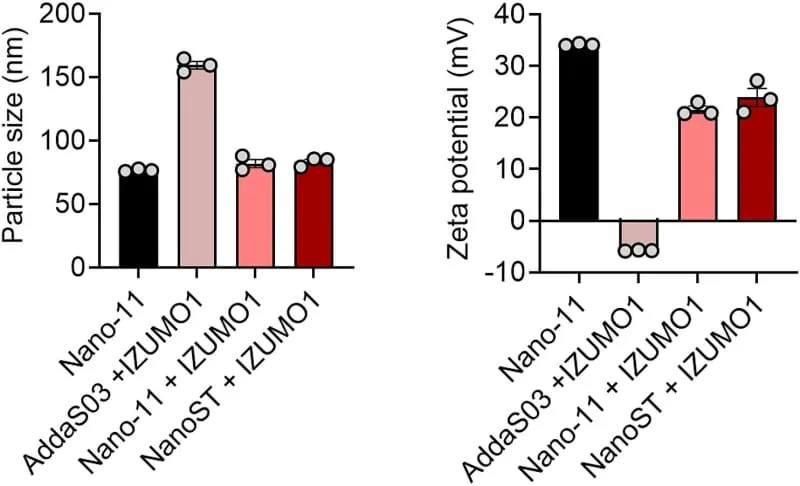
Physical characterization of NanoST and IZUMO1-based immunocontraceptive vaccine formulations. (CREDIT: Vaccine)
- IZUMO1 + AddaS03: 4 of 6 dams pregnant; 40 total pups (≈43% reduction vs. control).
- IZUMO1 + NanoST: 3 of 6 dams pregnant; 17 total pups (≈76% reduction vs. control).
- IZUMO1 + NanoST + AddaS03: 2 pregnancies; 25 pups.
In a two‑dose regimen, AddaS03 failed to reduce fertility (5 of 6 pregnant, 66 pups vs. 5 of 6 and 63 pups in controls), while NanoST formulations again reduced pregnancy rates and pup numbers by more than half in some groups (e.g., 2 of 6 pregnant; 24 pups).
Immune Correlates and Epitope Mapping
All vaccinated animals developed robust anti‑IZUMO1 IgG in serum and increased IZUMO1‑specific IgG1/IgG2a in reproductive tract fluids. However, overall antibody titers did not fully predict contraceptive effect. Epitope mapping revealed a clear pattern: sera from infertile, immunized mice bound strongly to peptides 7–9 (amino acids 148–173), a beta‑hairpin hinge region of IZUMO1 implicated in binding to the egg receptor JUNO. This suggests that antibody specificity — targeting critical functional epitopes — mattered more than simple antibody quantity.
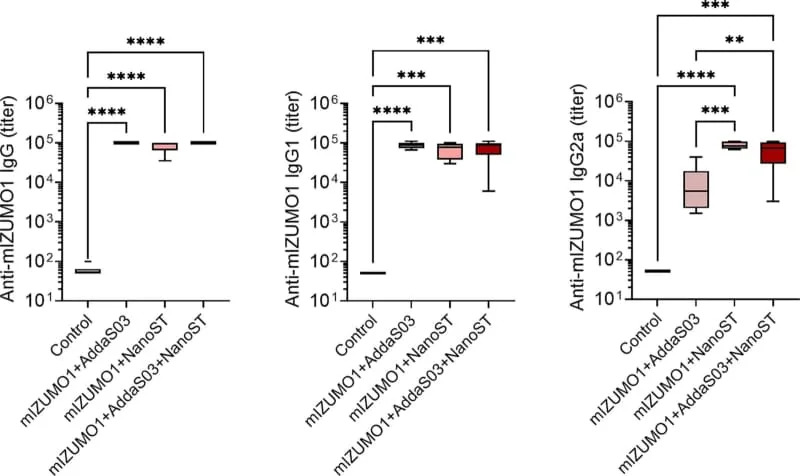
Increased serum anti-IZUMO1 IgG, IgG1 and IgG2a in mice immunized with IZUMO1 with AddaS03™, with NanoST, or with a combination of NanoST and AddaS03™. (CREDIT: Vaccine)
Limitations and Safety Considerations
The authors note several limitations: the peptide array covered only parts of the IZUMO1 construct and assessed linear epitopes (conformational epitopes may also be important). They also emphasize safety: older adjuvants like Freund’s can cause severe local reactions (necrosis, granulomas, abscesses), so the study prioritized adjuvants selected for broader tolerability.
Next Steps
HogenEsch and colleagues aim to develop a single‑dose, controlled‑release formulation (critical for wildlife where boosters are impractical), optimize dart or remote delivery, and explore oral options. Separately, the team completed year one of a three‑year Bureau of Land Management (BLM) trial in horses to evaluate real‑world performance and safety. Funding came from Humane World for Animals (formerly The Humane Society of the United States) and the Elinor Patterson Baker Trust.
Bottom line: An IZUMO1‑based vaccine, particularly when paired with the NanoST adjuvant, produced substantial reductions in mouse fertility and highlighted the importance of targeting a key IZUMO1 hinge epitope (aa 148–173). The approach shows promise as a humane wildlife contraceptive pending further optimization and field testing.
Help us improve.