Researchers used a folic-acid-modified dendrimer to deliver niclosamide into FRβ-positive macrophages and observed reduced lesion burden and lower pain-related sensitivity in a mouse model of endometriosis. One injection produced fewer and smaller lesions after two weeks, with 4/8 mice lesion-free at the lower dose and 5/8 at the higher dose. The study is preclinical, with small groups and short follow-up, and additional testing is needed before human trials.
Tapeworm Drug Niclosamide, Carried by a Dendrimer, Reduces Endometriosis Lesions and Pain in Mice

(MementoJpeg/Moment/Getty Images)
Researchers report that a modified form of the anti-tapeworm drug niclosamide, delivered directly into immune cells by a targeted dendrimer carrier, reduced lesion size and pain-related sensitivity in a mouse model of endometriosis. The experimental approach aims to concentrate the drug in a subgroup of macrophages that express folate receptor beta (FRβ) and may support abnormal tissue growth.
Why This Matters
Endometriosis occurs when tissue similar to the uterine lining grows outside the uterus, causing chronic pelvic pain, painful periods, inflammation and infertility in roughly one in 10 people of reproductive age. Current treatments—hormonal therapies and surgery—can help but often do not provide lasting relief, and there is no cure.
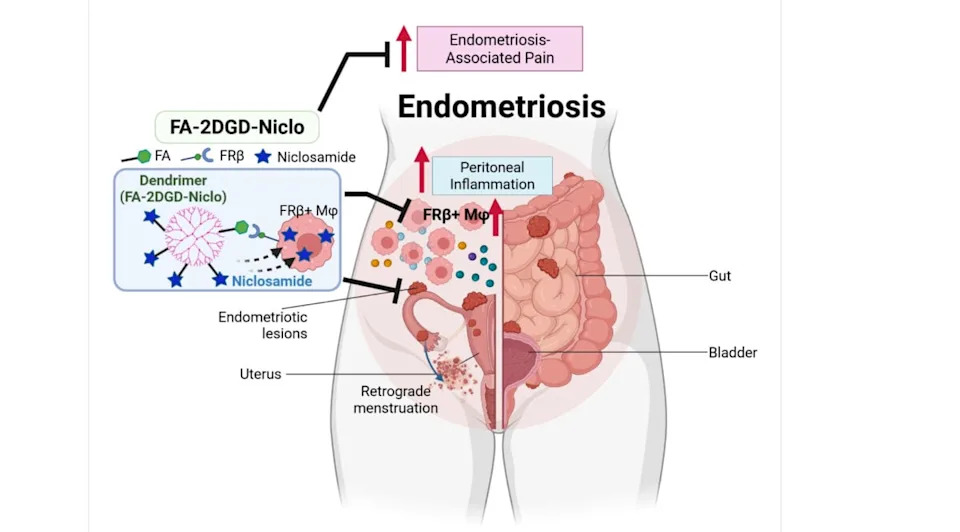
The experimental approach uses a molecular carrier to deliver niclosamide to specific immune cells associated with endometriosis. It has been tested in mice. (Image supplied by Kanako Hayashi)
Targeting Macrophages With a Dendrimer
Previous studies linked a subgroup of macrophages to lesion maintenance. These macrophages carry FRβ, a surface protein that the research team used as a delivery target. Investigators from Washington State University, the University of Michigan and the University of Florida synthesized a small, branching polymer called a dendrimer, attached folic acid to guide it to FRβ-positive macrophages, and chemically linked niclosamide to the carrier with a bond intended to release the drug after uptake by cells.
Advantages of the Approach
Niclosamide is an approved anti-parasitic with poor water solubility and low oral bioavailability, which has limited its repurposing for chronic conditions. The dendrimer strategy was designed both to improve apparent solubility and to localize drug delivery to target immune cells, potentially lowering required dosing frequency and reducing off-target side effects.
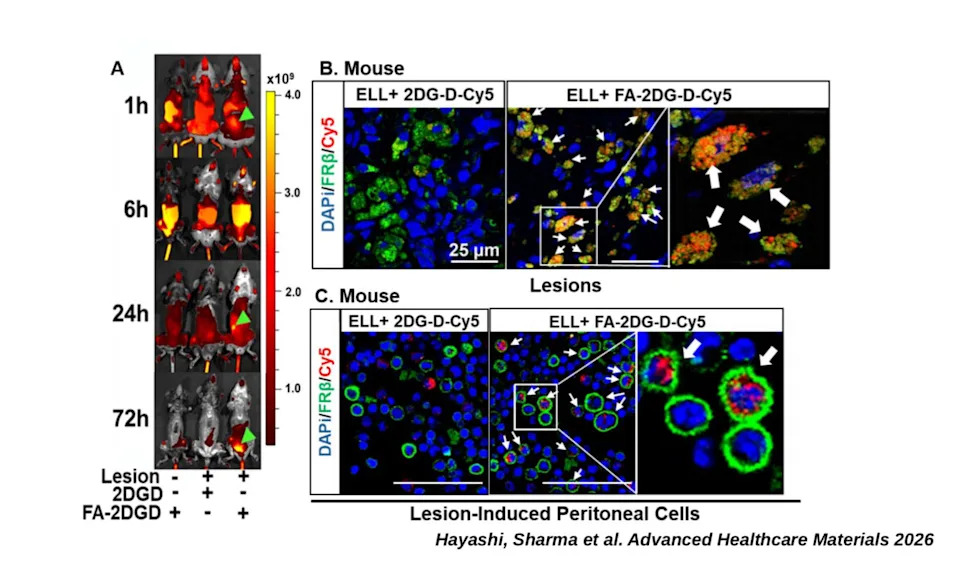
Fluorescence imaging tracks the experimental carrier in mice and shows its uptake by targeted immune cells. Blue marks cell nuclei, green marks FRβ, and red marks the labeled carrier. (Hayashi, Sharma et al.,Advanced Healthcare Materials, 2026)
What the Mouse Study Found
The team induced endometriosis-like lesions in mice by injecting uterine lining tissue into the abdominal cavity. Seven days later the animals received a single injection: either the carrier alone (control) or the carrier linked to niclosamide at one of two doses. Results were assessed two weeks after dosing.
- Mice that received dendrimer-delivered niclosamide had fewer and smaller lesions than controls.
- In the lower-dose group, 4 of 8 mice had no detectable lesions at the two-week assessment; in the higher-dose group, 5 of 8 mice were lesion-free at that time point.
- Both treatment doses reduced heightened pain-related sensitivity measured by calibrated filament withdrawal tests on the abdomen and hind paws.
Limitations and Next Steps
These findings are preclinical. The study used small groups (eight mice per treatment arm) and a single treatment with only two weeks of follow-up. It did not evaluate long-term benefits, repeated dosing safety, or effectiveness in humans. The authors emphasize that additional preclinical work and regulatory steps are required before clinical trials could begin.
Endometriosis is a chronic disease. Patients suffer from the symptoms (such as chronic pelvic pain) for multiple decades.
Since publication, members of the patient community have expressed interest in future trials, underscoring urgent demand for new therapies. Several authors, including Kanako Hayashi and Anjali Sharma, disclosed pending patents and invention disclosures related to the dendrimer technology.
Bottom line: Targeted dendrimer delivery of niclosamide shows promising early effects against lesions and pain sensitivity in mice, but further research is needed to establish safety, dosing schedules, and benefit in people.
Help us improve.