The La Jolla Institute team found that four fusion‑loop substitutions in a candidate Zika vaccine shifted protection from neutralizing antibodies to CD8+ T cells in mice. That CD8‑mediated protection controlled infection shortly after vaccination but largely disappeared by 12 weeks, while an unmodified vaccine that induced both neutralizing antibodies and T cells remained durable. The mutations disrupted prM cleavage and vaccine‑particle maturation, reducing neutralization of mature Zika virions and highlighting a trade‑off between reducing ADE risk and preserving long‑term antibody immunity.
Tiny Zika Vaccine Change Shifted Protection to CD8 T Cells — But It Sacrificed Long‑Term Immunity

Fusion-loop mutations shifted Zika vaccine protection onto CD8 T cells while weakening antibodies against mature virus. (CREDIT: La Jolla Institute for Immunology)
Researchers at the La Jolla Institute for Immunology report that four deliberate substitutions in a candidate Zika vaccine unexpectedly shifted protection from neutralizing antibodies to virus‑killing CD8+ T cells in mice — producing strong short‑term control of infection but poor durability by 12 weeks.
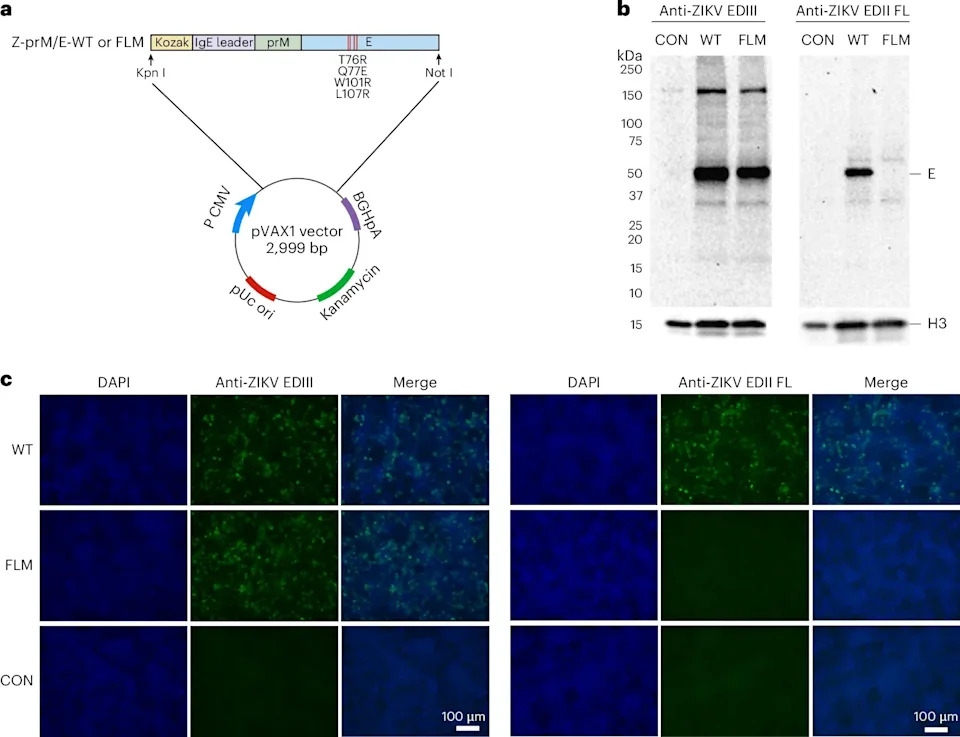
Characterization and validation of Z-prM/E DNA vaccines. (CREDIT: Nature Microbiology)
Study Design and Immediate Results
The team compared two experimental vaccines that express Zika premembrane (prM) and envelope (E) proteins: an unmodified (wild‑type) construct and a fusion‑loop mutant carrying four substitutions (T76R, Q77E, W101R and L107R) intended to reduce antibodies linked to antibody‑dependent enhancement (ADE). Mice received 50 µg of DNA vaccine on day 0 with boosters on days 21 and 35. Two weeks after the final dose, both vaccines protected susceptible mice from a 1,000 focus‑forming unit (FFU) challenge — infectious virus was undetectable in most tissues and viral RNA fell sharply; both also protected against a 1,000,000‑FFU lethal challenge.
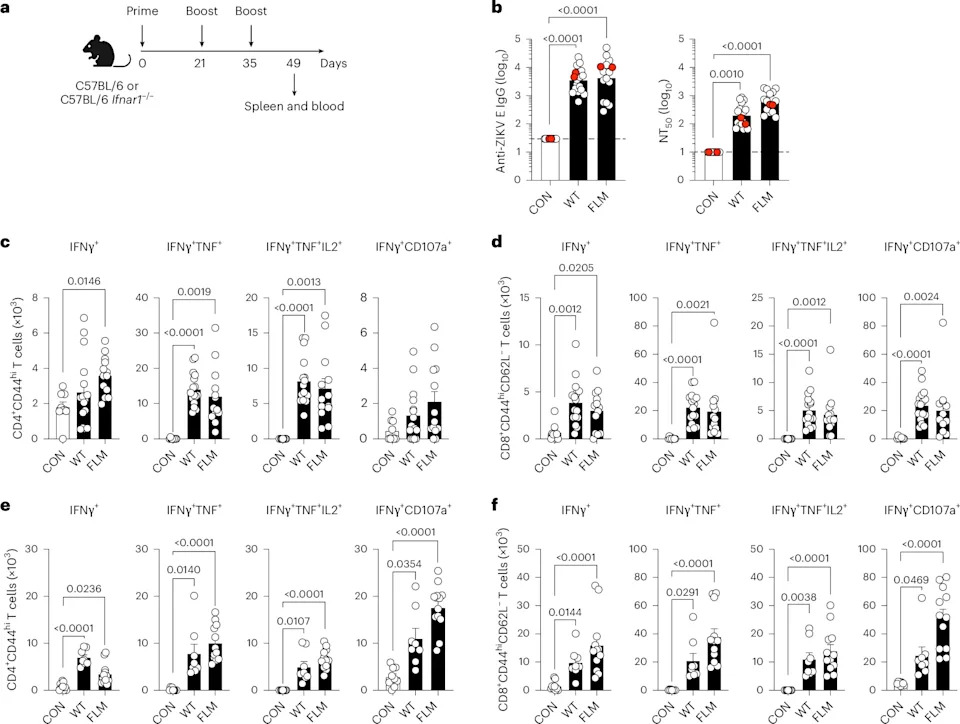
Z-prM/E-WT and Z-prM/E-FLM DNA vaccines induce robust immune responses in C57BL/6-WT and Ifnar1−/− mice. (CREDIT: Nature Microbiology)
Antibodies Versus T Cells
Early immune readouts were similar: both vaccines induced E‑specific antibodies and activated CD4+ and CD8+ T cells. But passive transfer experiments revealed a key difference. Serum from wild‑type–vaccinated mice conferred protection to naïve recipients; serum from fusion‑loop mutant–vaccinated mice did not. That pointed to a non‑antibody mechanism for the mutant vaccine.
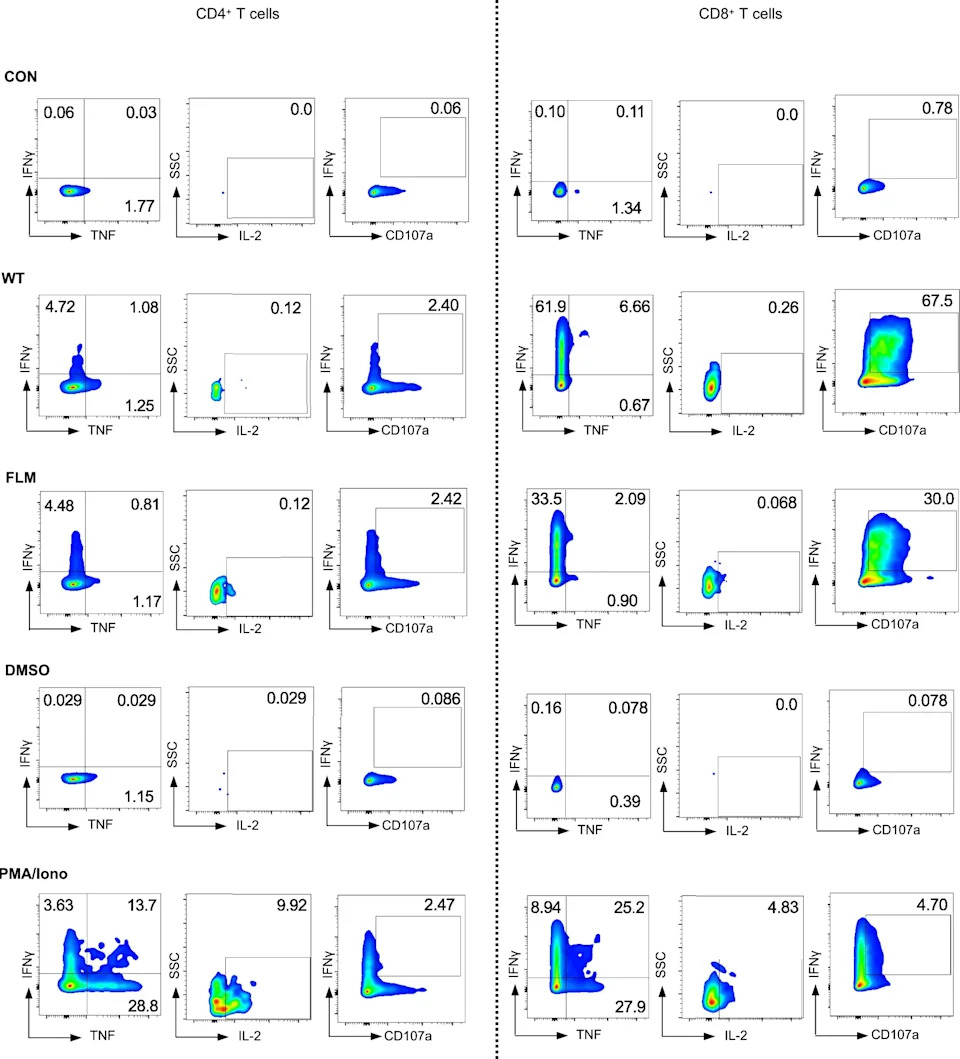
Representative Dot Plots for Cytokine Production Experiments. (CREDIT: Nature Microbiology)
'This vaccine wasn't protecting via antibodies,' said Sujan Shresta of La Jolla Institute for Immunology.
Direct Evidence for CD8+ T Cell‑Mediated Protection
Depleting >99% of CD8+ T cells in mice immunized with the fusion‑loop mutant caused protection to collapse, with significantly higher infectious virus in every tissue examined. Conversely, adoptive transfer of purified CD8+ T cells (≥95% purity) from mutant‑immunized donors reduced infectious virus in liver, testes and serum of unvaccinated recipients. Blocking interferon‑gamma (IFN‑γ) partially impaired CD8‑mediated control, increasing infectious virus in brain, spleen and serum. Together, these experiments show CD8+ T cells were necessary and sufficient for the short‑term protection afforded by the mutant vaccine in this mouse model.
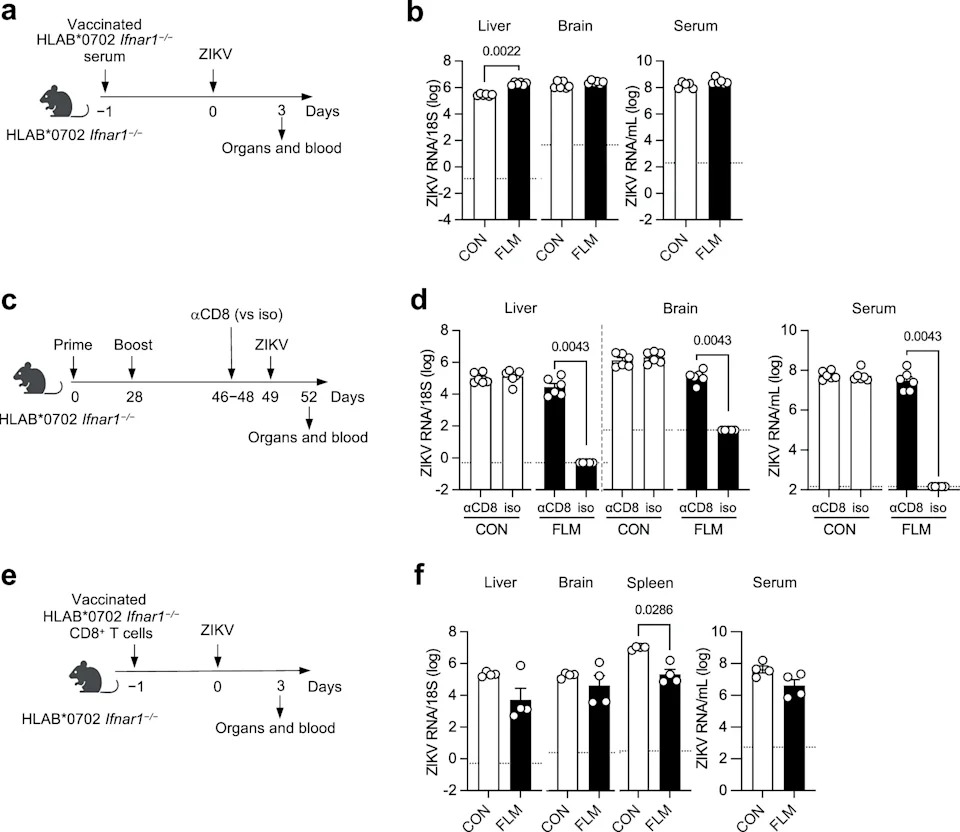
Z-prM/E-FLM RNA Vaccine Mediates Protection via CD8+ T cells in HLA-B*0702 Ifnar1−/− Mice. (CREDIT: Nature Microbiology)
Durability Lost By 12 Weeks
When mice were challenged 12 weeks after the final immunization, the two vaccines diverged. Animals given the unmodified vaccine remained strongly protected: infectious virus stayed virtually undetectable in most tissues. Mice that had received the fusion‑loop mutant, however, displayed readily detectable infectious virus and viral RNA levels not significantly different from unvaccinated controls, indicating the CD8‑centric protection waned and did not provide durable immunity.
Why Antibody Protection Fell Short
Detailed analyses identified an unintended structural consequence of the four substitutions. Initial neutralization assays used Zika produced in mosquito cells, which yields a mixture of mature and immature particles. When tested against mature virus produced in furin‑expressing Vero cells, only 4 of 11 serum samples from fusion‑loop–vaccinated mice showed detectable neutralization and mean neutralizing activity was significantly lower than that induced by the unmodified vaccine. Biochemical data showed virus‑like particles from the mutant vaccine contained mostly uncleaved prM, a hallmark of disrupted maturation. Structural modeling suggested the substitutions altered charge near the furin cleavage site, impairing prM cleavage and reducing the ability to generate antibodies that neutralize mature virions.
Platform Independence and Caveats
The team repeated key experiments with a self‑amplifying RNA (saRNA) version of the fusion‑loop mutant in HLA‑B*0702 Ifnar1−/− mice; protection again depended on CD8+ T cells, indicating the phenomenon was not limited to the DNA platform. The authors emphasize these are mouse experiments — including models with altered interferon signaling — and thus do not directly predict human outcomes.
Implications for Vaccine Design
The findings provide a cautionary lesson: altering or removing antibody targets to reduce ADE risk can change vaccine‑particle structure and maturation, unintentionally undermining generation of durable neutralizing antibodies. The work also underscores the value of measuring T‑cell responses during vaccine evaluation because candidates can appear highly protective shortly after immunization even when antibodies against mature virus are weak. Future work will aim to combine durable T‑cell immunity with safe, effective antibody responses and to explore designs that could protect across related orthoflaviviruses.
Context: Zika remains a public health concern: the World Health Organization reported evidence of current or prior mosquito‑borne transmission in 97 countries and territories as of the end of 2025, though incidence is far below the 2016 peak. The study appears in Nature Microbiology.
Help us improve.