The smallest QR code on record — just 1.977 μm² — was fabricated by a seven-scientist team from TU Wien and Cerabyte and certified by Guinness World Records on 3 December 2025. Using focused ion beams, they etched 49-nanometer pixels into a thin ceramic film, producing a pattern invisible to optical microscopes and the human eye. The readout was independently verified by the University of Vienna, and researchers estimate the technique could encode more than 2 TB of data on a single A4 sheet of ceramic storage medium.
World's Smallest QR Code Is Invisible to the Eye — Just 1.977 μm², Scannable Only by Electron Microscopes
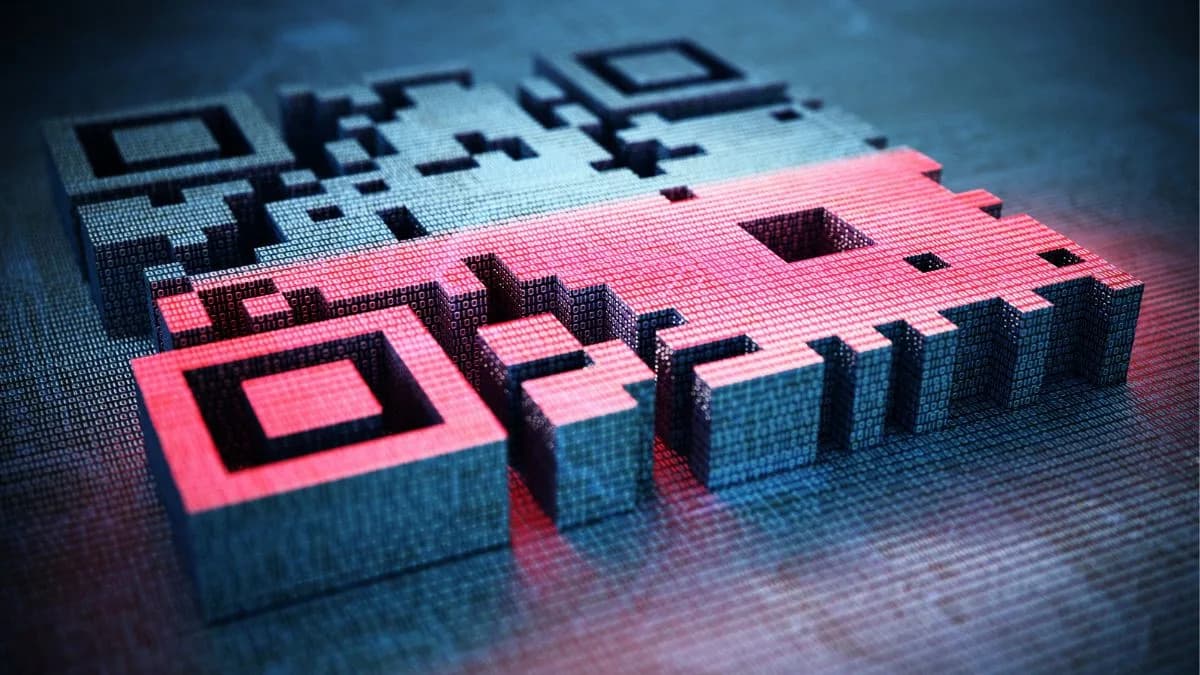
World's Smallest QR Code Is So Tiny It's Invisible to The Human Eye
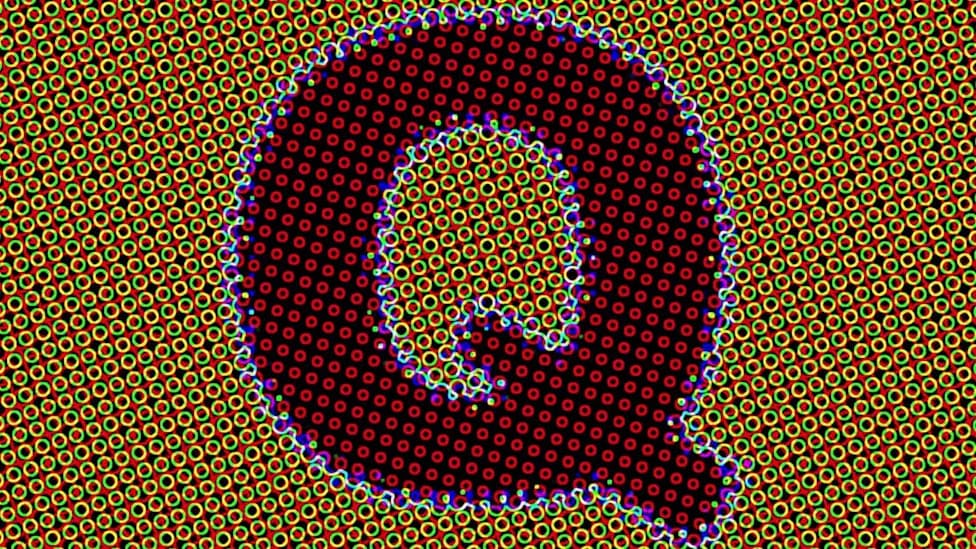
Researchers have produced the smallest QR code on record — a matrix barcode covering only 1.977 square micrometers, so tiny it cannot be seen with the naked eye or an optical microscope and requires electron-microscopy techniques to read.
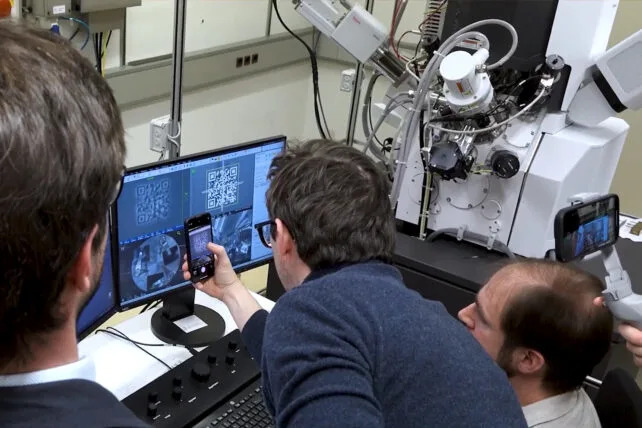
The tiny QR code scanned by a phone through an electron microscope. (TU Wien)
The seven-scientist team, led by Vienna University of Technology (TU Wien) in partnership with data-storage company Cerabyte, received a Guinness World Record for the achievement on 3 December 2025. Their QR code is roughly one-third the footprint of the previous record holder, and its successful readout was witnessed and independently verified by the University of Vienna.
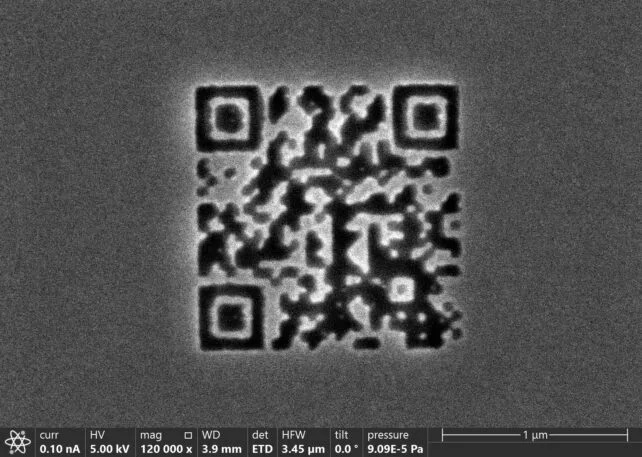
The world's tiniest QR code, when scanned by an electron microscope. (TU Wien)
To reach this scale the researchers etched the pattern into a thin ceramic film commonly used as a coating for high-performance cutting tools. Using focused ion beams, they produced pixels just 49 nanometers wide — about ten times smaller than the wavelength of visible light — which renders the pattern invisible to the human eye and conventional optical microscopes.

Subscribe to ScienceAlert's free fact-checked newsletter
Paul Mayrhofer, materials scientist at TU Wien: "The structure we have created here is so fine that it cannot be seen with optical microscopes at all. Micrometer-scale structures are common today, and atomic-scale patterns can be fabricated, but producing a stable, readable code at this scale is the remarkable part."
The team says the key to reliability was not only fabricating extremely small pixels but using a stable, inert ceramic medium that resists degradation — an approach the researchers compare to the lasting inscriptions left by ancient cultures.
Alexander Kirnbauer, TU Wien materials scientist: "With ceramic storage media, we write information into stable, inert materials that can withstand the passage of time and remain fully accessible to future generations."
Beyond the record itself, the researchers envision microscopic ceramic data storage for archival uses where longevity and stability are crucial. They estimate that, using their method, more than 2 terabytes of data could be encoded on a single A4 sheet of the ceramic medium — suggesting dense, long-lived archival storage with potential environmental advantages compared with some current technologies.
While the work demonstrates an impressive technical milestone in miniaturization and material stability, practical deployment would require scalable writing and reading tools (electron or ion-beam systems) and further development to evaluate long-term costs and energy footprints. Still, the project points toward novel approaches to compact, durable data preservation.
Help us improve.