Indian Prime Minister Narendra Modi and Brazilian President Luiz Inacio Lula da Silva met in New Delhi to deepen cooperation on critical minerals and rare earths, with an expected memorandum of understanding to strengthen supply chains. Brazil, which holds the world’s second-largest reserves, and India aim to diversify away from reliance on China while expanding bilateral trade, which reached $15 billion in 2025. The leaders also discussed global trade tensions after US tariffs affected both countries in 2025 and explored broader economic and industrial partnerships.
Modi, Lula Meet in New Delhi to Seal Critical Minerals Pact and Boost Trade
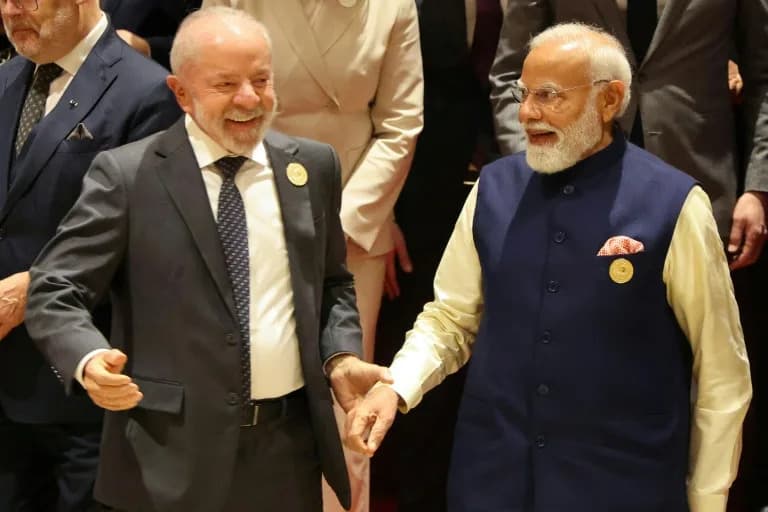
Brazil's President Luiz Inacio Lula da Silva (L) and Indian Prime Minister Narendra Modi are expected to discuss efforts to increase trade links (Ludovic MARIN)(Ludovic MARIN/AFP/AFP)
Indian Prime Minister Narendra Modi and Brazilian President Luiz Inacio Lula da Silva met in New Delhi to strengthen cooperation on critical minerals and rare earths, key components for technologies from electric vehicles and solar panels to jet engines and guided missiles. The talks are expected to culminate in a memorandum of understanding to deepen supply-chain ties and increase trade between the two economies.
Why This Matters
Brazil holds the world’s second-largest reserves of critical minerals and rare earths — resources that many countries are racing to secure as global demand rises. India, aiming to reduce dependence on China as a dominant supplier, has been expanding domestic production, recycling capacity and searching for new overseas partners.
Trade And Economic Goals
Bilateral trade between India and Brazil topped $15 billion in 2025, and both governments have set an ambitious target of $20 billion by 2030. A large Brazilian delegation, including more than a dozen ministers and business leaders, accompanied President Lula to New Delhi to explore investment and industrial partnerships.
Strategic And Geopolitical Context
Analysts say a partnership with Brazil complements India’s recent supply-chain engagements with the United States, France and the European Union by providing on-the-ground resource access. Rishabh Jain of the Council on Energy, Environment and Water noted that Global South alliances help diversify raw-material sources while Western partners provide advanced processing and finance.
Shared Concerns On Trade
Modi and Lula also discussed global economic headwinds and strains on multilateral trade systems after both countries were affected by US tariffs in 2025. Washington has since pledged to roll back some duties on Indian goods under a recently announced trade arrangement. Brazilian diplomat Susan Kleebank said the leaders would exchange views on challenges to multilateralism and international trade.
Business Moves And Next Steps
Major Brazilian exports to India include sugar, crude oil, vegetable oils, cotton and iron ore — the latter in strong demand as India pursues rapid infrastructure and industrial expansion. Brazilian firms are expanding their footprint in India: Embraer and the Adani Group announced plans to build aircraft in the country. After New Delhi, President Lula will travel to South Korea to meet President Lee Jae Myung and attend a business forum.
Takeaway: The Modi-Lula meetings aim to convert natural-resource complementarity into a strategic partnership that strengthens supply chains, boosts bilateral trade and addresses shared concerns over global trade rules.
Help us improve.