The national fight over congressional maps continues even as campaigns ramp up and some primaries proceed. Final district boundaries remain unresolved in multiple states amid court orders, ballot measures and legislative maneuvers. Both parties claim potential seat gains from recent map changes, but litigation and procedural hurdles leave outcomes uncertain ahead of the November midterms.
Redistricting Fight Heats Up as House Campaigns Move Forward

Paula Wood holds a sign protesting Missouri’s congressional redistricting effort while sitting beside her husband, Tim Wood, during a rally on Jan. 21, 2026, at the state Capitol in Jefferson City, Mo. (AP Photo/David A. Lieb)(ASSOCIATED PRESS)
Candidates are campaigning and many primaries are already underway, but a nationwide struggle over how U.S. House districts are drawn — often to secure partisan advantage — is still unfolding in several states ahead of the November midterm elections.
Why This Matters
Final congressional boundaries remain unsettled in several states, and governors in Florida and Maryland are urging legislatures to redraw maps. Those disputes sit alongside recent redistricting changes enacted in states including California, North Carolina, Ohio and Texas. The outcome will shape competitive races and could determine control of the U.S. House.
Background
Redistricting typically occurs once a decade after the census. An unusual wave of mid-decade map changes began after former President Donald Trump urged Texas Republicans last summer to revise congressional lines to favor the GOP; California Democrats responded, and the dispute spread to other states. Both parties now claim map changes could swing multiple seats — but those projections assume past voting patterns hold and do not account for the typical midterm trend of losses for the president’s party.
Current Status And Notable Contests
Overview: Legal challenges, ballot measures and court orders have created a patchwork of outcomes. Some recently enacted maps are being used after court rulings; others are stalled by litigation, petitions or procedural disputes. Below are concise summaries of the contested situations reported across states.
Entry: Current map: Six Democrats, five Republicans. Proposed map: A newly proposed House map could boost Democrats by up to four seats after a constitutional amendment was referred to the ballot to permit mid‑decade redistricting. Challenges: A state judge temporarily blocked the April referendum, ruling the amendment invalid because legislators violated their own rules when passing it; Democrats are appealing the decision.
Maryland: Current map: Seven Democrats, one Republican. Proposed map: The Democratic-led state House approved a plan backed by Gov. Wes Moore that could flip an additional seat to Democrats. Challenges: The president of the Democratic state Senate has said the chamber will not advance redistricting over concerns that the changes could backfire politically.
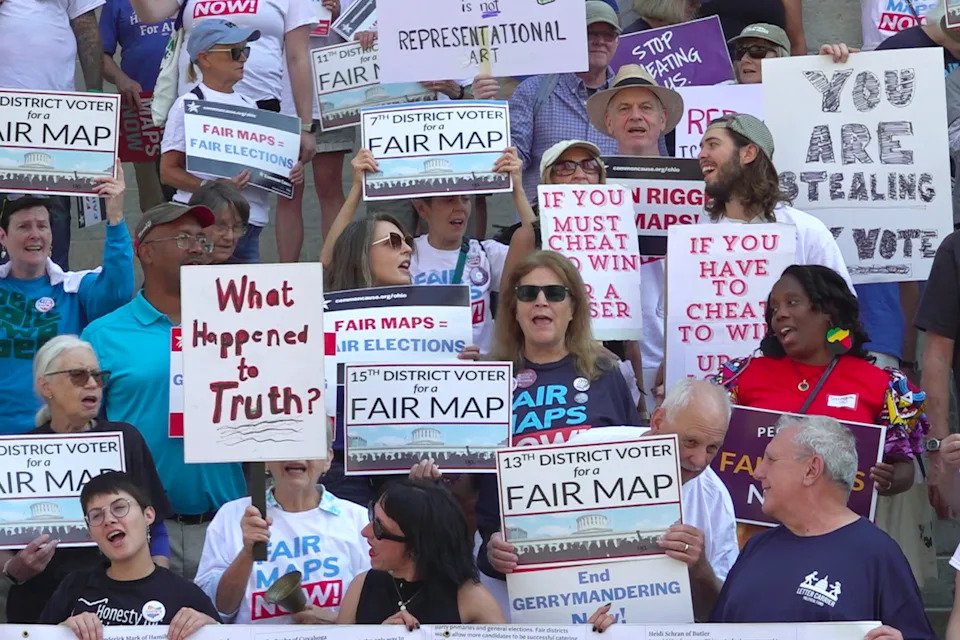
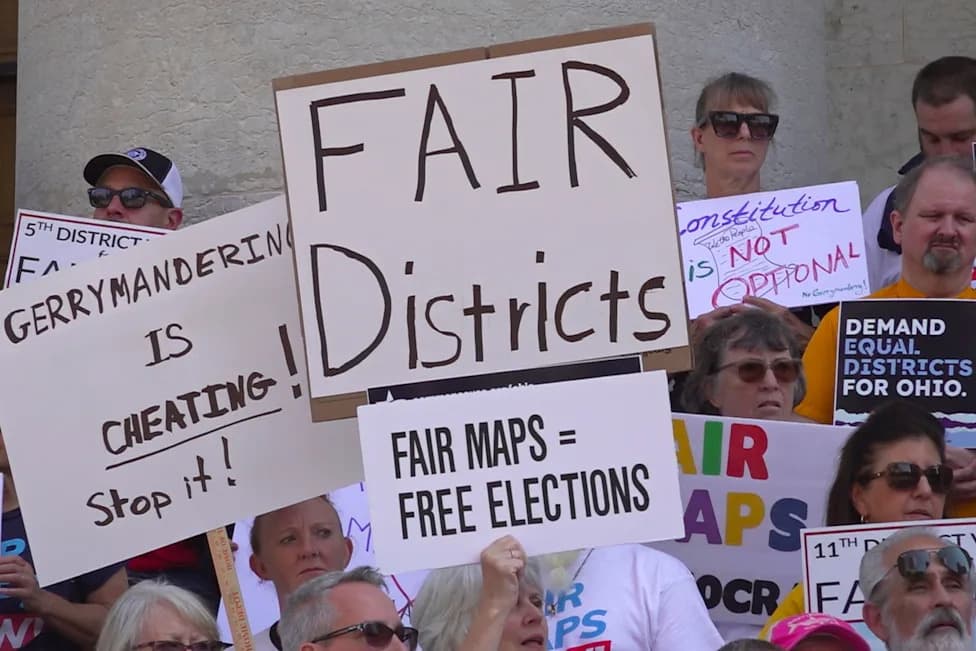
FILE - This photo taken from video shows organizers rallying outside of the Ohio Statehouse to protest gerrymandering and advocate for lawmakers to draw fair maps on Wednesday, Sept. 17, 2025, in Columbus, Ohio. (AP Photo/Patrick Aftoora-Orsagos, File)(ASSOCIATED PRESS)
Missouri: Current map: Two Democrats, six Republicans. New map: Republican Gov. Mike Kehoe signed a revised House map into law last fall that may help Republicans pick up a seat. Challenges: Opponents submitted petition signatures seeking a statewide referendum. The secretary of state has a deadline to validate the petition, and multiple lawsuits are challenging the map’s legality.
Entry: Current map: No Democrats, four Republicans. New map: In November, a judge imposed revised congressional districts after finding lawmakers had sidestepped voter‑approved anti‑gerrymandering standards; the new lines could enable Democrats to win a seat. Challenges: Republicans are appealing the judicially imposed map to the state supreme court and in federal court.
New York: Current map: 19 Democrats, seven Republicans. Proposed map: A January judge’s order directed a commission to redraw the boundaries for the only New York City district represented by a Republican, finding the prior lines diluted Black and Hispanic votes. Challenges: Republicans lost a state‑court appeal and have asked the U.S. Supreme Court to review the case.
Florida: Current map: Eight Democrats, 20 Republicans. Proposed action: Gov. Ron DeSantis said he would call a special legislative session in April to address congressional redistricting. Challenges: A lawsuit contends DeSantis lacks legal authority to convene the special session; the state constitution bars drawing districts with the intent to favor or disfavor a party or incumbent.
Texas: Current map: 13 Democrats, 25 Republicans. New map: Gov. Greg Abbott signed a revised House map last August that could help Republicans win up to five additional seats. Challenges: The U.S. Supreme Court in December allowed those new districts to be used this year by putting on hold a lower‑court ruling that had blocked the map as a racial gerrymander.
California: Current map: 43 Democrats, nine Republicans. New map: Voters in November approved new districts drawn by the Democratic‑led legislature that could benefit Democrats by about five seats. Challenges: The U.S. Supreme Court in February allowed the new districts to be used this year, denying an appeal from Republicans and the Department of Justice alleging the maps improperly advantaged Hispanic voters.
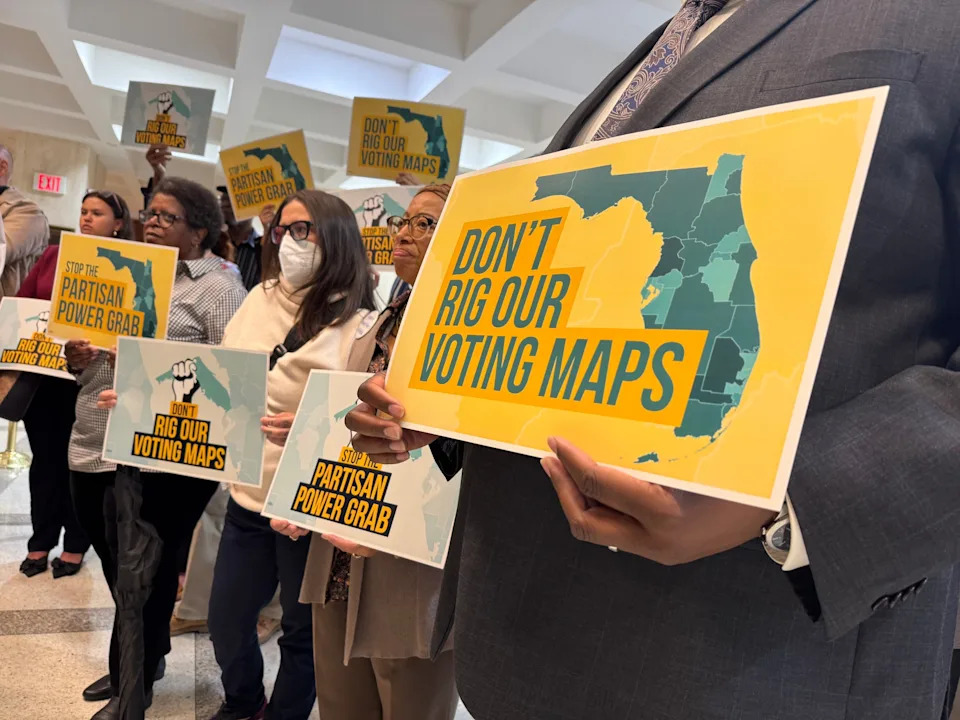
FILE - Opponents of mid-decade efforts to redraw congressional voting districts gather to protest in the Florida Capitol in Tallahassee, Fla., Dec. 2, 2025. (AP Photo/Kate Payne, File)(ASSOCIATED PRESS)
Entry: Current map: Four Democrats, 10 Republicans. New map: A Republican‑led legislature approved revised districts in October that may give Republicans an extra seat. Challenges: A federal court panel denied a request to block the revised districts from being used this year.
Entry: Current map: Five Democrats, 10 Republicans. New map: A bipartisan panel, composed mostly of Republicans, approved revised districts in October that improve Republican prospects by two seats. Challenges: None immediate; the state’s constitution required new districts before 2026 because prior maps lacked sufficient minority‑party support and were set to expire after 2024.
Louisiana: Current map: Two Democrats, four Republicans. Proposal: Gov. Jeff Landry signed legislation to delay the state’s primary from April 18 to May 16, potentially giving lawmakers more time to redraw districts if the U.S. Supreme Court overturns the current map. Challenges: The Supreme Court has heard arguments but has not yet issued a ruling.
Entry: Current map: One Democrat, six Republicans. Proposed map: A legislative committee is considering a plan that could net Republicans another seat. Challenges: Republican leaders worry the proposal could backfire and time is short ahead of the election.
Entry: Current map: Four Democrats, four Republicans. Proposed map: A ballot initiative seeks to allow mid‑decade redistricting and would impose a new House map that might deliver Democrats three more seats. Challenges: Organizers must gather enough signatures to qualify for November; even if approved, the new districts could not be implemented until 2028.
Entry: Current map: Eight Democrats, two Republicans. Proposed map: Democratic lawmakers proposed a constitutional amendment to permit mid‑decade redistricting. Challenges: Democrats lack the two‑thirds legislative majorities required to refer an amendment to the ballot, making approval before November unlikely.
Entry: Current map: Two Democrats, six Republicans. Proposed action: Two lawsuits claim congressional districts must be redrawn because they unconstitutionally favor Republicans. Challenges: One case is not scheduled for trial until 2027; the other may not be resolved before the midterms, leaving uncertainty about which maps will apply in November.
What To Watch
Key developments to monitor include state supreme court decisions, the U.S. Supreme Court’s rulings on outstanding appeals, the validity of petition drives and whether legislatures succeed in passing mid‑decade changes. The final maps will directly influence competitive districts and could determine whether Democrats or Republicans control the next Congress.
Help us improve.