Neiry Group’s PJN‑1 programme implants neural chips in pigeons and fits them with chest cameras to create remotely steered "bio‑drones". The company claims long range and endurance and pitches civilian uses such as infrastructure monitoring and search‑and‑rescue. Experts warn the platform could be repurposed for military or harmful applications, and an investigation found about one billion roubles in funding linked to Kremlin‑affiliated sources. The project follows other experiments worldwide in animal‑mounted or brain‑controlled systems.
Russia’s 'Pigeon Drones': Neural Implants Turn Birds Into Remote Surveillance Platforms
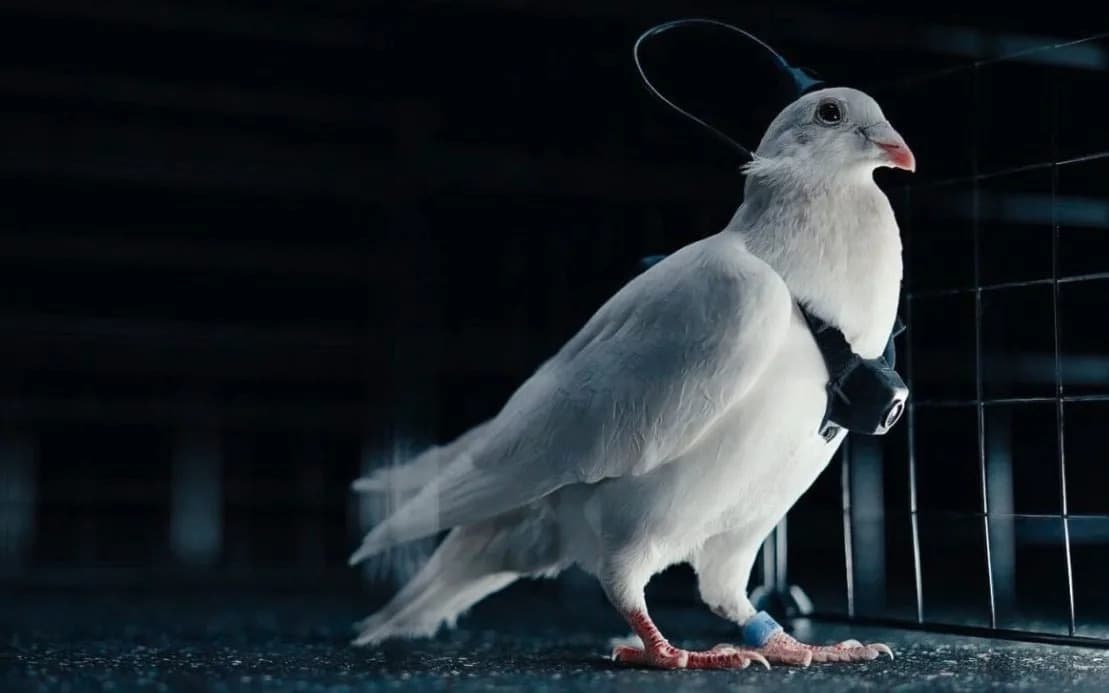
The birds have cameras strapped to their chests and their flight path is dictated by an operator with a remote control - Neiry Group
Russian startup Neiry Group is developing pigeon-based "bio-drones" under a programme called PJN-1 that implants neural chips into birds, equips them with chest-mounted cameras and steers them remotely. The company says the system could provide longer range and greater endurance than conventional small drones and reach places that are difficult to access.
How the System Works
According to Neiry, tiny electrodes are inserted through the pigeons’ skulls and connected to a stimulator mounted on the bird’s head. Operators send remote signals to trigger left‑ and right‑turn commands. A solar-powered backpack houses a flight controller and links to a camera mounted on the bird’s chest, streaming live video back to handlers.
Claims, Uses and Limitations
Neiry claims its pigeon platforms can travel more than 300 miles a day and envisages civilian applications such as monitoring infrastructure, inspecting industrial sites, operating in restricted airspace and supporting search‑and‑rescue missions. The company also says the approach could be adapted to other species—ravens for heavier payloads, seagulls for coastal monitoring and albatrosses for offshore coverage.
Security, Ethical and Operational Concerns
Outside experts and ethicists warn the same hardware could be repurposed for military missions or other harmful uses. James Giordano, Professor Emeritus of Neurology at Georgetown University and a former Pentagon science adviser, told reporters that, in theory, such bio‑drones could be adapted to deliver biological agents—an illustration of the security risks, even if such an outcome would face serious technical, ethical and legal barriers.
"Currently, the solution works with pigeons, but any bird could be used as a carrier," Neiry’s CEO Alexander Panov has said. He has also expressed ambitions to adapt the system to other species and discussed broader technological goals for the company.
Funding, Ties and Wider Context
An investigation by T‑Invariant, an independent anti‑war outlet founded by Russian scientists, reported that Neiry received roughly one billion roubles (almost £10 million) in funding, including financing tied to Kremlin‑linked programmes and investment groups. Reported sources include the National Technology Initiative, investment firms associated with Russia’s sovereign wealth structures, and funds linked to prominent Russian business figures. T‑Invariant also reported institutional ties to Moscow State University’s AI institute.
If Neiry achieves operational bio‑drone capability at scale, Russia would join only a few countries experimenting with animal‑mounted or brain‑controlled platforms; researchers elsewhere have reported work on cyborg bees and other animal‑control prototypes. Russia has also previously reported unconventional military uses of animals, such as trained dolphins for naval protection.
What To Watch
Key issues going forward include independent verification of Neiry’s technical claims, ethical oversight of experiments on animals, export controls and the potential military adaptation of the technology. The company’s public statements, the investigations into its funding, and expert warnings make PJN‑1 a programme likely to draw continued scrutiny from journalists, regulators and researchers.
Help us improve.