NASA's James Webb Space Telescope detected crystalline silicates forming in the hot inner disk of the protostar EC 53 and found they are carried outward by layered disk winds into the cold outer disk where comets form. EC 53 bursts roughly every 18 months, with ~100-day energetic episodes that forge and eject these minerals. Webb's MIRI observations provide the first direct evidence linking high-temperature crystal formation to their presence in cometary reservoirs.
Webb Sees Young Star Forge Crystals and Fling Them Toward Comet-Forming Zones
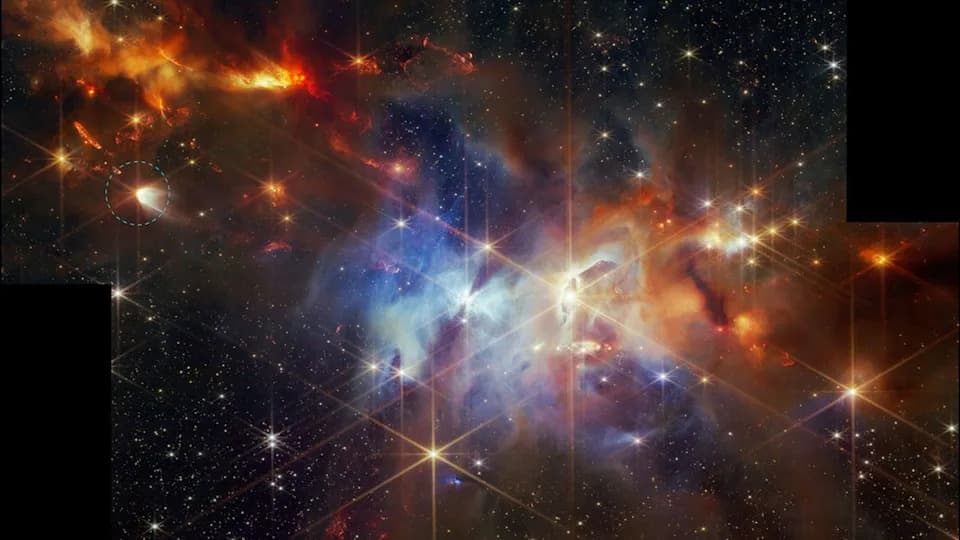
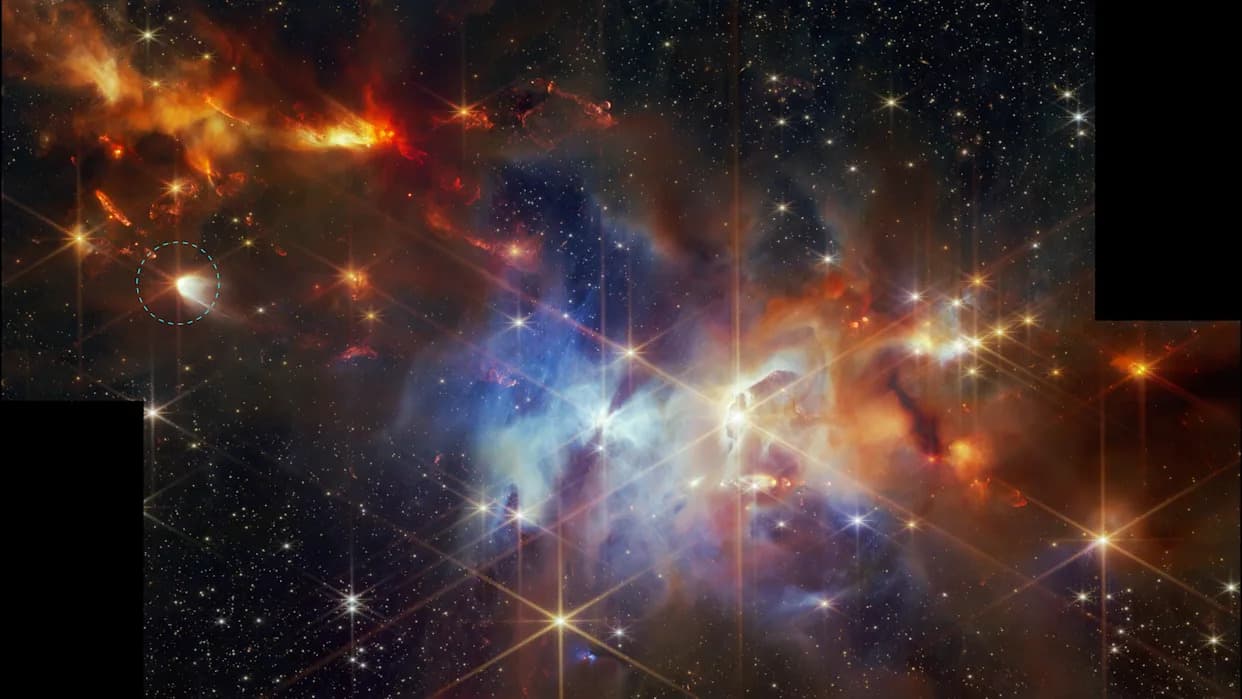
The young star EC 53, part of the Serpens Nebula — a stellar nursery located about 1,300 light-years from Earth that is brimming with actively forming stars — where NASA's James Webb Space Telescope has revealed crystals being forged near the star and carried outward by powerful winds. | Credit: NASA, ESA, CSA, STScI, Klaus Pontoppidan (NASA-JPL), Joel Green (STScI); Image Processing: Alyssa Pagan (STScI)
NASA's James Webb Space Telescope has for the first time directly observed a young star making crystalline minerals in blazing heat and launching them into the cold outer reaches of its planet-forming disk. The observations reveal a likely pathway by which hot-formed silicate crystals end up in icy comets.
What Webb Observed
The protostar EC 53, located about 1,300 light-years from Earth, is surrounded by a disk of gas and dust where planets and smaller bodies are assembling. Using the Mid-Infrared Instrument (MIRI) on the James Webb Space Telescope, astronomers mapped both the spectral signatures and the spatial distribution of crystalline silicates in the disk.
Where Crystals Form
Webb pinpointed the production zone to the disk's hot inner region—approximately where Earth and the inner planets would have formed in our own Solar System. These crystalline silicates are minerals that require high temperatures to form, so their presence near the protostar indicates in situ production during energetic episodes.
How Crystals Travel Outward
EC 53 undergoes episodic accretion bursts roughly every 18 months; each burst lasts on the order of 100 days. During these events the system drives powerful jets and layered disk winds. The new observations show these layered outflows can lift freshly formed crystals from the inner disk and carry them outward along a 'cosmic highway' into the cold outer disk, where comets may later assemble.
'EC 53's layered outflows may lift up these newly formed crystalline silicates and transfer them outward, like they're on a cosmic highway,' said Jeong‑Eun Lee, lead author of the study. 'Webb not only showed us exactly which types of silicates are in the dust near the star, but also where they are both before and during a burst.' — Jeong‑Eun Lee
Co-author Joel Green added that the observations reveal how the star creates and distributes superfine particles, each significantly smaller than a grain of sand.
Why This Matters
Although crystalline silicates have been detected previously in comets and in disks around other young stars, the connection between their hot origins and cold cometary reservoirs had been unclear. Webb's combination of detailed spectra and spatial mapping provides the first direct evidence linking formation in the inner disk to transport into comet-forming regions of the outer disk.
The findings underscore how dynamic and active young planetary systems can be, and they offer new clues about the raw materials available for planet and comet formation across the galaxy.
Publication: The team's results were published Jan. 21 in the journal Nature.
Help us improve.