Hungary has granted asylum to former Polish Justice Minister Zbigniew Ziobro, deepening tensions between Warsaw and Budapest. Ziobro, a prominent PiS figure, faces allegations that he misused victims' assistance funds and approved purchases linked to Pegasus spyware—charges he denies as politically driven. Hungary says it approved some asylum requests from Poles; Poland's government maintains it is enforcing the rule of law, not persecuting opponents.
Hungary Grants Asylum to Ex-Polish Justice Minister Zbigniew Ziobro, Escalating Rift With Warsaw
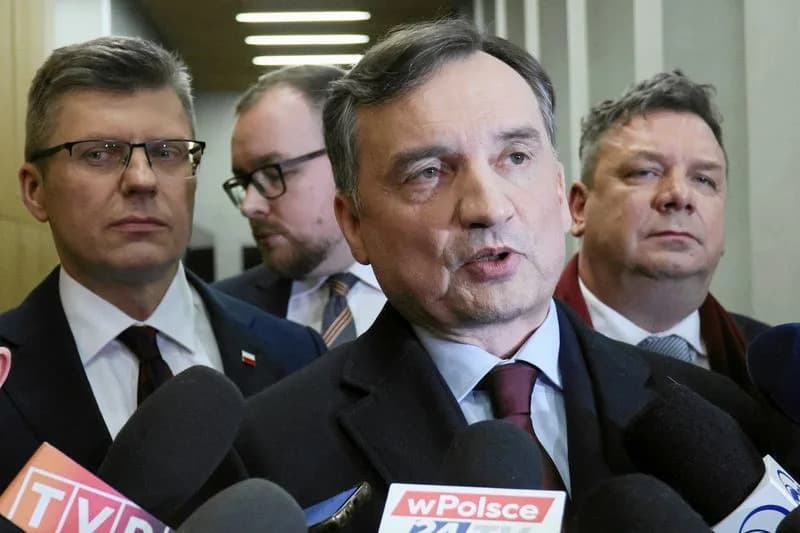
Member of the Law and Justice (PiS) party and former Poland's Justice Minister Zbigniew Ziobro speaks to the media after he was detained by police to be brought to testify before the Pegasus Investigation Committee at the Parliament, in Warsaw, Poland January 31, 2025. Agencja Wyborcza.pl/Slawomir Kaminski/via REUTERS
Hungary has granted asylum to former Polish Justice Minister Zbigniew Ziobro, a decision that has intensified diplomatic strain between Warsaw and Budapest and highlighted broader tensions inside the European Union over rule-of-law disputes.
Background
Ziobro, a senior figure in the nationalist Law and Justice (PiS) party, faces probes in Poland into allegations that he misused funds from a victims’ assistance program and authorised purchases tied to Pegasus spyware, which can infiltrate mobile phones. He denies the accusations, calling them politically motivated and saying he is the target of persecution after PiS lost power in 2023.
Diplomatic Fallout
Poland objected after Budapest notified EU partners that it had offered asylum to two Polish nationals without naming them. Hungary later confirmed that at least one of those individuals was Ziobro. Warsaw's reaction was sharp: Tomasz Siemoniak, the minister overseeing security services, called Ziobro’s departure "a total downfall," accusing him of fleeing Poland's justice system.
"I decided to take advantage of the asylum granted to me by the Hungarian government due to political repressions in Poland," Ziobro wrote on X, adding that he had also requested asylum for his wife.
Hungarian Foreign Minister Peter Szijjarto defended Budapest's actions, saying at a news conference that it had approved "some" asylum requests from Poles and arguing that "in Poland... many people are subject to political persecution." Hungary has repeatedly criticised Poland’s current pro-EU government for what it calls politically motivated prosecutions of former PiS officials.
Broader Context
Relations between Hungary and Poland were historically close while both were led by nationalist governments, but they diverged notably over policy toward Russia after Moscow’s 2022 invasion of Ukraine. Hungary under Viktor Orbán remains a vocal critic of some EU positions, and its offer of asylum to high-profile former Polish officials — including Marcin Romanowski in 2024 — has added friction with Warsaw.
Poland's current government, led by Prime Minister Donald Tusk, says it is upholding the rule of law and pursuing alleged wrongdoing by former officials, not persecuting political opponents. The dispute raises questions about mutual trust among EU member states and could complicate cooperation on justice and security matters within the bloc.
Key developments: Hungary confirms asylum for at least one former PiS justice official; Ziobro denies wrongdoing and claims political persecution; Warsaw insists it is enforcing the law. The episode underscores growing diplomatic friction between two influential EU members.
Help us improve.