The latest Suan Dusit and NIDA polls show the progressive People's Party leading voter intention ahead of Thailand's Feb. 8 general election, with roughly 30–34% support. Natthaphong Ruengpanyawut emerges as the most popular choice for prime minister in both surveys, while Anutin remains a competitive contender. The contest follows months of court rulings, party dissolutions and a recent border clash that could complicate coalition-building.
People's Party Surges in Thai Polls as Feb. 8 Election Nears — Natthaphong Tops PM Picks
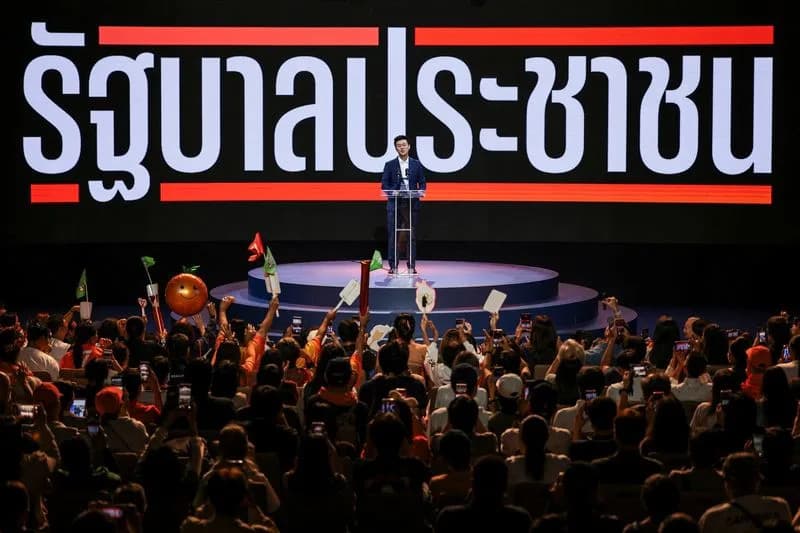
People's Party leader and prime ministerial candidate Natthaphong Ruengpanyawut speaks during a general election campaign rally ahead of Thailand's general election, in Bangkok, Thailand, January 11, 2026. REUTERS/Chalinee Thirasupa
BANGKOK — Two independent January surveys show Thailand's progressive People's Party leading voter intentions ahead of the February 8 general election, underscoring the challenge facing Prime Minister Anutin Charnvirakul and his conservative Bhumjaithai party.
Poll Results and Leaders
The Suan Dusit poll, conducted Jan. 6–9 with 2,682 respondents and released Sunday, put the People's Party on 34.2% support, Bhumjaithai on 16.2% and Pheu Thai on 16.0%. The survey named People's Party leader and opposition figure Natthaphong Ruengpanyawut as the top choice for prime minister at 32%, followed by Pheu Thai's Yodchanan Wongsawat on 17.4% and Anutin on 15.1%.
A separate National Institute for Development Administration (NIDA) poll, conducted Jan. 5–8 of 2,500 people, likewise placed the People's Party ahead — at about 30.5% — with Bhumjaithai at 22.3% and Pheu Thai at 15.4%. NIDA showed Natthaphong again leading the premier preference at 24.7%, with Anutin close behind at 20.8% and Yodchanan at 9.6%.
Why This Matters
The People's Party, which evolved from the Move Forward movement, has won strong support among younger and urban voters with an ambitious reform agenda. Move Forward won the most votes in the 2023 election but was prevented from forming a government by lawmakers allied with the royalist military; it was later dissolved by a court. Those legal and political upheavals, together with the rapid turnover of prime ministers — three in under three years — have kept Thailand's political landscape highly volatile.
Anutin called a snap election on Dec. 12 after serving less than 100 days in office amid a turbulent parliamentary session that threatened a no-confidence motion and the collapse of his minority administration. The campaign period has also unfolded against the backdrop of a recent three-week border clash between Thai and Cambodian forces.
Implications
With the People's Party leading in multiple polls and Natthaphong running ahead in public preference for premier, the Feb. 8 vote could reshape coalition dynamics. Rivalries among the People's Party, Bhumjaithai and Pheu Thai — combined with recent court rulings, party dissolutions, and legal actions against senior figures — may complicate post-election coalition-building and governance.
(Reporting by Panarat Thepgumpanat, Chayut Setboonsarng and Martin Petty; Editing by David Stanway)
Help us improve.