The EPA will propose a national drinking-water standard for perchlorate after a federal appeals court ordered the agency to act, but it said the rule is unlikely to deliver large public-health gains for most systems. The agency will seek comment on potential limits of 20, 40 and 80 parts per billion and require utilities to test, with reduced sampling allowed if initial results are clear. Environmental groups say even the strictest proposed limit could leave vulnerable infants and fetuses at risk, while the EPA estimates fewer than 0.1% of regulated systems will exceed the proposed thresholds.
EPA to Propose Perchlorate Drinking-Water Limit After Court Order, Says Health Gains Will Be Limited
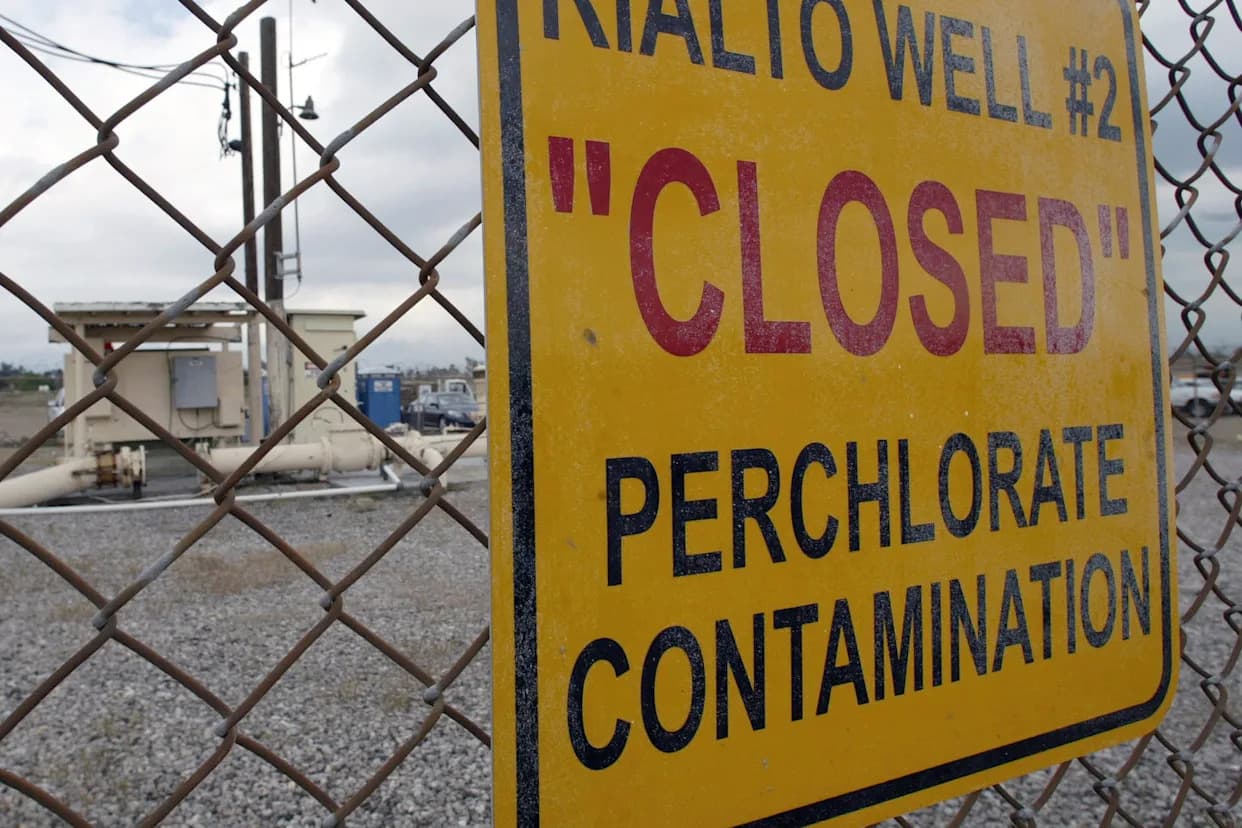
FILE - A sign is posted outside a water well indicates perchlorate contamination at a site in Rialto, Calif., March 28, 2005. (AP Photo/Ric Francis, File)
The Environmental Protection Agency announced Monday that it will publish a proposed drinking-water standard for perchlorate — a chemical used in rocket fuel, fireworks and other explosives — saying it is acting only because a federal appeals court ordered the agency to do so. The EPA also said the rule is unlikely to yield large public-health benefits for most water systems, and it will seek public comment on the strength of the limit and testing requirements.
What the Proposal Will Cover
The agency will invite public input on possible limits of 20, 40 and 80 parts per billion (ppb) and expects to require testing by utilities. EPA officials said sampling requirements could be relaxed for systems whose initial tests show no cause for concern, and the agency pledged to work with states and communities to address contamination sites.
Why Perchlorate Matters
Perchlorate can be manufactured for use in propellants and pyrotechnics but can also occur naturally. At some defense, aerospace and industrial sites it has leached into groundwater and migrated into drinking supplies, with contamination concentrated in parts of the Southwest and along stretches of the East Coast. The chemical interferes with thyroid function, which can be particularly harmful for developing fetuses and young infants; exposure has been linked in some studies to lower IQ scores and higher rates of behavioral problems.
Regulatory History and Court Order
In 2011, the EPA estimated perchlorate might appear in the drinking water of roughly 16 million people and concluded regulation was required under the Safe Drinking Water Act. That finding obligated the agency to propose a national standard within two years, but the rulemaking stalled as the agency updated its scientific analysis. The nonprofit Natural Resources Defense Council sued to force action, and after a series of changes — including a 2020 determination that a national standard was unnecessary — a federal appeals court has now ordered EPA to propose a regulation.
"Due to infrequent perchlorate levels of health concern, the vast majority of the approximately 66,000 water systems that would be subject to the rule will incur substantial administrative and monitoring costs with limited or no corresponding public health benefits as a whole," the EPA wrote in its proposal.
The agency reiterated that its data indicate perchlorate is not widespread in U.S. drinking water. "We anticipate that fewer than one‑tenth of 1% of regulated water systems are likely to find perchlorate above the proposed limits," EPA said, noting that a federal limit would help the relatively small number of affected communities but impose costs on many systems that do not need corrective action.
"Members of the public deserve to know whether there's rocket fuel in their tap water. We're pleased to see that, however reluctantly, EPA is moving one step closer to providing the public with that information," said Sarah Fort, a senior attorney with the Natural Resources Defense Council.
Reactions and Local Context
The NRDC criticized the agency’s approach, saying that even a 20 ppb standard would be too weak to protect vulnerable populations, particularly fetuses and infants. Some states, including Nevada, have argued that extensive local cleanup efforts—such as two decades of work around Lake Mead after perchlorate production in the Las Vegas Valley—have already reduced risks in their areas.
Broader EPA Actions on Drinking Water
Separately, the agency said it will retain strict limits adopted under the Biden administration for two common types of PFAS in drinking water while providing utilities more time to comply, and it will rescind limits on other PFAS compounds. The perchlorate proposal shows the agency balancing judicial direction, scientific assessment and concerns about costs to thousands of water systems.
The EPA will publish the full proposal and open a public-comment period on the proposed limits and related monitoring and implementation details.
Help us improve.