
Excavations at Gird-î Kazhaw in Iraq's Kurdistan Region revealed a Christian monastery dated to around A.D. 500 positioned only yards from a Sasanian fort where Zoroastrian worship occurred. Artifacts—including jug fragments bearing an early cross—support the identification of the church. A complementary study at Dedoplis Gora in Georgia documents adjacent sanctuary rooms used for Zoroastrian, Greek (Apollo), and syncretic local rituals, together highlighting religious pluralism under Persian influence.
1,500-Year-Old Christian Monastery Found Beside Zoroastrian Worship Site in Northern Iraq

The Gird-î Kazhaw archaeological site is in Iraq's northern Kurdistan region, near the modern village of Bestansur. | Credit: Institute of Archaeological Sciences, Goethe University Frankfurt
Archaeologists have uncovered the remains of a Christian monastery dated to around A.D. 500 at the Gird-î Kazhaw site in Iraq's Kurdistan Region — located only yards from a Sasanian fort where evidence of Zoroastrian worship was found. The close proximity of these two religious sites provides compelling material evidence that Christians and Zoroastrians lived side by side in this region with little sign of violent conflict.
Archaeological Findings at Gird-î Kazhaw
A team led by Alexander Tamm (Friedrich-Alexander University Erlangen-Nuremberg) and Dirk Wicke (Goethe University Frankfurt) reexamined a complex originally identified in 2015 and found buried stone pillars and other architectural remains consistent with a church at the core of a Christian monastery. The team dated the monastery to roughly the fifth–sixth centuries A.D.
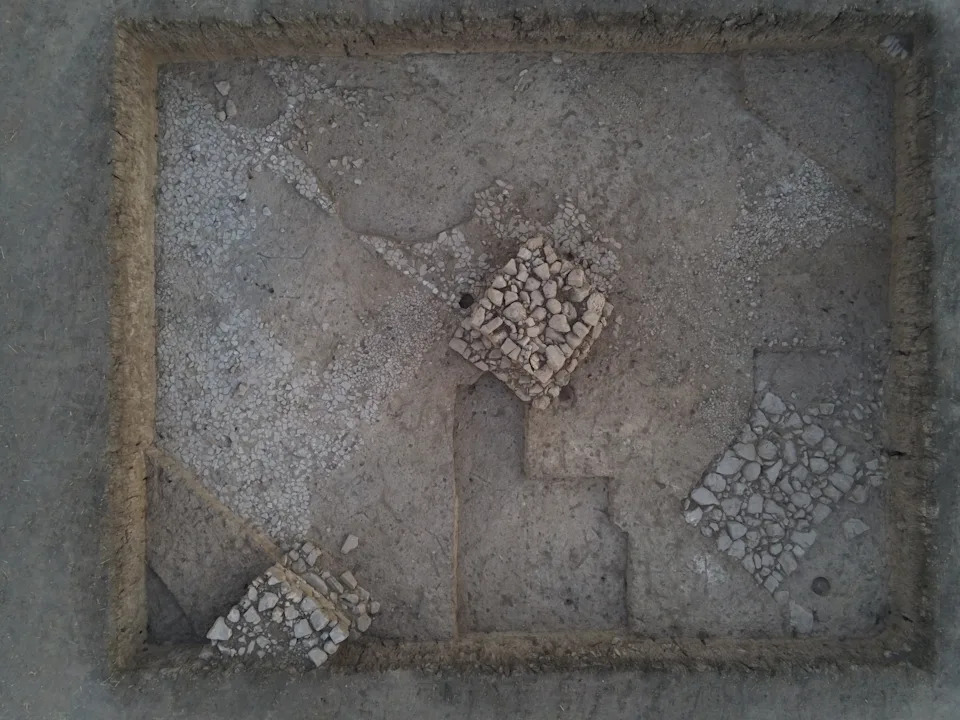
Buried pillars suggest there was a Christian church and monastery at the site about 1,500 years ago. | Credit: Institute of Archaeological Sciences, Goethe University Frankfurt
Notable artifact: Fragments of a large jug decorated with an early Christian cross were recovered. Cross imagery became more common after Christianity became legally recognized in the Roman Empire in the fourth century.
Importantly, the monastery lies only a few yards from a Sasanian fortification with material signs of Zoroastrian practice. The juxtaposition of the two sites suggests everyday coexistence rather than overt conflict at this locality.
Related Evidence From Dedoplis Gora, Georgia
A related study by David Gagoshidze (University of Georgia, Tbilisi), published in the January 2026 issue of the American Journal of Archaeology, examines a roughly 2,000-year-old sanctuary within the large temple complex at Dedoplis Gora, about 400 miles (600 km) north of Gird-î Kazhaw. There, three adjacent sanctuary rooms appear to reflect distinct but coexisting religious practices.
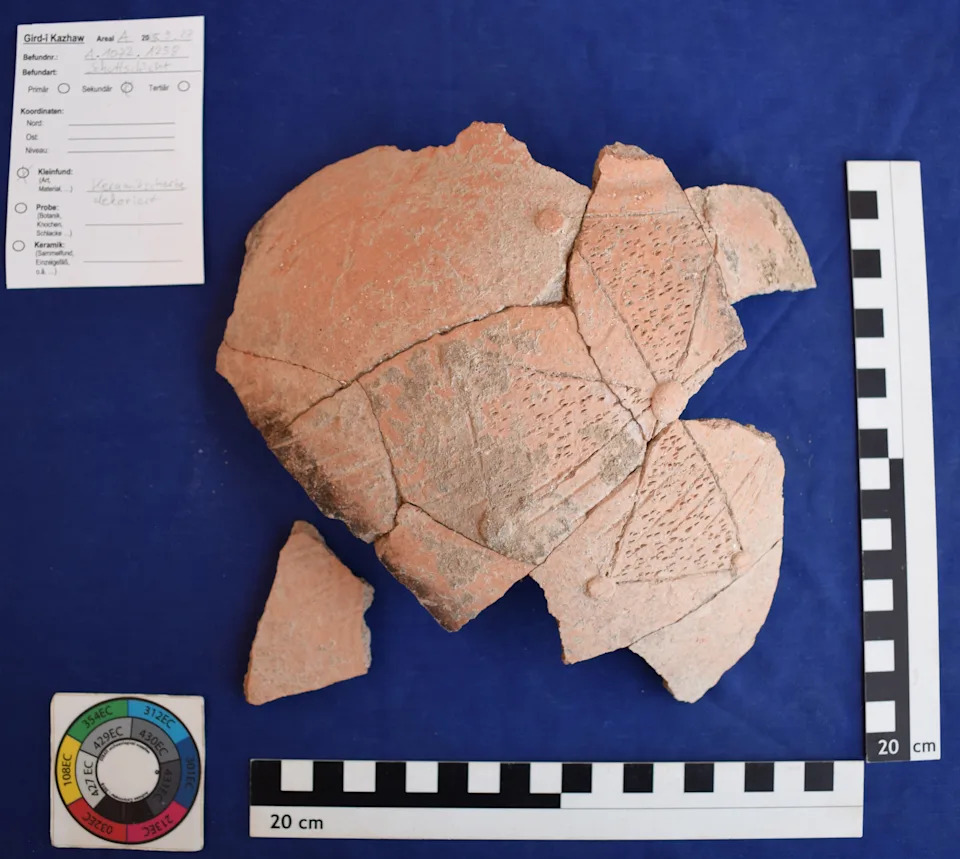
Archaeologists have unearthed pottery fragments in Iraq from a large jug decorated with a Christian cross. | Credit: Institute of Archaeological Sciences, Goethe University Frankfurt
- One room contained an altar tied to Zoroastrian rites where palace residents offered daily sacrifices.
- A second room held statuettes associated with the Greek cult of Apollo, indicating Hellenic influence among the elite.
- A third chamber appears to have hosted syncretic ceremonies combining local agricultural and fertility rituals with other traditions.
Historical Context and Significance
These discoveries fit a broader historical picture in which Zoroastrianism — the official religion of several Persian dynasties — often existed alongside other faiths across the Near East. While periods of persecution against Christians and other religious minorities did occur, especially during later Sasanian times, the material record at sites like Gird-î Kazhaw and Dedoplis Gora highlights instances of peaceful religious pluralism.
For background, Zoroastrianism traces to the prophet Zarathustra (Zoroaster), thought to have lived roughly 3,500 years ago. The faith centers on devotion to Ahura Mazda, with fire a principal symbol. After the Islamic conquest of the Sasanian Empire in the seventh century, Zoroastrian communities declined sharply; today there are about 120,000 practicing Zoroastrians worldwide.
Why It Matters
These finds enrich our understanding of religious life along the Persian frontier and challenge simplified narratives of constant antagonism between Persian and Christian communities. Instead, they reveal complex local realities in which neighbors of different faiths coexisted, exchanged ideas, and sometimes blended ritual practice.


