
Russia has scaled back its Russian Orbital Station (ROS) program and now plans to repurpose modules from the ISS rather than build a new polar-orbit outpost. Officials say ROS will operate at a 51.6° inclination — the same as the ISS — with the Russian segment detached and reconfigured after the ISS retirement around 2030. Major hurdles include reliance on the Baikonur Cosmodrome, concerns about bacterial contamination and aging hardware, and uncertain funding into the 2030s.
Russia Scales Back 'Next-Generation' ROS — Will Reuse ISS Modules and Rely on Baikonur

(Credit: NASA)
Russia has scaled back its plans for the Russian Orbital Station (ROS). Instead of launching a new polar-orbit station made of entirely new modules, Roscosmos now plans to repurpose modules from the Russian segment of the International Space Station (ISS) and place ROS into a 51.6° inclination — the same orbital plane as the ISS.
What Changed
Under the original roadmap, new ROS modules were expected to begin flying in 2027 from the Vostochny Cosmodrome into a polar orbit about 250 miles (roughly 400 km) above Earth. That polar-orbit plan has reportedly been abandoned. Russian officials now say the agency will detach and reconfigure the existing Russian ISS modules when the ISS is retired around 2030.
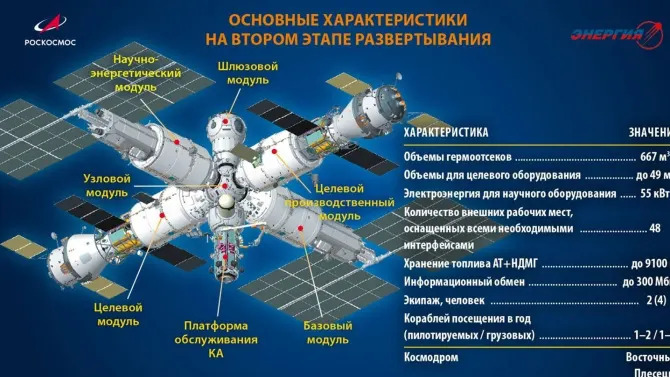
Russian Space station design.
“We’ve decided on a 51.6-degree inclination angle for our ROS space station,” said Oleg Orlov, director of the Institute of Biomedical Problems of the Russian Academy of Sciences. The Scientific and Technical Council of Roscosmos reportedly supported deploying a station constituted from the Russian segment of the ISS.
Key Challenges
Although repurposing ISS hardware reduces the need for immediate development of large new modules, the approach introduces multiple technical, logistical, and political risks:
- Launch Infrastructure: The plan depends on continued access to the Baikonur Cosmodrome in Kazakhstan — a facility recently damaged when blast doors were left open during a launch — tying the project to stable relations with Kazakhstan and to repairs and upgrades at the site.
- Aging Hardware: Some Russian modules will be approaching 30 years of service by 2030. Long-lived flight hardware requires careful assessment, refurbishment, and potentially replacement to ensure safety and mission viability.
- Biological Contamination: Experts have raised concerns about persistent bacterial contamination aboard the ISS and the added complications this poses for long-duration habitation in a converted station.
- Financial Uncertainty: Sustaining a space program into the 2030s will require steady funding. Economic pressures and competing budget priorities create real uncertainty about Russia's ability to finance refurbishment, operations, or additional hardware.
Political And Operational Considerations
Relying on Baikonur ties ROS operations to Kazakhstan for launches, ground support, and logistics. That relationship will require diplomatic stability and operational agreements. Any breakdown in access or cooperation would complicate the plan, potentially forcing Roscosmos to seek alternative launch sites or international partnerships.
Outlook
The revised plan is pragmatic in that it leverages existing assets, but it is far from guaranteed. Critical unknowns include the exact condition of Russian modules at the time of ISS retirement, the technical feasibility and safety of converting those modules into an independent station, and whether Russia can secure the necessary funding and access to launch infrastructure. The coming years will determine whether ROS becomes a repurposed successor to the ISS or a stalled proposal.


