
NASA astronaut Jonny Kim and Russian cosmonauts Sergey Ryzhikov and Alexey Zubritsky landed safely in Kazakhstan after an eight-month mission aboard Soyuz MS-27 as part of Expedition 73. The capsule touched down at 10:03 a.m. local time after a roughly 3.5-hour descent from the ISS. The crew completed 42 scientific experiments during about 245 days in orbit and covered nearly 104 million miles. Zubritsky required further medical evaluation at the landing site; Kim and Ryzhikov were reported in good condition.
Jonny Kim, Two Russian Cosmonauts Land Safely in Kazakhstan; Kim Says “Love Is The Greatest Thing”
05:22 PM, 12/10/2025

The Soyuz MS-27 spacecraft lands in a remote area near Zhezkazgan, Kazakhstan, with astronaut Jonny Kim and cosmonauts Sergey Ryzhikov and Alexey Zubritsky aboard on Tuesday morning. NASA Photo by Bill Ingalls/UPI
NASA astronaut Jonny Kim and Russian cosmonauts Sergey Ryzhikov and Alexey Zubritsky landed safely on a Kazakhstan steppe Tuesday after departing the International Space Station. The crew returned to Earth aboard the Soyuz MS-27 spacecraft following an eight-month mission as part of Expedition 73.
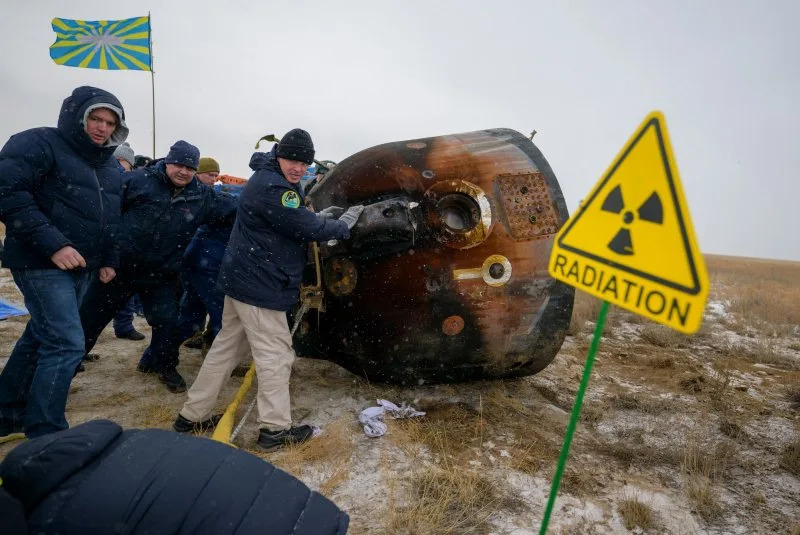
Russian support personnel work around the Soyuz MS-27 spacecraft shortly after it landed in a remote area near the town of Zhezkazgan, Kazakhstan, on Tuesday morning. NASA Photo by Bill Ingalls/UPI
The Soyuz capsule deployed parachutes and touched down at 10:03 a.m. local time. A joint NASA–Roscosmos recovery team met the crew, assisted them out of the capsule and performed medical checks. Mission commander Sergey Ryzhikov congratulated the team at the site:
"Congratulations on one more end of a Soyuz vehicle trip. Expedition 73, all tasks complete. The crew [members] are feeling great."
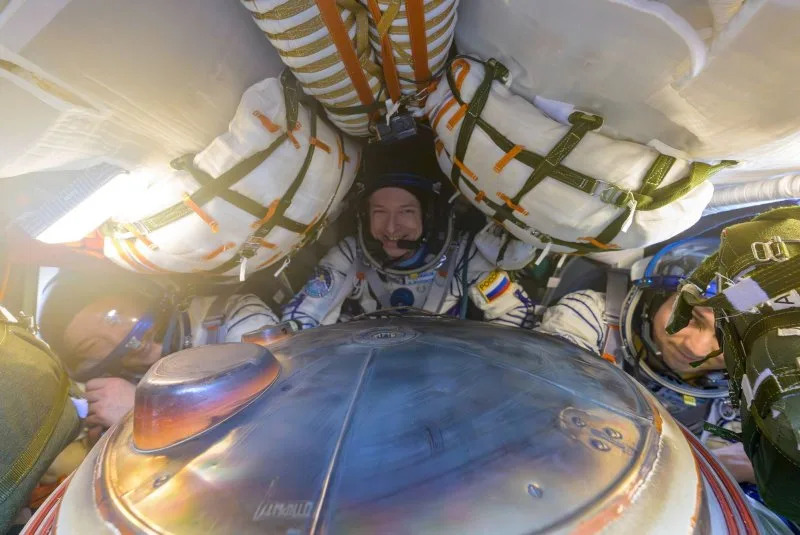
Expedition 73 NASA astronaut Jonny Kim, left, and Roscosmos cosmonauts Sergey Ryzhikov, center, and Alexey Zubritsky are seen inside the Soyuz MS-27 spacecraft after it landed in Kazakhstan on Tuesday morning. NASA Photo by Bill Ingalls/UPI
Kim and Ryzhikov were reported in good condition after landing. Zubritsky was taken from the capsule to an inflatable medical tent for further evaluation and care; officials said his condition required additional assessment and did not immediately confirm whether he continued onward with the rest of the crew.
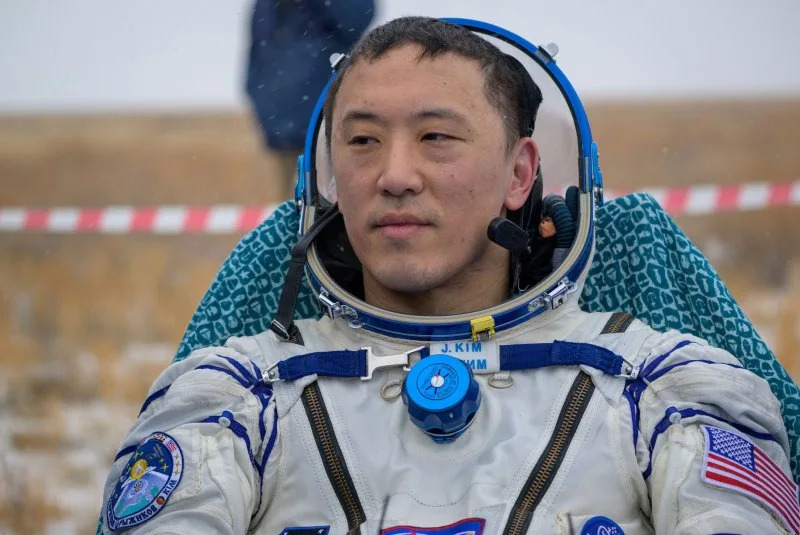
NASA astronaut Jonny Kim and Roscosmos cosmonauts Sergey Ryzhikov and Alexey Zubritsky underwent medical checkups upon landing in Kazakhstan on Tuesday morning after returning from the International Space Station. NASA Photo by Bill Ingalls/UPI
The trio undocked from the ISS Monday at 8:41 p.m. EST and made the roughly 3.5-hour descent back to Earth. In total, the crew spent about 245 days associated with the mission, completing 42 scientific experiments and traveling nearly 104 million miles while the station orbited Earth.
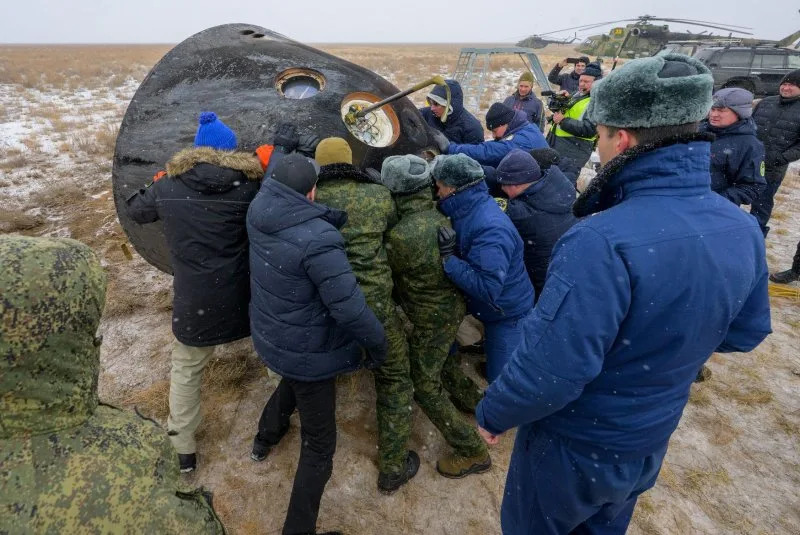
Russian support personnel work around the Soyuz MS-27 spacecraft shortly after it landed in a remote area near the town of Zhezkazgan, Kazakhstan, on Tuesday morning. NASA Photo by Bill Ingalls/UPI
Reflecting on their time together after touchdown, Kim emphasized the personal bonds formed in orbit. He said,
"What I think I'm going to remember most is the bond that we shared together... After having spent eight months in space, I firmly believe that the greatest quality of an astronaut and a human is not technical competence or loyalty... It's love. Love is the greatest thing that an astronaut can have for each other and for the people that they work with and for our lovely planet."
Following medical screening at the landing site, a helicopter transported the crew to Karaganda, Kazakhstan, where they met with their respective NASA and Roscosmos recovery teams. From there, Kim began his return to Houston aboard a NASA aircraft, while Ryzhikov and Zubritsky were scheduled to be flown to the Roscosmos training center in Star City, Russia, pending Zubritsky's medical status.
Mission Highlights: Expedition 73 successfully completed dozens of scientific tasks across multiple disciplines, supported ongoing station operations, and reinforced international cooperation in low Earth orbit.
Similar Articles

Soyuz MS-27 Crew Returns After 245 Days: Two Cosmonauts and NASA Astronaut Land Safely in Kazakhstan
Two Roscosmos cosmonauts, Sergey Ryzhikov and Alexey Zubritsky, and NASA astronaut Jonny Kim landed safely in Kazakhstan afte...

Three-Person Soyuz Crew Returns to Earth After Eight-Month ISS Mission
Three crewmembers—Soyuz commander Sergey Ryzhikov, cosmonaut Alexey Zubritsky and NASA astronaut Jonny Kim—undocked from the ...

Astronaut Jonny Kim and Two Roscosmos Cosmonauts To Return to Earth After 245-Day ISS Mission — Live Coverage Planned
NASA astronaut Jonny Kim and Roscosmos cosmonauts Sergey Ryzhikov and Alexy Zubritsky will undock from the ISS's Prichal modu...

Jonny Kim Returns to Earth After 245 Days and 3,920 Orbits of the ISS
NASA astronaut Jonny Kim and Roscosmos cosmonauts Sergey Ryzhikov and Alexey Zubritsky returned to Earth near Zhezkazgan, Kaz...

Astronaut Jonny Kim and Two Cosmonauts Set for Parachute-Assisted Return From ISS
Astronaut Jonny Kim and Roscosmos cosmonauts Sergey Ryzhikov and Alexey Zubritsky are scheduled to undock from the ISS Monday...

Expedition 73 Settles In: Snowy Japan From Orbit, New Crew Orientation and Ongoing Science (Dec. 1–5, 2025)
Expedition 73 spent Dec. 1–5, 2025 conducting research, station upkeep and crew orientation as newly arrived and departing cr...

Soyuz MS-28 Delivers Three New Crew Members to the ISS — Station Bustles with 10 During Handover
The Soyuz MS-28 docked at Rassvet on Nov. 27, delivering three new crewmembers — NASA’s Chris Williams and Roscosmos’ Sergey ...

Why Russia Removed a Cosmonaut From SpaceX’s Crew‑12 Mission — What We Know
Roscosmos has removed Oleg Artemyev from NASA–SpaceX’s Crew‑12 and replaced him with Andrei Fedyayev, saying only that Artemy...

Thanksgiving Morning Liftoff: Three Crew Members Head to the International Space Station
The Soyuz MS-28 crew—NASA astronaut Chris Williams and Roscosmos cosmonauts Sergey Kud-Sverchkov and Sergei Mikaev—will lift ...

Damaged Baikonur Launch Pad: When Will Russia Resume Crewed Flights to the ISS?
Summary: The Nov. 27 Soyuz MS-28 launch from Baikonur delivered three crew members safely to the ISS, but post-launch inspect...

ISS Crew Take Shelter as Solar Storms Ignite Auroras Across the Globe
Overview: Coronal mass ejections from sunspot group AR4274 on Nov. 11–12 produced bright auroras and an energetic particle ev...

Baikonur Launch Pad Severely Damaged in Botched Soyuz Liftoff; Crew Reaches ISS Safely
The Baikonur Cosmodrome’s launch pad was heavily damaged during a flawed Soyuz MS-28 liftoff on November 27, although the thr...

Baikonur Launch Pad Damaged During Soyuz MS-28 Liftoff; Crew Safe and Docked
On Nov. 29, a Soyuz MS-28 liftoff from Baikonur dislodged a service bay beneath the launch pad, sending debris into an exhaus...

Soyuz MS-28 Safely Docks at ISS — Baikonur Launch Pad Damaged During Liftoff
The Soyuz MS-28 mission docked safely at the International Space Station after a 12:28 p.m. Moscow liftoff. Roscosmos reporte...

Russian Cosmonauts Sleep in ISS Lab During Severe Nov. 11–12 Solar Storm as Auroras and Disruptions Follow
The Nov. 11–12 solar event produced an X5.1-class flare and several CMEs that triggered a G4 (severe) geomagnetic storm and b...