
Japan's H3 rocket failed to place the Michibiki 5 navigation satellite into its planned orbit after the second-stage engine burn ended prematurely. JAXA cannot confirm whether the satellite separated and is analysing flight data while the government has formed a task force to investigate. The setback — the H3's second since its 2023 debut — delays Japan's effort to expand its QZSS regional positioning network and reduce reliance on U.S. GPS.
Japan’s H3 Rocket Fails to Confirm Michibiki 5 Orbit After Second-Stage Cutoff

The H3 rocket (8th) by the Japan Aerospace Exploration Agency (JAXA), carrying a navigation satellite, is launched from the Tanegashima Space Center in Minamitane, Tanegashima island, southern Japan Monday, Dec.22, 2025. (Kyodo News via AP)(ASSOCIATED PRESS)
Japan's space agency reported that its H3 rocket carrying the Michibiki 5 navigation satellite failed to deliver the payload into its planned orbit after a premature cutoff of the second-stage engine burn.
The launch lifted off from the Tanegashima Space Center on Monday as part of Tokyo's effort to expand the quasi-zenith satellite system (QZSS) and build a more independent regional positioning capability for smartphones, maritime navigation and drones.
Anomaly on Second Stage
Masashi Okada, a JAXA executive and the launch director, said the second-stage burn ended earlier than planned and controllers could not confirm that the satellite separated from the vehicle. It is currently unknown whether Michibiki 5 was released into space or where it may have ended up. JAXA is analysing flight telemetry to determine the cause.
Government Response
Jun Kondo, a senior official at the Ministry of Education, Culture, Sports, Science and Technology, called the outcome "extremely regrettable." The government has established a task force to investigate the incident and take necessary measures to restore confidence in Japan's launch program.
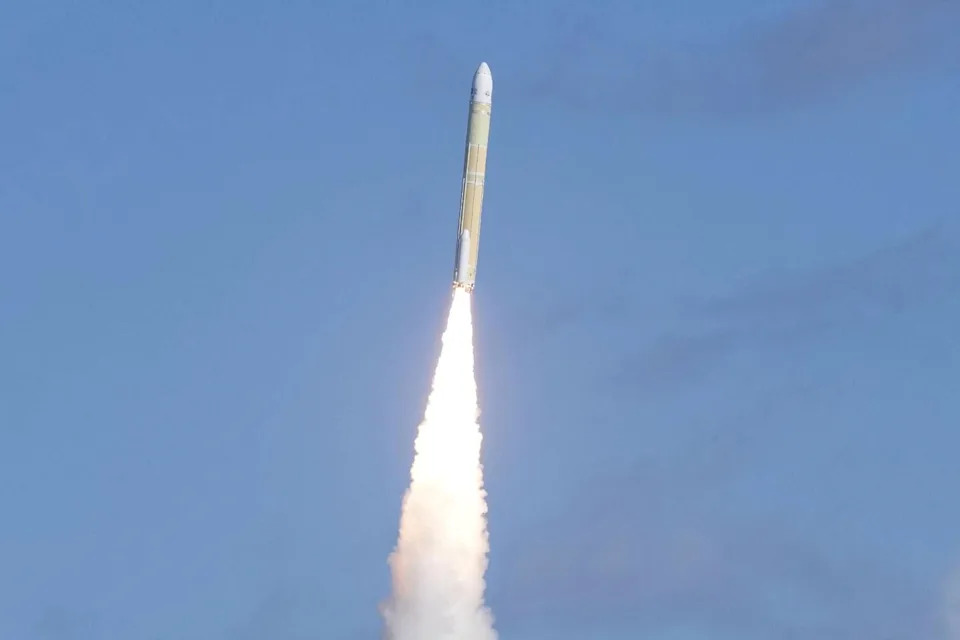
The H3 rocket (8th) by the Japan Aerospace Exploration Agency (JAXA), carrying a navigation satellite, is launched from the Tanegashima Space Center in Minamitane, Tanegashima island, southern Japan Monday, Dec. 22, 2025. (Kyodo News via AP)(ASSOCIATED PRESS)
Program Context and Impact
The setback is the H3’s second failure since its troubled debut in March 2023, which also involved a second-stage engine problem. In between those failures the H3 completed six successful flights. The H3 was developed to succeed the H-2A — a workhorse launcher with an almost flawless record — and to offer Japan a more cost-competitive, commercially viable launch capability important to both civilian and national security objectives.
The delay affects Japan's timetable for expanding QZSS: Tokyo aims to field a seven-satellite regional network by March 2026 and eventually grow to 11 satellites by the late 2030s to reduce partial reliance on U.S. GPS.
Next Steps
JAXA’s H3 project manager, Makoto Arita, emphasized that the rocket is still in the early operational phase and remains competitively viable globally. Officials pledged a full technical investigation and remedial actions to return the H3 program to a reliable flight cadence.
“We will fully investigate the cause and put H3 back on track,” Arita said.
Notably, the launch followed an abort five days earlier when JAXA scrubbed a countdown 17 seconds before liftoff due to an anomaly with a pad water-spray system. The agency continues to review both the recent pad issue and the flight data from Monday’s mission.


