
The Kentucky General Assembly directed the permanent reinstallation of a Ten Commandments monument to state Capitol grounds after passing HJR 15. The granite marker, donated by the Fraternal Order of Eagles in 1971, was removed around 1980 and could not be reinstalled after a 2000 ACLU lawsuit under the Lemon test. Supporters cited historical significance and a 2022 Supreme Court shift in Establishment Clause analysis, while some lawmakers warned about separation of church and state and representation for other faiths.
After 40 Years, Kentucky Reinstalls Ten Commandments Monument On State Capitol Grounds

The Ten Commandments monument returned to the Kentucky state Capitol grounds after 40 years.
A donated Ten Commandments monument has been permanently returned to the grounds of the Kentucky State Capitol this week, more than four decades after it was removed.
The granite marker was reinstalled on Wednesday after the Kentucky General Assembly approved House Joint Resolution 15. The measure passed the House 79–13 on Feb. 19 and the Senate 32–6 on March 13, directing state officials to restore the monument to Capitol property in Frankfort.
Rep. Shane Baker (R–Somerset), sponsor of HJR 15, praised the move in a press release: "I am pleased to see this historic Ten Commandments monument returned to its rightful place. The Ten Commandments have widely recognized historical significance in the history of the Commonwealth of Kentucky and the nation."
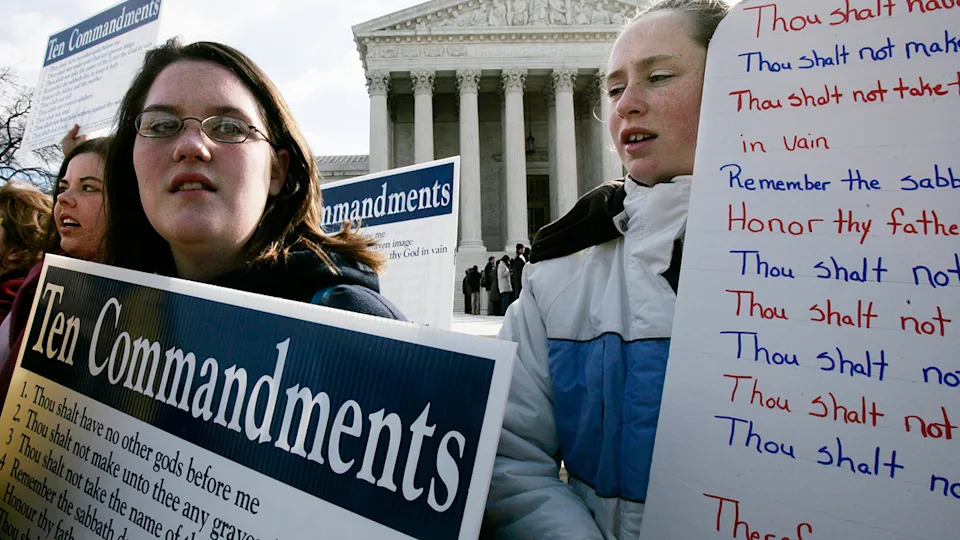
Anna Dollar (2nd L) of Boone, NC, and Deanna Gosnell (R) of Avery, North Carolina, hold posters during a rally in front of the U.S. Supreme Court to support the Ten Commandments March 2, 2005, in Washington, D.C.
Kentucky Attorney General Russell Coleman also celebrated the return, saying the Ten Commandments are "at the heart of America’s history and founding" and thanking lawmakers and Solicitor General Matt Kuhn for locating and helping restore the monument to the Capitol grounds.
The stone was originally donated to the state in 1971 by the Fraternal Order of Eagles and remained on display until it was removed around 1980 during a construction project. A later effort to reinstall the marker was halted in 2000 when the American Civil Liberties Union sued and a federal district court found that displaying the monument on public grounds violated the Establishment Clause under the then-applicable "Lemon" test.
The legal environment shifted in 2022 when the U.S. Supreme Court, in Kennedy v. Bremerton School District, stated that the Court had "long ago abandoned Lemon" and directed lower courts to resolve Establishment Clause disputes by considering "historical practices and understandings." Supporters of the reinstallation cited that ruling in arguing the monument’s return was legally and historically justified.

The Kentucky state Capitol in Frankfort, Kentucky, photographed on Wednesday, June 8, 2022.
First Liberty Institute, a religious-liberty law firm that represented the Fraternal Order of Eagles, applauded the restoration. Roger Byron, senior counsel for First Liberty, said the move restored "a part of their history." Vic Jeffries, trustee of Fraternal Order of Eagles Aerie 3423 in Hopkinsville, noted the organization has donated more than 100 Ten Commandments monuments to state and local governments and welcomed having theirs back at the Capitol.
Not all lawmakers supported the reinstatement. Some raised concerns about separation of church and state and how the Capitol should represent diverse faiths. State Rep. Joshua Watkins said the reinstallation "gives me a little heartburn around separation of church and state," and State Sen. Keturah Herron (D–Louisville) asked why the Ten Commandments were singled out and whether other faith traditions would have similar opportunities for representation.
Representative Baker responded that the resolution was intended to recognize the Ten Commandments' historical role in state and national history, not to open a general program authorizing religious displays. Fox News Digital reached out to the ACLU for comment.
Why it matters: The reinstallation illustrates how shifting Supreme Court precedent and state-level action can change the legal and public-policy landscape for religious symbols on government property. It also highlights ongoing debates about pluralism, representation and the separation of church and state.


