
The largest genetic analysis to date of psychiatric disorders identified five shared genomic factors linking 14 mental illnesses. Researchers analysed DNA from more than 1 million diagnosed individuals and about 5 million controls, finding 238 variants that explain roughly two-thirds of the genetic variance between cases and controls. The factors map to groups such as compulsive disorders, internalizing disorders, substance use disorders, neurodevelopmental conditions, and a bipolar–schizophrenia cluster, with pathways tied to excitatory neurons and oligodendrocytes. While not immediately changing clinical practice, the findings may guide future diagnostic and therapeutic research.
Major Study Finds Five Shared Genetic Factors Link 14 Psychiatric Disorders

Blue brain with purple double helix DNA in background
Genes we inherit shape our lifetime risk for mental illness, and a large international study now shows substantially more biological overlap across psychiatric disorders than previously recognised. The researchers say their findings could help reshape diagnosis and treatment by incorporating shared genetic influences alongside symptoms and behavior.
The Study And Methods
An international team analysed DNA from more than 1 million people diagnosed with one of 14 psychiatric disorders and compared those genomes with roughly 5 million controls without these diagnoses. The analysis used large-scale genetic methods to identify recurring patterns of genetic signals that occur across multiple disorders.
Five Shared Genomic Factors
The researchers identified five genomic factors — clusters of shared genetic signals — that underlie the conditions studied. Altogether, these factors are composed of 238 genetic variants and, on average, explain roughly two-thirds of the genetic variance that distinguishes people with psychiatric diagnoses from controls.
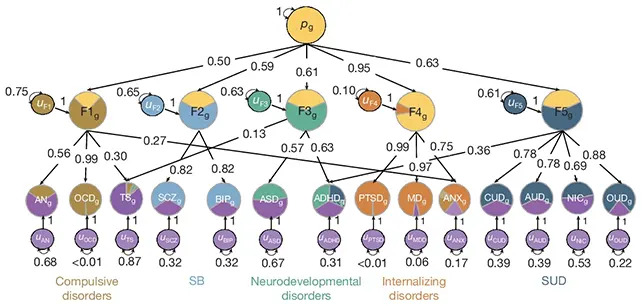
Disorders were grouped based on shared genetics. (Grotzinger et al.,Nature, 2025)
Each factor aligned most strongly with a particular set of conditions: a compulsive-disorders group (for example, obsessive-compulsive disorder), an internalizing-disorders group (including anxiety and depression), substance-use disorders, neurodevelopmental conditions (such as autism), and a combined bipolar–schizophrenia factor.
Notably, the bipolar–schizophrenia factor showed that about 70% of the shared genetic signalling between those two illnesses is common to both. "Genetically, we saw that they are more similar than they are unique," said neuroscientist Andrew Grotzinger of the University of Colorado Boulder.
Biological Pathways And Cell Types
The team mapped the shared risk variants to biological pathways that may point to mechanisms for future treatments. Several implicated pathways relate to early brain development and neuronal signalling. Genetic risks common to bipolar disorder and schizophrenia were associated with excitatory neurons, while the variants shared in the depression/anxiety cluster appeared to implicate oligodendrocytes — the support cells that maintain neuronal function.

Subscribe to ScienceAlert's free fact-checked newsletter
Implications For Diagnosis And Treatment
Researchers say these findings offer a biological explanation for the high rates of comorbidity seen in psychiatry — previous work shows more than half of people diagnosed with one psychiatric condition later receive another diagnosis. By identifying shared biology, the authors hope future strategies can target overlapping mechanisms so patients might not need multiple separate medications or entirely distinct psychotherapy approaches.
Limitations And Next Steps
The authors do not expect these results to immediately change clinical diagnostic rules. The study predominantly used existing datasets and the researchers emphasise the need to extend analyses to larger and more diverse populations to confirm that the findings generalise across ancestries and environments.
"This work provides the best evidence yet that there may be things we are currently giving different names to that are actually driven by the same biological processes," said Grotzinger.
"These findings provide valuable clues for advancing our understanding and treatment of mental illness with greater precision," added geneticist Jordan Smoller of the Broad Institute of MIT and Harvard.
The study was published in Nature.


