
New research in Nature Communications finds that microbialites—rock-like structures formed by microbial mats on South Africa’s coast—are actively and efficiently sequestering carbon. Fieldwork at four sites shows rapid calcium carbonate deposition (about two inches per year) and similar carbon uptake rates day and night, indicating non-photosynthetic carbon fixation. The authors estimate microbialites absorb roughly 20–25 lbs (9–16 kg) of CO2 per square meter per year, making them among nature’s most effective long-term carbon stores.
Living Rocks: South Africa’s Microbialites Lock Up Large Amounts of Carbon

A cross sectional image of an actively growing microbialite from South Africa.
Alongside South Africa’s carnivorous plants, great white sharks and orca whales, a remarkable and unexpected form of life thrives: “living rocks” known as microbialites. These reef-like structures are built by dense mats of microbes that precipitate dissolved minerals into hard, rock-like layers. Microbialites are not only modern ecosystems but also some of the oldest records of life on Earth.
A new study published in Nature Communications shows that microbialites on South Africa’s southeast coast are actively sequestering carbon by converting dissolved carbon into calcium carbonate. Researchers investigated four coastal sites where calcium-rich hard water seeps through sand dunes and examined growth and carbon uptake over multiple field seasons.
Fast Growth and Day–Night Carbon Uptake
The team found surprisingly rapid vertical growth—roughly two inches per year—and measured carbon dioxide uptake rates of about 20–25 pounds (9–16 kg) of CO2 per square meter annually. Equally notable, daytime and nighttime carbon uptake rates were similar. Because photosynthesis requires sunlight, the persistence of nighttime uptake indicates microbes are using additional metabolic pathways to fix carbon in the dark, akin to microbes that thrive at deep-sea vents.
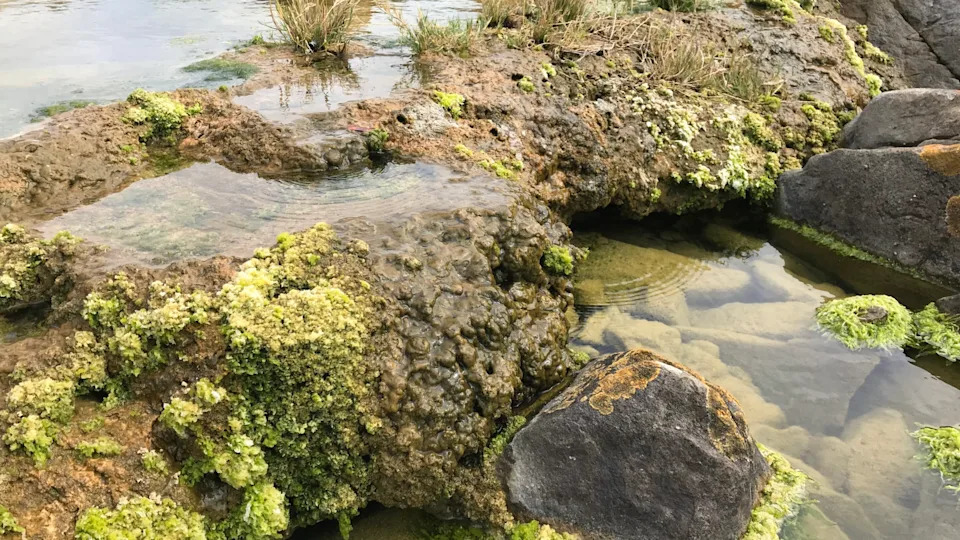
A pool of water dominated by microbialites in South Africa’s Eastern Cape.Image: Rachel Sipler.
“These ancient formations that the textbooks say are nearly extinct are alive and, in some cases, thriving,” said Dr. Rachel Sipler, a study co-author and marine biogeochemist at Bigelow Laboratory for Ocean Sciences. “We’ve found robust microbial communities capable of growing quickly under challenging conditions.”
Why It Matters
By converting dissolved carbon into stable mineral deposits, microbialites move carbon out of the water column and lock it into long-lasting calcium carbonate. The authors estimate that a patch the size of a tennis court could sequester as much CO2 annually as about three acres of forest, making microbialites one of the most efficient biological mechanisms observed for long-term carbon storage.
The researchers contrast microbialites with coastal marshes, which also absorb carbon at comparable rates but store it mainly as organic matter that is easier to decompose. The team is now investigating how environmental conditions and microbial community composition determine whether carbon ends up in short-lived organic pools or in durable mineral form.
These findings underscore how diverse microbial metabolisms and geochemistry can combine to produce unexpectedly effective natural carbon sinks, and they highlight the value of studying living microbialites as windows into both Earth’s past and potential climate-relevant processes today.


