The heart can adopt the biological age of its new host after transplantation, according to a bioRxiv preprint by Jesse Poganik et al. Mouse heterotopic transplants showed older donor hearts become epigenetically younger in young recipients, while younger hearts aged faster in older hosts. Small human biopsy data (11 patients) and follow-up clinical records—particularly exercise capacity and VO2max—support the pattern. The findings suggest systemic, possibly metabolic or mitochondrial, factors shape organ aging, but larger clinical studies are needed to confirm clinical benefits.
Old Hearts Rejuvenate in Young Recipients: Transplanted Hearts Adopt Their Host's Biological Age
(Violka08/Creatas Video+/Getty Images Plus)
The heart is one of the body's most vital organs, protected by the sternum and ribs and continuously pumping blood to deliver oxygen, nutrients and other essentials. A new preprint on bioRxiv from Jesse Poganik and colleagues at Harvard Medical School challenges the assumption that an organ’s biological age is fixed: when a heart is transplanted into a body much younger or older than its donor, the organ can begin to mirror the biological age of its new host.
Key Findings
Using mouse models and a small set of human biopsy samples, the researchers report that:
YouTube Thumbnail
- Old donor hearts placed into younger mice or people showed epigenetic signs of rejuvenation.
- Young donor hearts placed into older recipients displayed epigenetic signatures consistent with accelerated aging.
- The effect in mice appeared largely one-way: the recipient’s own heart, liver and blood showed little change in biological age after receiving a heterochronic graft.
How They Studied It
In mice, the team used a heterotopic heart transplant model (the recipient keeps its native heart while a donor heart is connected to vessels in the neck) and performed age-mismatched transplants alongside same-age controls. Four to six months after surgery they measured DNA methylation patterns—commonly used in epigenetic clocks—to estimate biological age in transplanted and native tissues.
Human Evidence
The authors analyzed archived biopsy tissue from 11 human cardiac transplant recipients whose donor ages differed substantially from their own (recipient ages ranged from 24 years younger than donor to 50 years older). DNA methylation patterns in those biopsies correlated more closely with recipient age than donor age, mirroring the mouse results. The human sample is small but directionally consistent with the animal data.
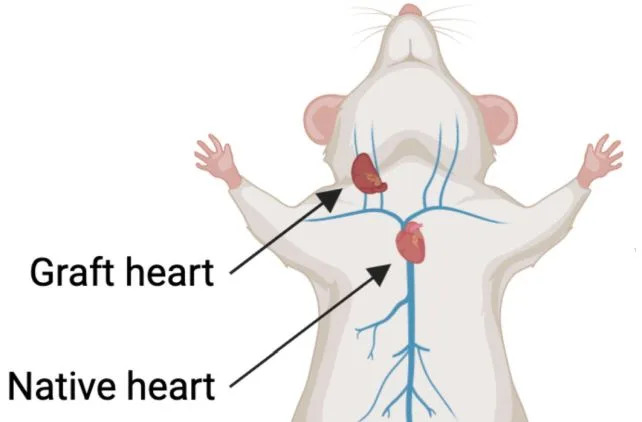
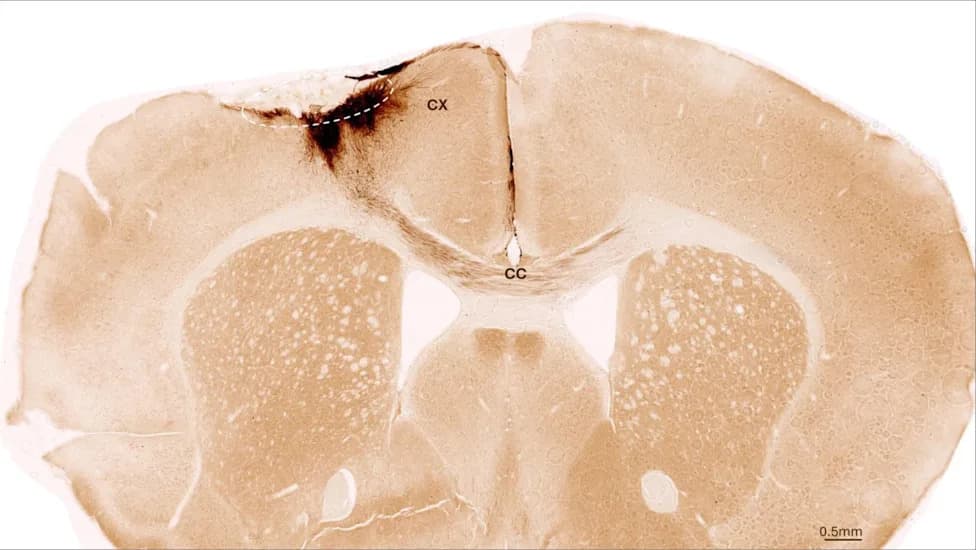
A diagram illustrating the heterotopic heart transplant protocol used in the study, in which a donor heart is connected to blood vessels in the recipient mouse's neck. (Poganik et al., bioRxiv, 2026)
Clinical Records and Function
To broaden the evidence beyond biopsies, the study also evaluated clinical follow-up data from hundreds of transplant recipients one year after surgery. Several structural and functional measures correlated with recipient age rather than donor age; most notably, exercise capacity and VO2max declined as recipient age increased regardless of donor heart age.
Possible Mechanisms
Gene-expression changes in the transplanted mouse hearts implicated mitochondrial and metabolic pathways, suggesting host systemic factors (circulating metabolites, immune milieu, or signaling molecules) may remodel an organ’s molecular aging profile. The exact mediators remain unknown.
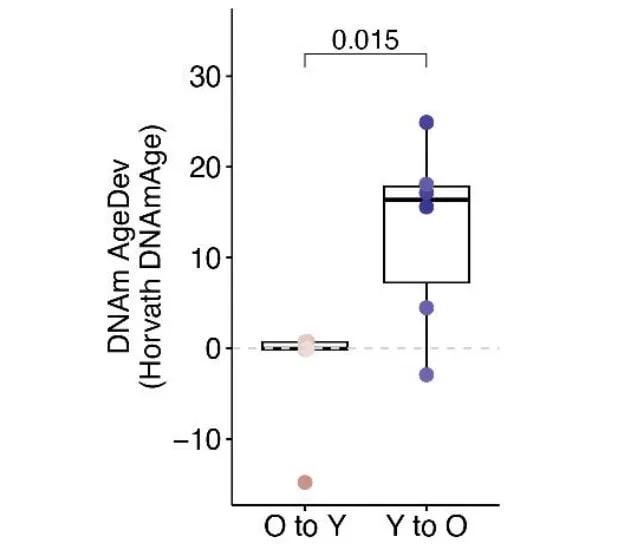
Older hearts transplanted into younger recipients (O to Y) showed signs of biological rejuvenation compared with younger hearts transplanted into older recipients (Y to O). (Poganik et al., bioRxiv, 2026)
Implications
If validated in larger clinical datasets, these findings could influence donor selection policies. Chronological donor age may be an incomplete indicator of an organ’s potential—older hearts might perform well in younger recipients if they undergo molecular rejuvenation, potentially expanding the donor pool.
Limitations and Cautions
- The human dataset is small (11 biopsy samples) and retrospective; causation and clinical benefit are not established.
- It remains unclear whether molecular signs of rejuvenation translate to improved long-term outcomes for recipients.
- Timing, durability of the effect, and whether other organs behave similarly are unanswered questions.
- The study is currently a preprint and has not yet undergone peer review.
“Our carefully controlled mouse study paired with our extensively quality-controlled human DNAm data present compelling evidence supporting age assimilation of tissues placed into heterochronic systemic environments,” the authors write.
Overall, the work offers an intriguing glimpse into how a host’s systemic environment can reshape the biological age of a transplanted organ. Larger, controlled clinical studies are needed to confirm these results and to determine whether they can safely broaden donor criteria or improve transplant outcomes.
Help us improve.