Declining secondary enrollment in STEM is becoming a regional problem across West Africa. Ivory Coast reported just 0.6% in the elite maths-and-physics baccalaureate track in 2022, while broader science participation fell from 45% in 2015 to 38% in 2022. Officials cite underinvestment, teacher shortages and few labs; governments are launching campaigns, specialised schools and preparatory programmes to rebuild the pipeline of scientists and engineers.
West Africa's STEM Crisis: Falling Science Enrollment Threatens Future Researchers
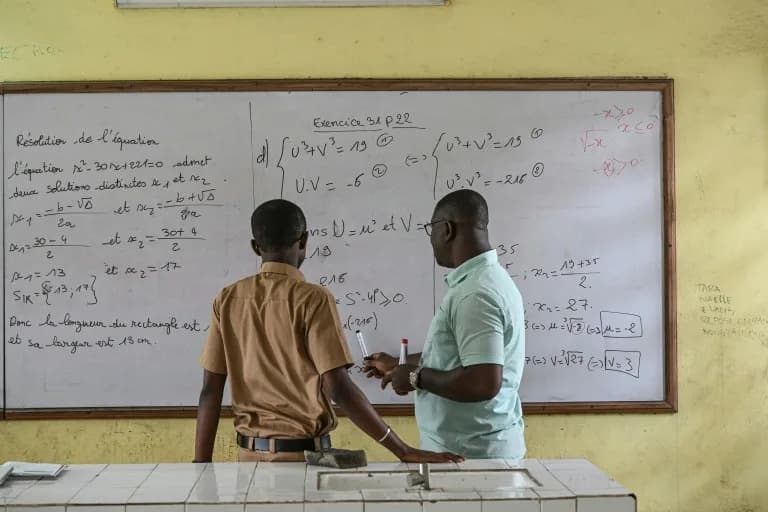
Fewer and fewer students are choosing to study science across west Africa (Sia KAMBOU)
Across West Africa, a stark classroom contrast is emerging: overflowing humanities lessons sit beside sparsely populated maths and science classes. The shift away from STEM (science, technology, engineering and mathematics) at secondary level risks creating a long-term shortage of engineers, researchers and innovators.
Evidence From Ivory Coast And Beyond
In Ivory Coast, just 0.6% of candidates for the 2022 baccalaureate sat the elite maths-and-physics track, while the broader sciences stream fell to 38% in 2022 from 45% in 2015, according to education ministry figures. Similar declines have been recorded in Mali, Burkina Faso, Guinea, Senegal and Niger. In Senegal, for example, the share of baccalaureate students taking science fell from nearly 30% in the early 2000s to 15.5% by 2026. Some schools in Niger have even shut down science classes because of chronically low enrolment.
Why Students Are Turning Away
Officials and teachers point to multiple causes: long-term underinvestment in science education, a shortage of qualified teachers, and inadequate laboratories and equipment. Many students also view STEM subjects as unusually difficult and time-consuming, and some teachers, unintentionally, make the disciplines feel intimidating.
"Students are afraid of choosing science streams because they think it means more work," said Melagne Agnimel, Ivory Coast's inspector-general for secondary education.
Post‑Secondary Bottlenecks And The Brain Drain
Problems persist after graduation. University programmes often lag behind international scientific advances; specialist engineering schools and research opportunities are limited; and local salaries and career paths outside teaching can be uncompetitive. As a result, many graduates seek scholarships or jobs abroad, deepening a regional brain drain.
Government Responses And Local Examples
Governments across the region are trying to reverse the trend by launching awareness campaigns, creating science-focused schools, expanding specialist programmes and establishing science hubs. In Ivory Coast, officials are introducing elite preparatory classes and nationwide science centres aimed at attracting top maths and physics students.
On The Ground: Students And Teachers
In Abidjan’s Lycée Moderne de Cocody, an 11th-grade maths class of 37 students—unusually large by current local standards—worked through equations under teacher Fabrice Guei’s probing questions. Yet literature classes nearby can swell to about 80 pupils, underscoring the shift in student preferences.
For students like 19-year-old Abdoulaye Harouna, the sacrifice can pay off: his brother studied the same subjects and now works as a solar-energy engineer. "If you do well in this field, your future is guaranteed," he said.
Why It Matters
With African countries seeking to grow sectors from medicine and manufacturing to artificial intelligence, a dwindling pipeline of STEM-trained graduates threatens economic development and the continent's ability to contribute to global research. Reversing the trend will require sustained investment in teachers, labs, curricula and career pathways that make science both accessible and attractive to young people.
Help us improve.