The DHS Office of Inspector General found ICE could not locate most visa overstays it designated as Priority 1 between 2021 and late 2024, resulting in only eight arrests from roughly 104,000 such cases. The shortfall is linked to a September 2021 memo narrowing ICE priorities, incomplete address data, verification challenges, limited staffing and coordination issues with CBP. The report has prompted renewed debate over interior enforcement and led to policy shifts and increased funding since the review period.
Watchdog: ICE Couldn’t Locate Most ‘High‑Risk’ Visa Overstays During 2021–2024

Then-President Joe Biden, U.S. Army Corps of Engineers Chief of Engineers and Commanding General William Graham, Jr. (L), and Homeland Security Secretary Alejandro Mayorkas (C) at the White House on October 11, 2024.
A Department of Homeland Security (DHS) Office of Inspector General (OIG) report released Thursday found that U.S. Immigration and Customs Enforcement (ICE) was unable to locate or take meaningful action against the majority of visa overstays the agency labeled as high risk while the Biden administration dealt with record arrivals at the southern border and increased temporary entries at airports.
Key Findings
The OIG said that between 2021 and late 2024 ICE could not locate most of nearly 105,000 individuals classified as potential national security or public safety threats—so-called Priority 1 overstays. During the period covered by the review, ICE made just eight arrests tied to those cases.
Between October 2020 and September 2024, ICE received 3,145,375 overstay leads, about 3% of which (approximately 104,049) were flagged as potential national security or public safety concerns. ICE deemed 21,895 of those leads viable for investigation; investigators ultimately arrested eight people connected to those CBP-monitored leads.
Why So Few Arrests?
The OIG identified several operational and policy drivers behind the shortfall:
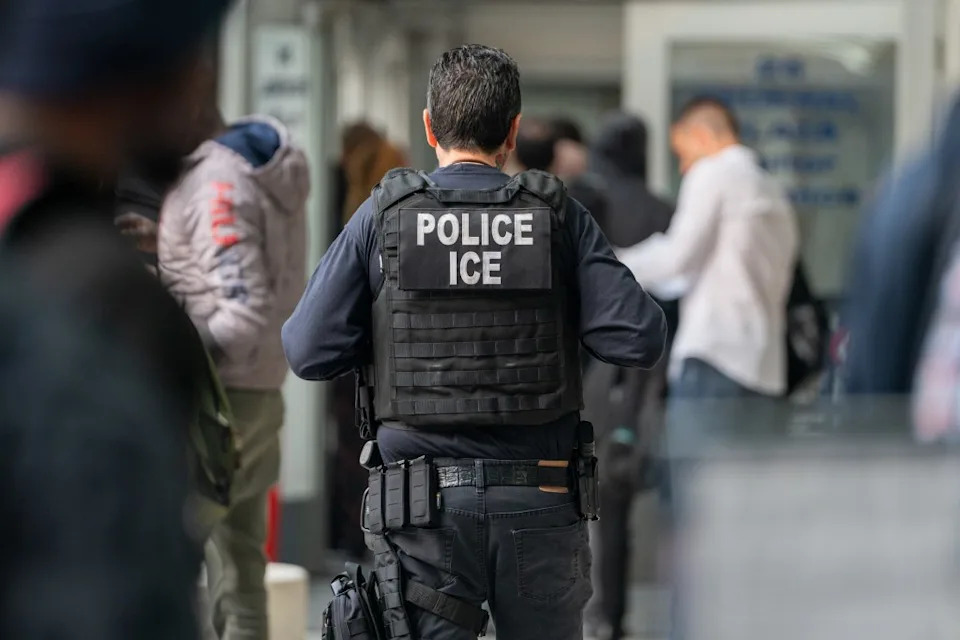
An ICE agent monitors asylum seekers being processed at the Jacob K. Javits Federal Building on June 6, 2023, in New York City.
- Policy Prioritization: A September 2021 memo from then‑Secretary Alejandro Mayorkas emphasized a narrow set of enforcement priorities, which limited ICE’s pursuit of many overstay leads.
- Incomplete Data: Many records lacked usable address information or contained unverifiable contact details. The report notes that at the end of fiscal 2024 ICE could not refer 194 of 205 identified Priority 1 leads because address information was missing.
- Resource Constraints: ICE reported insufficient staffing and technology to follow up on the large volume of leads.
- Coordination Gaps: The OIG cited earlier findings that Customs and Border Protection (CBP) did not always collect complete address information before transferring cases to ICE; the OIG said some of those issues had since been addressed.
Examples and Reactions
The report includes case examples that illustrate both risks and investigative hurdles: a Honduran national admitted on a B‑2 visa who later faced rape and sexual assault charges and whose visa expired before federal agents detained him months later; and convicted offenders from Jamaica and Chile who could not be located after release or disappearance.
"As a result, foreign nationals who potentially posed threats to the United States remained at large despite their illegal status," the OIG wrote.
Responses were sharply divided. Immigration‑restriction advocates argued the findings validate calls for more vigorous interior enforcement. Jessica Vaughan of the Center for Immigration Studies said the report underscores the need to prioritize overstays and increase enforcement resources. By contrast, critics warned that sweeping interior enforcement can uproot families and communities and that it is unrealistic to find every overstayer. Greg Chen of the American Immigration Lawyers Association cautioned against targeting long‑established residents and noted public opposition to broad sweeps.
Policy Changes Since the Report
The OIG noted that DHS priorities have shifted under the administration in office after the report’s timeframe, with ICE saying it is committed to improving identification, investigation and enforcement of overstay cases. The agency has received increased funding to expand staff and improve tracking systems, though DHS has also reduced public access to some enforcement data since January 2025, limiting direct cross‑administration comparisons.
What The Report Means
The OIG’s review highlights persistent challenges in interior immigration enforcement: very large volumes of overstay leads, incomplete or inconsistent data collected at entry, finite investigative resources, and changing policy priorities across administrations. Taken together, those factors contributed to many Priority 1 overstays remaining in the United States after their visas expired.
Newsweek sought comment from DHS and from Alejandro Mayorkas, who has been a visiting fellow at Harvard's Institute of Politics; no substantive public responses were reported in the OIG release.
Help us improve.