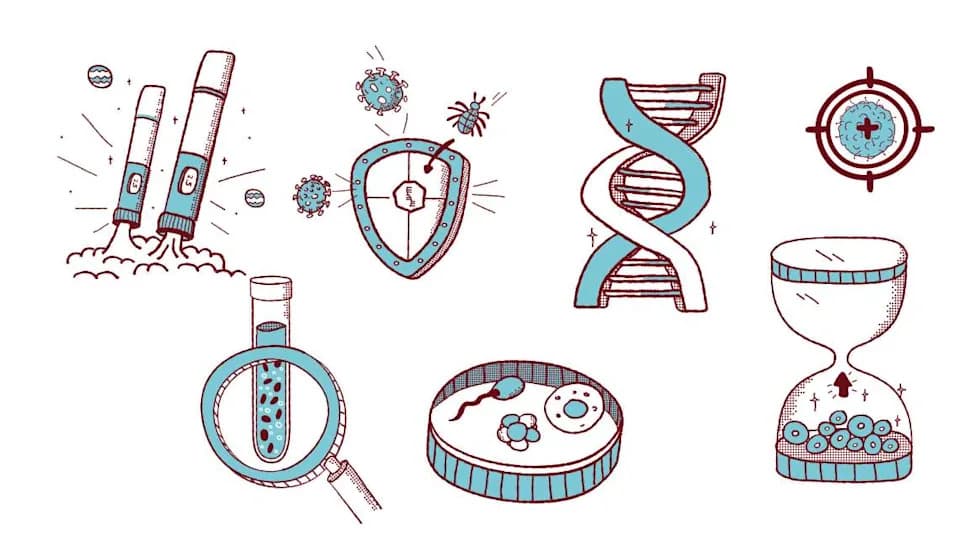
PGT‑P uses polygenic risk scores to estimate probabilities for complex traits — from disease risk to height and, controversially, IQ — but it does not give certainties. While some parents pay thousands to select embryos with perceived advantages, professional societies warn the method is new and lacks long‑term validation. The technology offers reassurance for some and new anxieties for others, raising ethical concerns about eugenics, inequity and the emotional cost of decisions based on probabilistic data.
Would You Pay $50,000 for a Few Extra IQ Points? Inside Families Choosing Embryo Selection (PGT‑P)

Inside the World of "Smart" EmbryosJamie Chung
To the casual observer, nine‑month‑old Tex Demeisen Collins looks like any other baby: calm in a carrier during a Zoom call and content in his mother's arms. What sets Tex apart is that, before implantation, his embryo was analyzed, scored and ranked using preimplantation genetic testing for polygenic disorders (PGT‑P). His parents, Simone and Malcolm Collins, paid thousands to select what they judged the healthiest embryo from a cohort.
What Is PGT‑P and How Is It Different?
In IVF, embryos can be tested before transfer. Traditional tests include PGT‑A (which screens for chromosomal abnormalities such as Down syndrome) and PGT‑M (which looks for single‑gene hereditary disorders like cystic fibrosis or Huntington’s disease). Both return relatively clear results: euploid vs. aneuploid, or presence vs. absence of a pathogenic mutation.

Dan Saelinger
PGT‑P is different. It uses polygenic risk scores derived from large adult biobanks to estimate an embryo’s relative probability of developing complex traits or conditions — for example, type 2 diabetes, some cancers, height and, controversially, intelligence (IQ). Instead of a yes/no answer, PGT‑P returns probabilistic estimates: an embryo might be described as having a higher or lower predicted risk for a condition compared with population averages or sibling embryos.
Costs, Claims, And Who’s Offering It
Embryo screening can be expensive. Testing alone may cost up to roughly $50,000 in some packages, not counting IVF cycles. Several startups — notably Nucleus Genomics, Herasight and Orchid Health — offer PGT‑P or related services. Firms vary in which traits they report and how they present results; some provide broad “health scores,” others also model height or IQ ranges.

Peter Crowther
Scientific Limits And Professional Caution
Major reproductive‑medicine bodies are cautious. The American Society for Reproductive Medicine (ASRM) calls PGT‑P "a nascent and unproven technology" and does not recommend it as a routine clinical service. Experts note there are no long‑term, decades‑long validation studies that follow embryos screened today into adulthood, so claims about predictive power remain probabilistic and contested.
Company leaders defend their models. Some founders say polygenic scores are robust for a limited set of traits and that large datasets enable validation across populations. Others — including Orchid’s leadership — explicitly avoid offering IQ as a central decision factor, citing fragile evidence for intelligence prediction. Genetic counselors emphasize that interpreting polygenic scores is complex even for clinicians.
Getty Images
Ethics, Marketing And The Risk Of Eugenics
PGT‑P raises sharp ethical concerns. Critics warn that expanding embryo selection beyond medical prevention to traits such as height or IQ flirts with eugenic ideas and creates new moral pressures on prospective parents. Marketing that frames unscreened reproduction as a "roll of the dice" can shift responsibility and stigmatize choices made without testing. Companies have faced public backlash for tone‑deaf ads and slogans such as “Have your best baby.”
Why Parents Choose PGT‑P: Control, Guilt, Hope
For many families, the appeal of PGT‑P is emotional as well as statistical. Some parents seek to reduce known genetic risk (e.g., a family history of cancer or early‑onset disease); others want any additional reassurance they can afford. Personal stories reflect this mix of motives:

Hearst Owned
- The Collinses used PGT‑P to prioritize embryos with lower modeled cancer risk and also considered predicted IQ as one of several weighted factors when planning birth order and implantations.
- Carmen traveled from Romania to receive IVF+ services, choosing a female embryo despite a male embryo having a higher predicted IQ because sex selection mattered more to her.
- Cheri pursued testing after her second child was born with congenital adrenal hyperplasia, feeling guilt about unknowingly passing on carrier genes.
- Sarah endured multiple IVF rounds and now wonders whether knowledge of an embryo’s abnormal status helped or complicated her emotional journey; she keeps a frozen abnormal embryo and struggles with what to do next.
- Some families — like early Orchid users — treated results as reassurance rather than destiny, emphasizing that screened and unscreened siblings often develop in normal, unpredictable ways.
What PGT‑P Can (And Can’t) Do
PGT‑P can shift relative probabilities. Within a set of embryos from the same parents, a given embryo may have a lower modeled risk for certain conditions than its siblings. But it cannot guarantee outcomes or deliver exact IQ scores. Scores are built from adult datasets and carry uncertainty; environmental factors and gene‑environment interactions remain critical determinants of health and traits.
Practical Guidance For Prospective Parents
Genetic counselors and ethicists recommend clarifying goals before testing: Are you aiming to reduce a specific medical risk, or to select for nonmedical traits? Understand costs, limitations and the emotional consequences of probabilistic information. Ask providers how models were validated, whether scores are adjusted for ancestry, what traits are robustly supported, and how results will be communicated and used.
Bottom line: PGT‑P is emerging technology that offers probabilistic insights into embryo traits. It gives some families a sense of control and reassurance, but it raises unresolved scientific, ethical and emotional questions. No test can promise a “perfect” child; expecting certainty from probabilistic scores creates inevitable what‑ifs.
Help us improve.