Missouri invested millions in reading reform, but fourth-grade NAEP scores fell 10.4 points from 2013 to 2024. The 74's Bright Spots analysis adjusted for poverty and identified 2,158 schools — out of roughly 42,000 — that outperform expectations. Several open-enrollment and magnet schools posted especially strong results for low-income students, English learners and students with disabilities. Policymakers should study these schools to identify scalable practices that could help more children read proficiently.
These Missouri Schools Beat the Odds on Reading — Lessons for Statewide Reform

Missouri has poured millions into teacher training, evidence-based reading instruction, universal literacy screening and targeted interventions — yet statewide reading results have not recovered. On the National Assessment of Educational Progress (NAEP), the state's average fourth-grade reading score dropped 10.4 points between 2013 and 2024, one of the nation's steepest declines.
What The Data Shows
A detailed Bright Spots analysis from The 74 adjusted for student demographics and poverty to identify schools that produce stronger-than-expected reading outcomes. After controlling for economic differences, researchers analyzed roughly 42,000 public schools and flagged 2,158 as "Bright Spots": schools that appear to add measurable value for students' reading achievement.
Which Schools Stand Out
Rather than rewarding raw scores that can reflect family resources or prior preparation, the Bright Spots approach highlights schools that outperform expectations for their student populations. In Missouri:
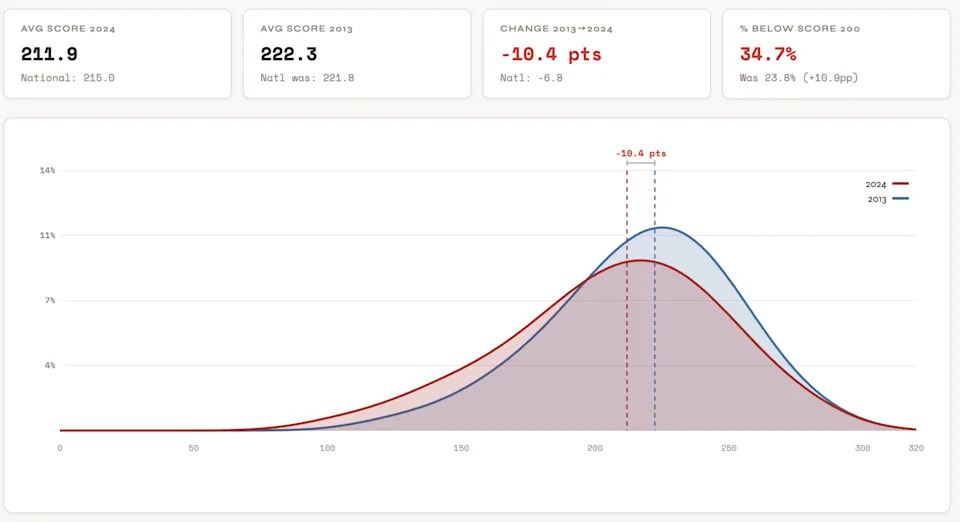
Source: Image comes from aNAEP Score Distribution Explorertool the author built using Claude. Raw data comes fromNAEP.
- Statewide third-grade reading proficiency was just under 42% in 2025, while low-income students scored under 30%.
- Among schools with at least 20 low-income test-takers, 83 achieved proficiency rates for economically disadvantaged students that exceeded the statewide average for all students. Some of these are selective magnets (for example, Mallinckrodt Elementary in St. Louis and John T. Hartman Elementary in Kansas City), while others are open-enrollment neighborhood schools that may offer more replicable practices (for example, Cedar Springs and Cole Camp elementaries).
- English learners performed especially well at certain schools: McKelvey Intermediate reported 71% proficiency for English learners on the third-grade reading test — roughly 30 percentage points higher than the statewide overall proficiency rate. The North Kansas City School District supplied two of the top five schools in this category.
- Students with disabilities statewide reached just 14% proficiency in third-grade reading, but some schools bucked that trend. For example, students with disabilities at Lakeview Elementary (Wentzville) outscored the statewide average for all students. The Lindbergh School District had two of the top five schools serving this population.
Why These Results Matter
Income, language status and disabilities are strongly correlated with reading outcomes, but they do not fully determine school results. Exceptional leadership, skilled teachers, targeted curricula, screening and intervention systems, and local supports may explain why some schools beat the odds. Data alone cannot reveal which factors are causal, but it can point policymakers and practitioners where to look.
Actionable Steps For Policymakers
To accelerate statewide improvement, Missouri leaders should study Bright Spots closely. Practical steps include:
- Visiting classrooms to observe instruction and intervention in action.
- Interviewing principals, teachers and literacy coaches about training, pacing and supports for struggling readers.
- Reviewing adopted curricula, screening tools and progress-monitoring systems.
- Examining how schools allocate staff time, use paraprofessionals and deliver small-group instruction.
The Bright Spots project provides a starting map: it identifies schools producing unexpectedly strong reading outcomes. From careful visits and follow-up analysis, state leaders may identify practical, scalable strategies to help more Missouri children read proficiently.
Sources: NAEP; Bright Spots project (The 74). The author used a NAEP score-distribution explorer tool in the analysis.
Help us improve.