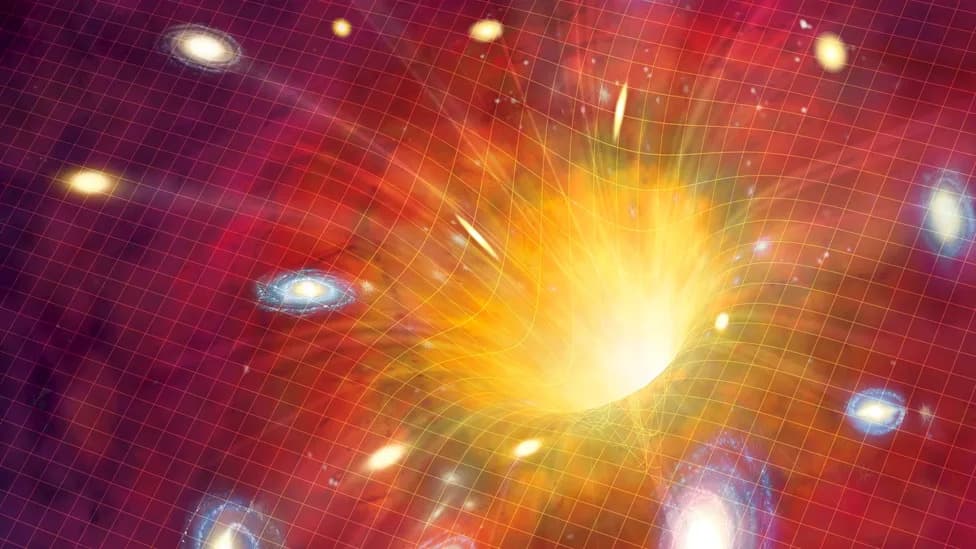
Big Bang Nucleosynthesis (BBN), the brief era about 10 minutes after the Big Bang when light nuclei first formed, is regaining prominence as a precision cosmological probe. A September 2026 helium‑4 measurement, together with precise deuterium data, now constrains the early‑universe radiation content more tightly than current CMB measurements and pins down the baryon density with comparable accuracy. Because better BBN constraints mainly need more observing time rather than new facilities, this revival offers a timely, cost‑effective way to test dark‑matter and beyond‑standard‑model theories.
Big Bang Nucleosynthesis Is Back in the Spotlight: How a 10‑Minute Epoch Is Rewriting Early‑Universe Tests
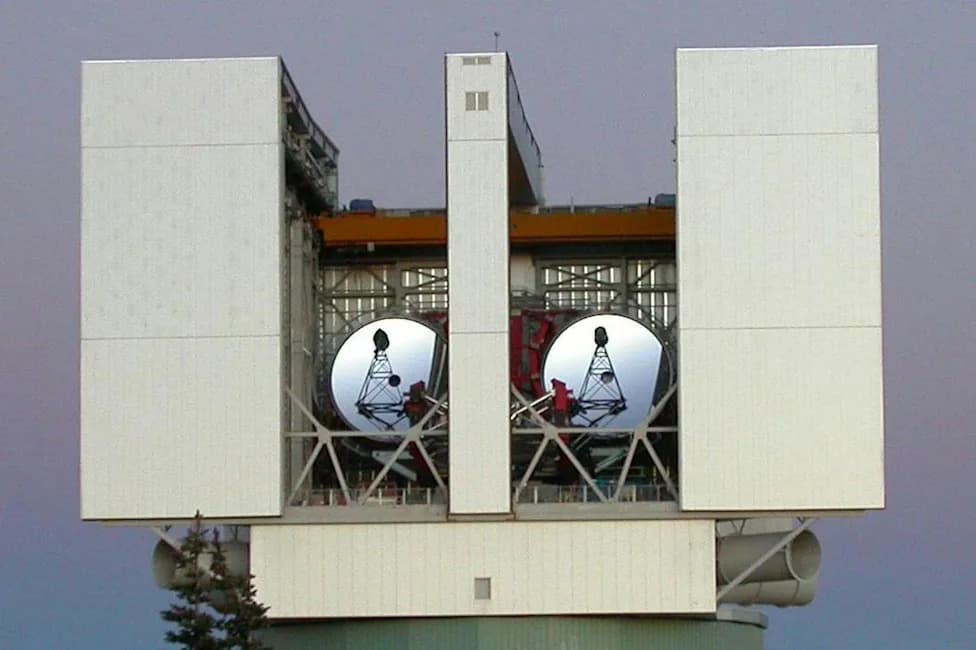
The Large Binocular Telescope was used to take the new measurement of primordial helium-4.NASA
Could you imagine pagers making a comeback? Your smartphone would still do everything—notes, flashlight, camera, music, wallet—but a simple device that made one task effortless could find a niche. A similar surprise is unfolding in cosmology: an old, overlooked epoch of the universe—Big Bang Nucleosynthesis (BBN)—is staging a comeback as a precision probe of fundamental physics.
Why BBN Matters
BBN refers to the first minutes after the Big Bang, when the universe was hot and dense enough for protons and neutrons to fuse into the first light nuclei. In roughly the first 10–20 minutes, nuclear reactions produced deuterium, helium-3, tritium and the abundant helium-4. Free neutrons are unstable (with a lifetime of about 15 minutes) and decay into protons, so the evolving neutron-to-proton ratio strongly influences the final mix of light elements.
Astrophysicists measure the primordial abundances of helium-4 and deuterium in distant, chemically primitive gas clouds and nearby low-metallicity galaxies. Those primordial abundances encode the conditions of the very early universe—most importantly the radiation density (often parameterized as N_eff), and the baryon density (the abundance of protons and neutrons).
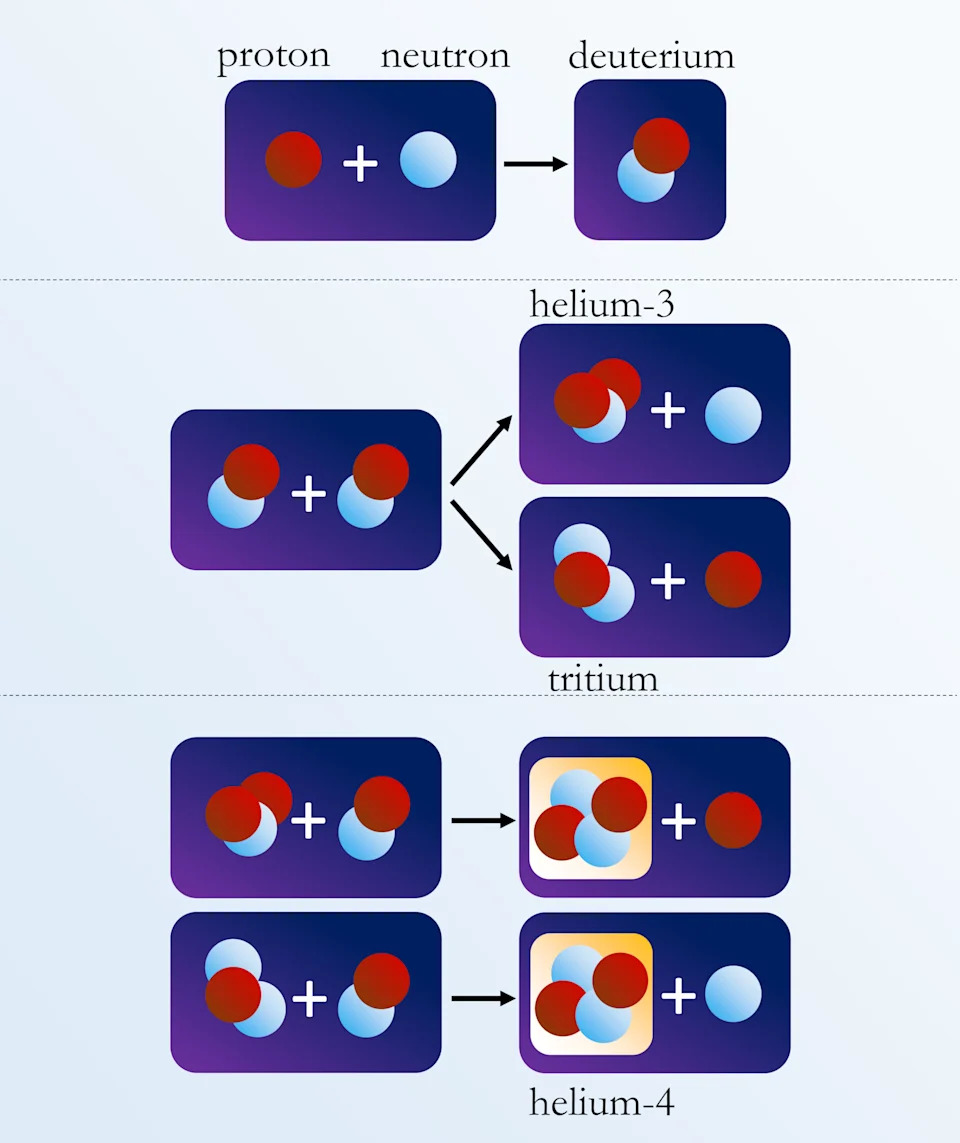
Particles fused together in the first few minutes of the universe to create larger and more complicated particles. Cara Giovanetti, CC-BY-SA
New Precision, New Power
A helium-4 abundance measurement published in September 2026 has reached remarkable precision. Combined with two decades of ever-improving deuterium determinations, BBN now constrains the early-universe radiation density more tightly than current measurements of the Cosmic Microwave Background (CMB). Deuterium measurements independently pin down the baryon density with precision approaching that of the CMB.
Why this matters: Small deviations in the radiation content of the early universe are predicted by many particle-physics scenarios—additional light particles, some dark-matter models, or other beyond‑standard‑model physics. Tight BBN constraints can validate or rule out these proposals.
How BBN Compares With the CMB
The CMB—radiation emitted roughly 400,000 years after the Big Bang—has been the workhorse of precision cosmology because its temperature fluctuations let us infer six key cosmological parameters. But upcoming progress for the CMB depends on major projects: the Simons Observatory is beginning observations and should improve constraints, while the proposed next-generation experiment CMB‑S4 was suspended, creating a gap in the roadmap.
By contrast, improving BBN constraints is relatively low‑cost: observers mainly need more time on current or planned telescopes to measure primordial abundances in additional pristine environments. That makes BBN a timely and complementary way to sharpen our picture of the universe's composition and to test particle‑physics ideas.
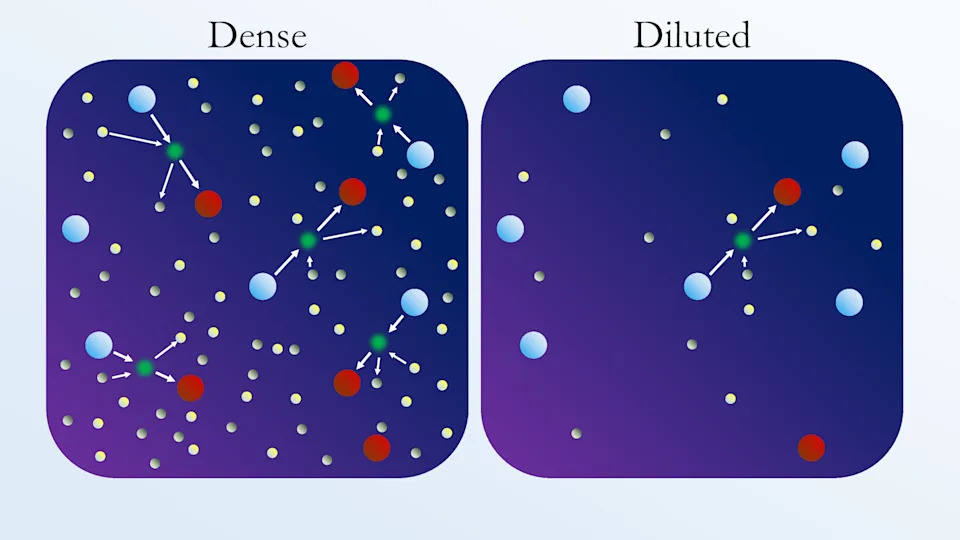
In a dense universe, particles interact easily, and neutrons (blue) turn into protons (red). If the universe is not very dense, interaction becomes much harder, and more neutrons stick around. Cara Giovanetti, CC-BY-SA
Outlook
BBN is not replacing the CMB; rather, it is emerging as a powerful, independent probe that now rivals the CMB for specific quantities—especially the radiation budget and baryon density. Together, BBN and CMB measurements offer cross-checks that strengthen conclusions about dark matter and new physics. With modest investments in observing time and careful analysis, cosmologists and particle physicists can use this 10‑minute epoch to learn more about the universe's origin, content and fate.
By Cara Giovanetti, University of California, Berkeley
Republished from The Conversation, a nonprofit news organization providing trustworthy analysis.
Help us improve.