Researchers modeled giant impacts and interior evolution of early Earth and identify a narrow window — centered at about 4.33 billion years ago — when conditions were most favorable for an RNA‑dominated stage of life. Heavy bombardment likely sterilized Earth's surface until roughly 4.4 billion years ago; once impacts subsided, shallow hydrothermal systems could concentrate nucleotides, peptides and lipids. The findings suggest a possible ~130‑million‑year gap before LUCA, though uncertainties could extend this to ~240 million years.
Scientists Pinpoint 4.33‑Billion‑Year 'Sweet Spot' for the RNA World Before LUCA

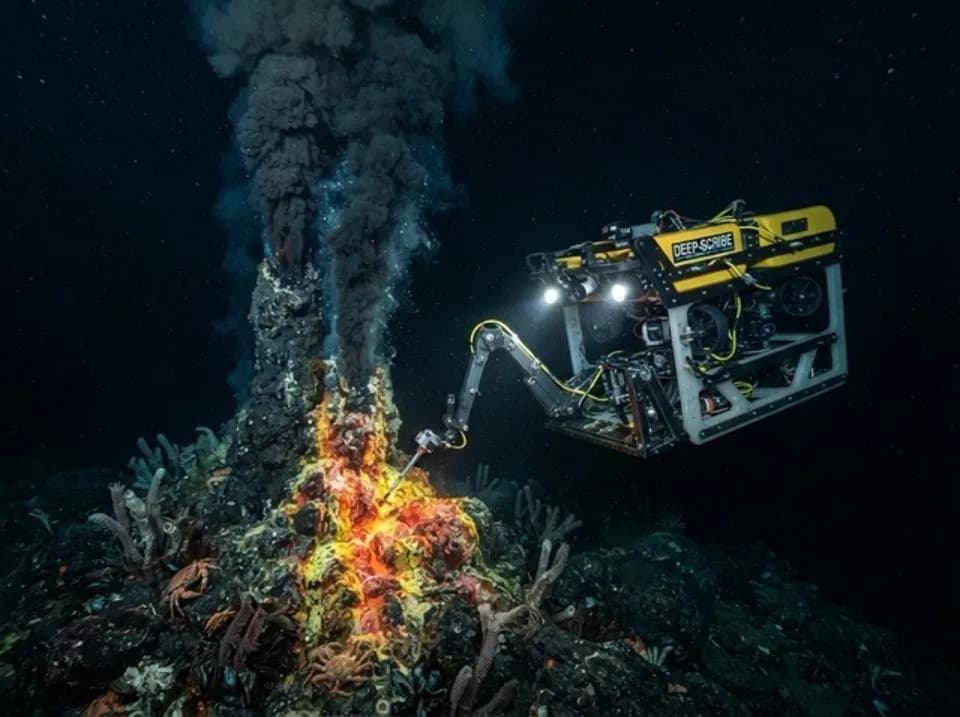
Shallow hydrothermal springs similar to the ones in Yellowstone may have hosted the building blocks of early life on Earth. | Credit: Manon Rousselle via Getty Images
Scientists have identified a narrow window in Earth's deep past when conditions were most favorable for a hypothesized early stage of life known as the RNA World. New simulations place that "sweet spot" at about 4.33 billion years ago, with habitable conditions possibly emerging as early as 4.4 billion years ago once the heaviest phase of asteroid and comet bombardment subsided.
What Is the RNA World?
The RNA World is a leading hypothesis for a pre‑DNA era in which single‑stranded ribonucleic acid (RNA) both carried genetic information and catalyzed chemical reactions. In this scenario, RNA-based systems later gave rise to RNA‑and‑protein biology and, eventually, DNA before the Last Universal Common Ancestor (LUCA) emerged.
How the Study Was Done
Led by Oleg Abramov of the Planetary Science Institute, the team built a computer model of Earth's interior and surface evolution to simulate the effects of giant impacts between about 4.5 and 3.5 billion years ago. The model was constrained by observables such as the lunar cratering record and examined both the destructive effects of impacts (for example, surface sterilization and thermal degradation of biomolecules) and impact-driven processes that could foster life, such as generation of hydrothermal systems.
Key Findings
The simulations suggest powerful, repeated bombardment by very large projectiles sterilized Earth's surface until roughly 4.4 billion years ago. After this period of heavy impacts, conditions stabilized and clusters of shallow hydrothermal systems could form in the near‑surface crust. These systems are predicted to concentrate essential RNA precursors — nucleotides, short peptides and lipid‑like compounds — and could create environments similar to the hydrothermal springs seen today at places like Yellowstone.
“Our criteria point to Earth becoming suitable for an RNA World between 4.4 and 4.3 billion years ago, with optimal conditions centered near 4.33 billion years ago,” Abramov said.
Implications and Uncertainties
The study implies a possible gap of roughly 130 million years between the RNA World's peak and the estimated emergence of LUCA (often placed around 4.2 billion years ago). However, substantial uncertainties remain: the interval could be as long as about 240 million years, and the duration of the RNA World itself is not constrained by this work.
Publication: The study was published Sept. 22 in Nature Communications. The model refines earlier, broader timing estimates from geochemical and biomolecular studies by narrowing the uncertainty around when early Earth may have been hospitable to RNA‑based life.
Image credit: Manon Rousselle via Getty Images — shallow hydrothermal springs like those in Yellowstone may have hosted the building blocks of early life.
Help us improve.