Glasgow City Council will issue redundancy notices to more than 23,000 non‑teaching staff and seek to rehire them on revised contracts from 1 January after pay talks with GMB, Unison and Unite broke down. The proposed pay and grading overhaul is intended to resolve long‑running equal pay disparities, with the council saying 63% would gain while about 11% would lose pay and pay protection extended from six to 12 months. Unions condemn the "fire and rehire" approach and warn of industrial action if a negotiated settlement is not reached.
Glasgow Council To Issue Redundancy Notices To 23,000 Non‑Teaching Staff After Pay Talks Collapse
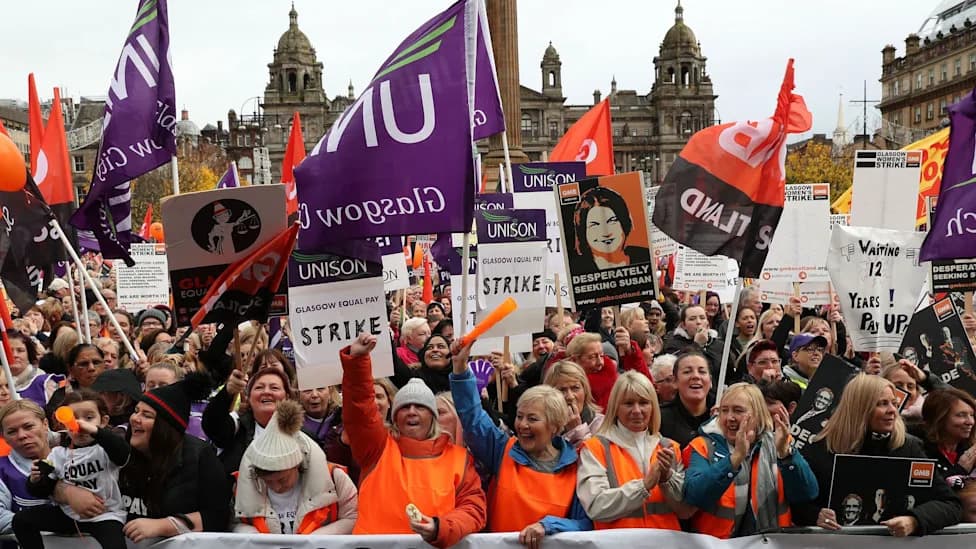
Glasgow City Council faced a long-running women's campaign for equal pay [PA Media]
Glasgow City Council has told more than 23,000 non‑teaching employees it will issue redundancy notices and then re‑engage them on new contracts after pay negotiations with the unions broke down. Letters are due to be issued next week and the council says the revised contracts would take effect from 1 January.
What the dispute is about
The dispute centres on a proposed overhaul of the council's pay and grading system, intended to resolve a long‑running equal pay issue that previously cost the authority about £770m in settlements. The council says the new scheme aligns pay with equality law and that 63% of affected staff would be better off while around 11% would see pay reductions. Council officials also claim the package would mean pay rises or no change for around 90% of employees overall, and that pay protection for those in detriment has been extended from six to 12 months.
Why redundancy notices are being issued
Talks between the council and the unions GMB, Unison and Unite collapsed after Unison said it would not ballot members on the council's proposed pay offer. The council says it will withdraw redundancy notices if all three unions agree to ballot their members on the proposal. The dismissal letters will affect all non‑teaching staff on the council payroll, including nursery workers and refuse collectors, and will also be issued to senior officials.

Glasgow City Council says it will fire around 23,000 workers and then rehire them [Getty Images]
Figures and funding
Union negotiators GMB and Unite say they helped secure an additional £110m for the funding package. Unison has said that money is intended for assimilation and arrears rather than to prevent cuts for those facing reduced pay. The council estimates the largest individual pay drop under the new scheme could be about £11,500.
Responses from council and unions
Colin Edgar, Director of Communications and Corporate Governance (Council): "The new pay and grading scheme removes unequal pay and sees pay rise or stay the same for 90% of staff. For those in detriment our joint trade unions negotiated an increase in pay protection from six months to 12 months."
Mandy McDowall, Unison Scotland regional organiser: "Glasgow City Council staff are not going to be bounced into a shoddy deal by bosses trying to bully them with arbitrary deadlines. The council's decision to dismiss workers helps nobody."
Graham McNabb, Unite industrial officer: "The council must remove direct threats to our membership and abandon any fire and rehire tactics. If they go down this reckless path it will be met with the full force of Unite."
What this means for staff
The council says continuity of service will not be affected because new contracts would begin the day after existing ones end. However, employees who refuse to sign the new contracts would effectively lose their jobs and some may consider legal options such as claims of constructive dismissal. Unions have warned they will immediately enter into dispute action, and industrial action cannot be ruled out if a settlement is not reached.
Context and next steps
Glasgow's proposed job evaluation scheme was designed to end historic unequal pay between predominantly female roles (such as catering and cleaning) and male‑dominated roles (such as refuse collection). The council and unions remain in disagreement over the precise distribution of the funding and the treatment of those who would face reduced pay. The immediate next steps are the issuing of letters, the unions' decision on balloting, and further local consultations aimed at mitigating impacts for staff in detriment.
Reporting note: All figures and quotes are drawn from council statements and union responses as made public during the dispute.
Help us improve.