Researchers at the University of Georgia found that blue light does not "fry" the retina but does scatter more inside the eye, reducing spatial resolution. In tests with 60 young adults, participants needed larger separations to see two blue pinpoints compared with longer wavelengths or broadband light. Lighter irises showed more scatter; melanin in darker eyes provided a modest advantage. The study suggests optical, not tissue-damaging, reasons underlie some complaints about screen-related vision problems.
Blue Light Won’t “Fry” Your Eyes — But It Makes Fine Detail Harder to See
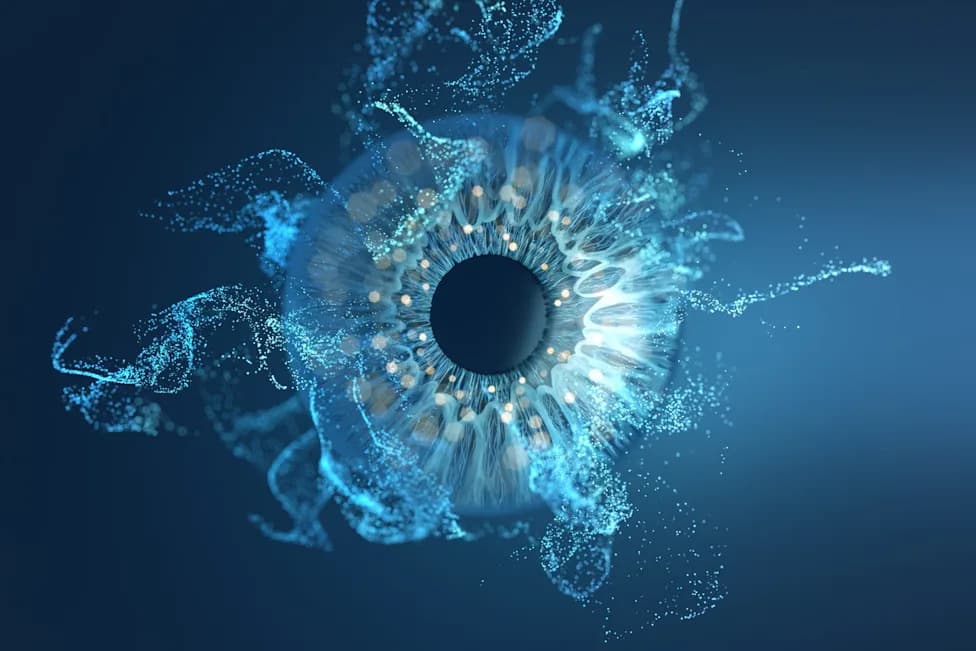
The Blue Light Myth Is Wrong—Here's the Real DealYuichiro Chino - Getty Images
Online warnings that blue light from screens will permanently "fry" your retinas or burn your skin are overstated. New research from the University of Georgia shows a subtler — but real — optical effect: short-wavelength blue light scatters more inside the eye, reducing the eye’s ability to resolve closely spaced light sources.
What Researchers Tested
Yaw Buabeng (optometrist and psychology doctoral candidate) and Billy Hammond (cognitive neuroscientist) recruited 60 young adults for a controlled laboratory experiment. Participants sat in a darkened room with their heads stabilized and viewed a shield about five feet away that held two pinpoint lights. With one eye patched, each trial began with the pinholes aligned so they appeared as one; the experimenter slowly separated them until the subject reported seeing two distinct points. The gap was measured with a digital micrometer. Trials were repeated across narrowband wavelengths (including blue) and broadband light.
Key Findings
The study found that blue (short-wavelength) light was consistently the hardest to separate: subjects needed a larger gap between pinpoints to perceive two distinct sources when viewing blue light versus longer wavelengths or broadband light. Broadband sources were easier to resolve overall. The researchers also observed a clear effect of iris pigmentation: lighter irises exhibited more intraocular scatter, while darker irises — which contain more melanin in the iris and retinal pigment epithelium — absorbed some scattered light and showed a modest advantage in resolving close blue points. Even so, dark-eyed participants still required a larger separation for blue than for other colors.
“Although the influence of wavelength on spectral sensitivity has been extensively characterized, far less is known about how wavelength impacts spatial discrimination thresholds,” Buabeng and Hammond write in Attention, Perception, and Psychophysics.
Why This Matters
This result clarifies an important distinction: the common discomfort from prolonged screen use (digital eye strain) is largely due to reduced blinking and dry eyes, not retinal "burning" from blue light. However, the optics of short wavelengths do produce more blur and reduce fine spatial resolution, an effect that varies with both wavelength and ocular pigmentation. Action spectra and earlier studies offer mixed results on wavelength-dependent scatter, but this experiment directly measured spatial discrimination thresholds across colors.
Practical Takeaways
- Blue light from screens is unlikely to cause permanent retinal damage.
- Blue light scatters more in the eye and can impair the ability to resolve very fine detail.
- People with lighter irises may experience slightly more scatter; melanin in darker eyes provides some protection but does not eliminate the effect.
- Simple measures — regular breaks, conscious blinking, proper screen brightness/color temperature, and ergonomic setup — remain the most effective ways to reduce digital eye strain.
- The benefits of blue-light-blocking glasses for resolution or comfort remain debated and are likely modest for most people.
Overall, the University of Georgia study reframes blue light concerns away from tissue damage and toward wavelength-dependent optical effects that influence how we perceive fine detail.
Help us improve.