Researchers at UC Berkeley analyzed more than 500 natural images using models of the three human cone types and found that natural color distributions are uneven, clustering toward red, yellow‑green and blue. They propose that the brain uses a sparse-coding strategy that anchors perception on red vs green, blue vs yellow, and black vs white — a framework that reconciles Hering's 19th-century unique hues with modern understanding of cone responses. The study is theoretical; next steps include behavioral tests and cross‑species comparisons.
Why Our Visual World Boils Down to Red, Yellow, Green and Blue — A New Explanation from Natural Color Statistics
(90336895/The Image Bank/Getty Images)
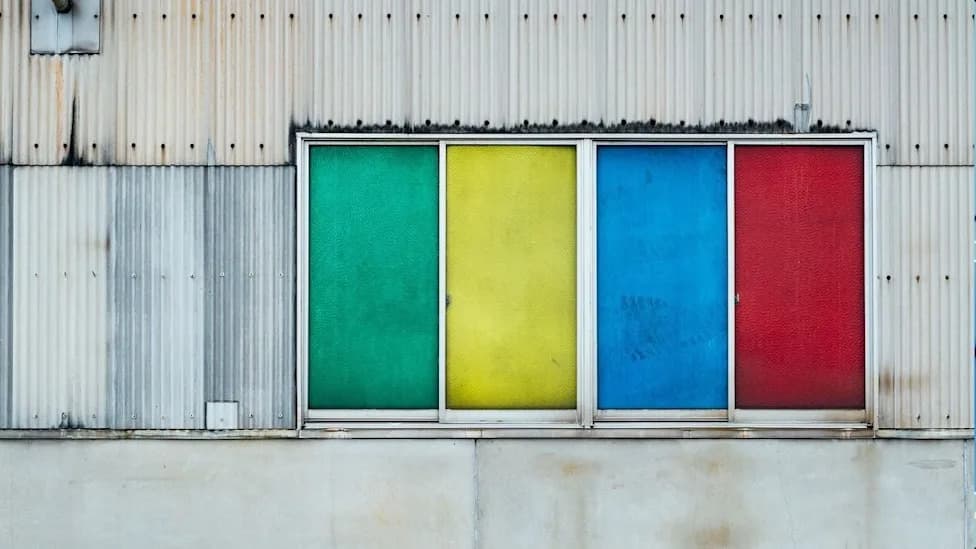
Since German physiologist Ewald Hering proposed the idea in the 19th century, color theorists have treated red, yellow, green and blue as special — the perceptual anchors on every modern color wheel. But scientists have struggled to connect these four "unique hues" to the physics of light, the three cone photoreceptors in the eye, or neural representations in the brain.
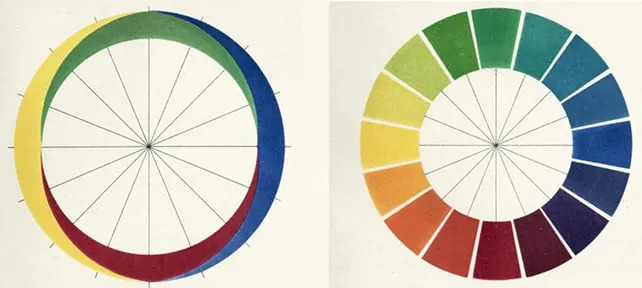
Color wheels have focused on red, yellow, blue, and green for over 100 years. (Zur Lehre vom Lichtsinne)
A new theoretical study from researchers at the University of California, Berkeley offers a possible explanation by looking outward: at the statistics of colors in nature. Published in the Journal of the Optical Society of America A, the paper suggests that the uneven distribution of colors in natural scenes helps explain why the brain encodes perception around those particular hues.
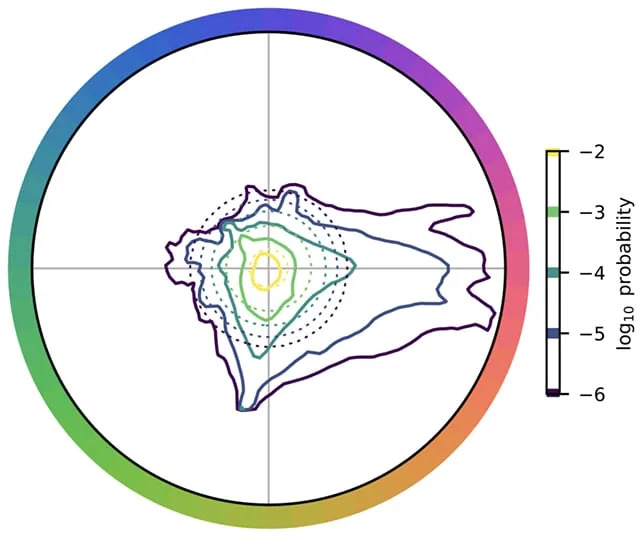
The distribution of hues in natural images tends toward red, yellow-green, and blue. (Alexander Belsten/Bruno Olshausen/UC Berkeley)
What the Researchers Did
Alexander Belsten and Bruno Olshausen and their colleagues analyzed more than 500 images of natural environments and used computational models to simulate how the human eye's three cone types (long-, medium- and short-wavelength sensitive cells) would respond. In other words, they mapped which colors appear most often in nature and what early visual signals those colors would generate.
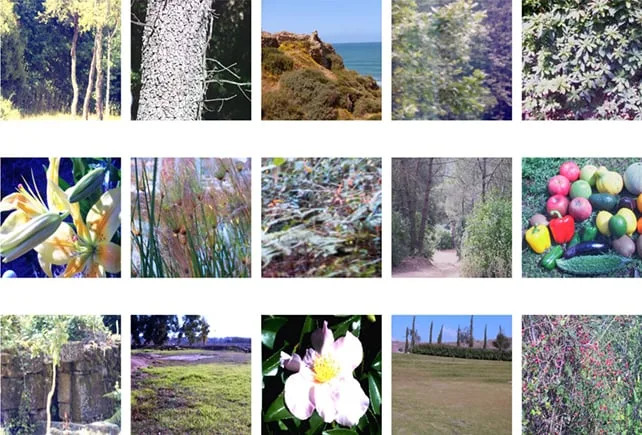
Some of the natural color images used in the study. (Alexander Belsten/Bruno Olshausen/UC Berkeley)
Key Finding: An Asymmetric Natural Palette
The team found that the distribution of hues in natural scenes is far from uniform. Instead, images tend to cluster toward red, yellow-green, and blue. As Olshausen explains, large data sets with millions of pixels are required to reveal these dominant—but sometimes rare—color components.

Subscribe to ScienceAlert's free fact-checked newsletter
"The color distribution in the environment is very asymmetric and non-uniform," says Bruno Olshausen. "Nobody's ever looked at this before because the availability of these very large data sets is relatively new."
How the Brain Might Use That Information
To account for these statistics, the authors propose that the visual system uses a sparse-coding strategy: it represents a wide variety of natural colors using a small set of efficient building blocks. In this framework, perception is anchored on opponent axes — red vs. green, blue vs. yellow — plus black vs. white for brightness, which closely mirrors Hering's phenomenology of color opponency.
"Sparse coding inference introduces mutual exclusivity… and yields a color representation that mirrors the phenomenology of color perception," says Alexander Belsten.
The study does not assign each unique hue to a single cone type. Rather, it shows how combinations of cone responses naturally cluster around those principal hues, providing a theoretical bridge between Hering's unique hues and the three cone photoreceptors.
Limitations And Next Steps
This work is theoretical and based on image statistics and computational modeling. The authors propose further validation through behavioral experiments with human participants, tests that incorporate real-world spatial layouts and shapes, and comparative studies across species to see how different visual systems partition color space.
The paper appears in the Journal of the Optical Society of America A.
Help us improve.