The Trump administration has proposed two mandatory Medicare pilots, GLOBE and GUARD, that tie U.S. drug prices to lower international benchmarks. Internal CMS documents and a Lancet analysis show that manufacturers participating in the voluntary Medicaid model GENEROUS are exempt from the Medicare pilots, cutting projected savings by more than 71%. Implementation hurdles—opaque foreign net prices, foreign laws limiting transparency, and limited drug participation (notably GLP-1 exclusions)—further reduce likely Medicare savings.
Why Trump’s Medicare Drug-Price Pilots May Fall Far Short Of Promised Savings
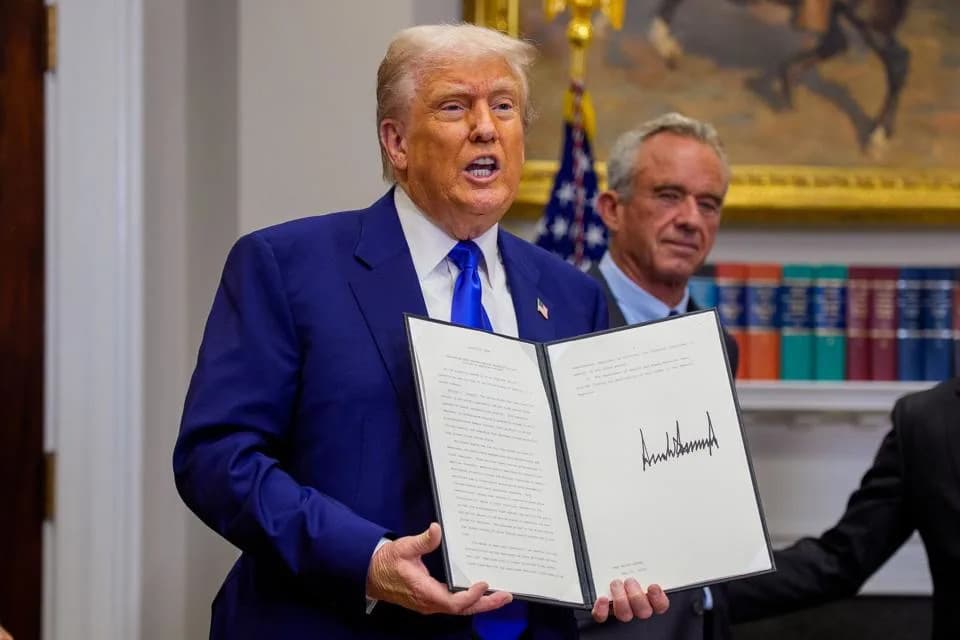
WASHINGTON, DC - MAY 12, 2025: President Donald Trump, accompanied by Health and Human Services Secretary Robert F. Kennedy Jr., holds up an executive order aimed at reducing the cost of prescription drugs and pharmaceuticals by 30% to 80% during an event in the Roosevelt Room of the White House. Trump announced his plan to lower drug prices would tie their cost to drug prices paid in foreign nations. (Photo by Andrew Harnik/Getty Images)Getty Images
The Biden-era rhetoric has given way to new Trump administration policy moves that aim to lower prescription drug costs in Medicare by linking U.S. prices to lower international benchmarks. But internal Centers for Medicare & Medicaid Services (CMS) correspondence obtained via a Freedom of Information Act request and a recent analysis in The Lancet indicate the programs’ headline savings could shrink dramatically once manufacturer carve-outs and practical implementation hurdles are accounted for.
How The Programs Fit Together
CMS is pursuing three related initiatives:
- GENEROUS (voluntary, Medicaid): A Generating cost Reductions fOr U.S. Medicaid Model that would let participating state Medicaid programs access most-favored-nation (MFN) level prices for certain drugs from 2026–2030.
- GLOBE (mandatory, Medicare Part B): Global Benchmark for Efficient Drug Pricing, a mandatory five-year pilot beginning Oct. 1, 2026, targeting roughly 80 physician-administered medicines and using international price benchmarks to calculate manufacturer rebates.
- GUARD (mandatory, Medicare Part D): Guarding U.S. Medicare Against Rising Drug Costs, a mandatory five-year pilot proposed to start in January 2027 and expected to affect many high-cost Part D medicines.
Major Finding: Exemptions Erode Projected Savings
Internal CMS documents show that manufacturers who opt into the voluntary GENEROUS Medicaid program are exempt from mandatory Medicare pilots GLOBE and GUARD. A Lancet analysis modeling the effect of these carve-outs finds that if 17 large manufacturers that initially signed onto GENEROUS are exempted from the Medicare pilots, more than 71% of the programs' projected Medicare savings disappear. That impact likely increases as additional manufacturers join GENEROUS.
Numbers Behind The Headlines
When modeled without exemptions, GLOBE and GUARD were estimated to reduce annual Medicare spending by about $5.2 billion for Part B (physician-administered drugs) and about $6.4 billion for Part D (outpatient drugs). But those figures assume broad manufacturer participation and reliable measures of foreign net prices—assumptions that are now in doubt.
Practical And Political Roadblocks
Several implementation challenges further weaken the projected gains:
- Opaque Foreign Net Prices: Most comparator countries do not disclose net prices. CMS intends to use MFN indices based on international net prices, but accurate, verifiable data are scarce.
- Foreign Pushback On Transparency: France and Spain have taken steps to keep negotiated net discounts confidential, citing risks from MFN-style policies. These actions limit the data pool CMS can use to construct MFN benchmarks.
- Selective Manufacturer Offers: Companies appear to be offering only a limited slate of drugs under GENEROUS MFN terms. High-revenue product classes, notably GLP-1 drugs, are conspicuously excluded in many offers, materially lowering expected savings.
Scope And Beneficiary Impact
GLOBE and GUARD are geographic pilot programs that will each affect roughly 25% of Medicare beneficiaries in selected regions. CMS has not finalized the selection areas. Unlike Medicaid—where beneficiary cost-sharing is minimal and co-pay savings are unlikely—Medicare enrollees in pilot areas could see reduced patient cost-sharing for eligible Part B medicines (potentially 10% instead of the standard 20%).
What This Means
Administration announcements have touted large savings from GLOBE and GUARD. But once manufacturers who join GENEROUS are excused from the Medicare pilots, and once the practical limits on creating reliable MFN benchmarks and on which drugs are included are considered, most of those projected savings appear to vanish. Policymakers and observers should treat early headline estimates with caution and watch for finalized participation agreements, transparent benchmark methodology, and which medicines manufacturers actually include in their offers.
Note: This article summarizes reporting based on CMS documents released through a FOIA request and a Lancet analysis. Final program details, participation agreements, and CMS methodology for constructing MFN indices will determine the ultimate fiscal impact.
Help us improve.