The US's proposed most-favoured-nation (MFN) drug-pricing model — which links US prices to the lowest rates in other high-income countries — could prompt pharmaceutical firms to delay launches in low-priced European markets, a Lancet modelling study warns. Researchers examined 195 patented medicines accounting for $87.9bn in US spending and found that for about three-quarters, potential US revenue losses would exceed annual sales in reference countries. Early data show fewer EU launches and the EU is now reviewing whether US policy is driving delays or price pressure. Exemptions negotiated by some manufacturers could also sharply reduce expected US savings.
US Push To Tie Drug Prices To Lowest Abroad Could Delay New Medicines In Europe, Study Warns

US push to cut drug prices could mean longer waits for European patients
A US proposal to link American drug prices to the lowest levels paid in other high-income countries — a so-called most-favoured-nation (MFN) approach — could lead manufacturers to postpone launches in low-priced markets, potentially slowing European patients' access to new medicines, a Lancet modelling study warns.
Key Findings From The Lancet Modelling
Researchers analysed 195 patented medicines that together represent about $87.9 billion in annual US spending. They found that for roughly three in four of those products, the revenue manufacturers would forfeit by cutting US prices to match lower reference-country levels would exceed the companies' total annual sales in those reference countries.
How Delays Might Occur
To avoid steep losses in the United States — the world's largest pharmaceutical market — companies could delay launching medicines in the lowest-priced reference countries. By postponing or withholding launches in those markets, manufacturers can limit the downward pressure those low prices would exert on US prices.
"Policies in the US may impact access to medicines globally," said study author Kerstin Vokinger of ETH Zurich and the University of Zurich.
Real-World Signals And Reactions
There are early signs that launch behaviour in Europe has shifted. Reuters reported that drug launches in EU markets fell by about 35% in the ten months after the US executive order compared with the preceding ten months. In February, a drug for severe high cholesterol was withdrawn from the market — a move that observers suggested may be linked to pricing pressures related to the US policy.
Industry representatives and patient groups warn of practical consequences. The European Patients' Forum said delays in launches would directly harm people with serious or progressive conditions, for whom each additional month without access can affect health and quality of life. Alexander Natz of biotech lobby Eucope urged governments to consider whether public budgets must increase to ensure timely access.
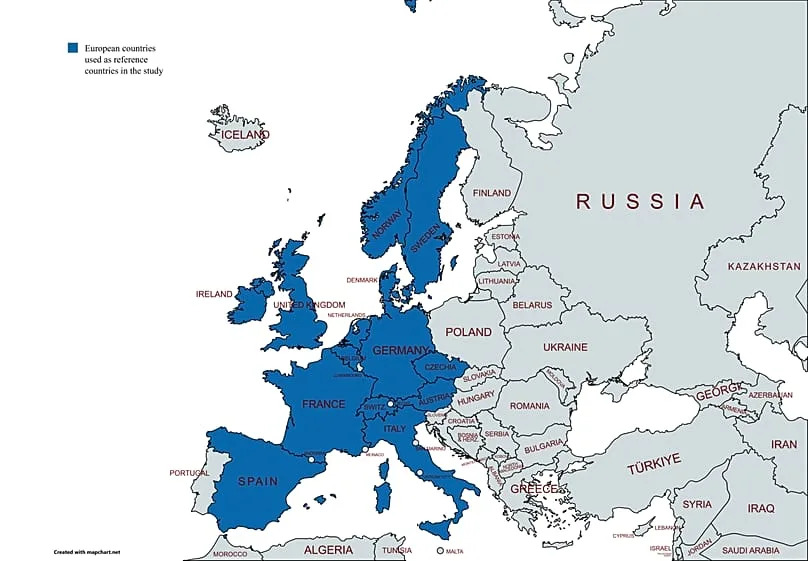
Reference countries in Europe that were included in the modelling study. - MapChart
Budgetary And Policy Trade-Offs
The Lancet analysis estimated that MFN-style pricing could reduce US spending on hospital medicines by about $5.2 billion and pharmacy medicines by about $6.4 billion; broader application of the approach could increase savings to roughly $21 billion and $25.5 billion respectively. However, the study notes that confidential exemptions negotiated by 17 companies could cut those projected savings by about 71%.
Authors also warn of a likely response that could blunt the policy's effect: using list prices (the manufacturer's sticker price before confidential discounts) rather than net prices when calculating MFN benchmarks. That shift would distort price signals and complicate efforts to achieve transparent savings.
European Countermeasures And Ongoing Review
The European Union has updated pharmaceutical rules requiring companies to launch a new medicine if a member state requests it within three years — or face a two-year reduction in market exclusivity. Researchers describe this as a counterweight to US measures but say it is unlikely, on its own, to fully offset launch delays prompted by MFN incentives.
The European Commission is assessing whether MFN is contributing to delayed launches, higher prices, or reduced access to innovative medicines. A Commission study seen by Euronews Health stated it is currently hard to determine if observed delays are directly caused by US policy or by uncertainty around it; clearer evidence may emerge over the next few years.
What This Means For Patients
Stakeholders caution that imperfect implementation could create a lose-lose outcome: delayed access for patients in Europe without the promised savings for US taxpayers and Medicare if manufacturers can secure exemptions. As Thomas Hwang, lead author of the study, put it, countries from Germany to Japan and Australia face pressure to accept higher prices — but many lack the budget room to do so.
Bottom line: Tying US prices to the lowest prices abroad may reduce US drug spending in theory, but it also risks reshaping global launch strategies in ways that delay European patient access and complicate efforts to secure genuine savings.
Help us improve.